Livopleen Drops
Ayurvedic liver drops for children and adults
Liver care in drops — gentle enough to measure for little ones.
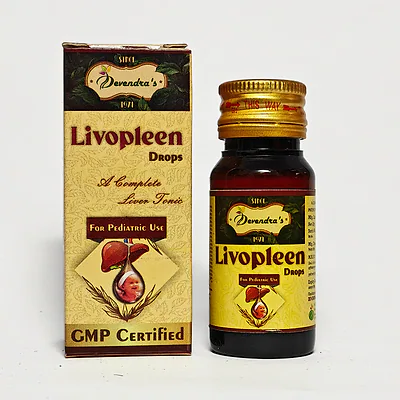
30 mL: ₹50
Livopleen Drops are the concentrated, drop-dosed member of the Livopleen family: an ark of nineteen herbs led by Kakmachi, Kutki, aloe, Pleehari (Sarpunkha) and Anantmool, with Trikatu, a little Kasees bhasma (iron) and Narsar.
The pack lists them for an enlarged and sluggish liver, indigestion, flatulence, constipation, hepatitis and jaundice.
Used for
- Sluggish or enlarged liver
- Indigestion & flatulence
- Constipation
- Jaundice (Kamala)
Why the liver gets sluggish
The liver makes the bile that digests fat and clears much of what the body doesn't need. When it is inflamed — after an infection such as hepatitis, or from fatty change — bile slows, appetite drops, wind and constipation set in, and the whites of the eyes may turn yellow.
Ayurveda sees this as disturbed Pitta in the liver (Yakrit) with blocked channels: bile stagnates (Kamala) and digestion (Agni) weakens. Bitter, cooling herbs clear the Pitta, and digestive spices restart Agni.
Livopleen Drops work in 3 ways
- Hepatoprotective & Choleretic (Yakrituttejaka) — Kutki's picrosides and Kalmegh's andrographolide protect liver cells and increase bile flow in animal studies, and aloe gel is hepatoprotective in experimental studies.
- Digestive & Gentle Laxative (Deepana, Anulomana) — Trikatu kindles digestion, Vidanga eases wind and worms, and Nisoth keeps the bowels moving.
- Blood Support (Raktavardhaka) — A little Kasees bhasma supplies iron for the anaemia that often comes with liver trouble.
Key ingredients
- Kakmachi (Makoy) (Solanum nigrum, whole plant) — 250 mg. Black nightshade, used in Ayurveda and Unani medicine for an enlarged liver and spleen and for swelling. Its steroidal glycoalkaloids, saponins and polyphenols are hepatoprotective, anti-inflammatory and antioxidant in experimental studies.
- Kutki (Katuki) (Picrorhiza kurroa, rhizome) — 250 mg. A Himalayan bitter for the liver and Kamala (jaundice). Its iridoid glycosides (picroside I and II, kutkoside) are hepatoprotective, choleretic and anti-inflammatory in experimental studies.
- Ghritkumari (Aloe vera) (Aloe barbadensis, leaf) — 250 mg. The inner gel of the aloe leaf, rich in polysaccharides (acemannan), phenolics and vitamins. Reviews describe wound-healing, anti-inflammatory, antioxidant and hepatoprotective effects, mostly from experimental studies.
- Sarpunkha (Tephrosia purpurea, whole plant) — 250 mg. Traditionally used for an enlarged liver and spleen and in Ayurvedic liver preparations. Its flavonoids (quercetin, rutin) and triterpenoids are antioxidant and anti-inflammatory, and its extract lessened arsenic-induced liver damage in rats.
- Anantmool (Indian sarsaparilla) (Hemidesmus indicus, root) — 250 mg. Ayurveda's classic Raktashodhaka for skin, urine and fever. Its root carries 2-hydroxy-4-methoxybenzaldehyde and saponins, with anti-inflammatory, antioxidant, antimicrobial and hepatoprotective activity in experimental studies.
- Kalmegh (Andrographis paniculata, leaf) — 125 mg. The 'king of bitters'. Its diterpene andrographolide protects liver cells by curbing oxidative stress and inflammation (NF-κB and Nrf2 pathways) and increased bile flow in animal studies — more potently than silymarin. Ayurveda uses it for Kamala and poor appetite.
- Nisoth (Trivrit) (Operculina turpethum, root) — 125 mg. Turpeth root, Ayurveda's preferred purgative for clearing Pitta and accumulated stool. Its resin glycosides (turpethins) are the purgative principle; in laboratory studies the extract also relaxed intestinal and airway smooth muscle.
- Kasees bhasma (calcined ferrous sulphate) — 62.5 mg. Green vitriol (ferrous sulphate) processed into an Ayurvedic iron preparation. In a small randomised study in iron-deficiency anaemia, Kasisa bhasma 125 mg three times a day for 30 days raised haemoglobin.
Full ingredient list
Distillate (ark) of
- Kakmachi (Solanum nigrum, whole plant) — 250 mg
- Kutki (Picrorhiza kurroa, rhizome) — 250 mg
- Ghrit Kumari (Aloe barbadensis, leaf) — 250 mg
- Pleehari (Tephrosia purpurea, whole plant) — 250 mg
- Anantmool (Hemidesmus indicus, root) — 250 mg
- Baybidang (Embelia ribes, fruit) — 125 mg
- Nisot (Operculina turpethum, root) — 125 mg
- Punarnava (Boerhavia diffusa, whole plant (red variety)) — 125 mg
- Kalmegh (Andrographis paniculata, leaf) — 125 mg
- Kasni (Cichorium endivia, whole plant) — 125 mg
- Guruchi (Tinospora cordifolia, stem) — 125 mg
- Pittpapra (Fumaria parviflora, whole plant) — 125 mg
- Rohit Chhaal (Tecomella undulata, bark) — 125 mg
- Kali Mirch (Piper nigrum, fruit) — 62.5 mg
- Sonth (Zingiber officinale, rhizome) — 62.5 mg
- Pippal (Piper longum, stem) — 62.5 mg
- Kantkari (Solanum virginianum (S. xanthocarpum), whole plant) — 62.5 mg
- Narsar (ammonium chloride, purified) — 62.5 mg
- Kasees Bhasma (ferrous sulphate, purified) — 62.5 mg
- Chini (sugar) — 7.5 g
- Colour (approved red) — q.s.
- Preservative (sodium benzoate) — q.s.
How to use
Dose: Children 5–20 drops, adults ½–1 teaspoon, twice a day in a little water or fruit juice, or as directed by the physician. Shake well before use.
- Shake well — Shake the bottle before each dose.
- Measure the dose — Use the measuring cap — the dose above, or the one your physician gives.
- Keep a routine — Take it at the same times each day, for as long as advised.
Safety & suitability
- Who it's for: Adults and children — children at the drop dose a doctor confirms
- Pregnancy & nursing: Not advised — see the cautions
- Other medicines: Tell your physician what else you take
- Diabetic?: Contains sugar (7.5 g per 10 mL) — ask your physician
- Storage: Cool, dry place, away from direct sunlight
- Ingredients: See the full list below
Cautions
- Contains Nisot, a purgative herb: not during pregnancy, and stop if it causes loose stools.
- Jaundice, dark urine, pale stools or a swollen belly — especially in a child — need a doctor's care; use the drops alongside it, not instead.
- Contains processed metal or mineral preparations: Kasees bhasma. Take only at the stated dose and for the advised duration, under an Ayurvedic physician.
- Contains iron: Kasees bhasma. Keep it out of children's reach — an iron overdose is dangerous for children.
- Contains sugar (7.5 g per 10 mL) — people with diabetes should ask their physician first.
- Do not use if any precipitate, fungus or foreign particle is found — replace the bottle.
More information
- Net content: 30 mL
- Storage: Keep in a cool, dry place away from direct sunlight. Close the cap tightly after use.
- Country of origin: India
- Manufacturer: Devendra Ayurved Ashram Pvt. Ltd., A-12, Industrial Estate, Sujroo, Muzaffarnagar (U.P.) – 251003. Mfg. Lic. No. A-50/77/94 · GMP-certified company.
References
- Wang J, Pan J, Luan F, et al. Progress in Solanum nigrum L. research: Traditional uses, phytochemistry, pharmacological activities, quality control, and clinical applications. J Ethnopharmacol. 2025;352:120271.
- Almeleebia TM, Alsayari A, Wahab S. Pharmacological and Clinical Efficacy of Picrorhiza kurroa and Its Secondary Metabolites: A Comprehensive Review. Molecules. 2022;27(23).
- Kaur S, Bains K. Aloe Barbadensis Miller (Aloe Vera). Int J Vitam Nutr Res. 2024;94(3-4):308-321.
- Rao AS, Yadav SS, Singh P, et al. A comprehensive review on ethnomedicine, phytochemistry, pharmacology, and toxicity of Tephrosia purpurea (L.) Pers. Phytother Res. 2020;34(8):1902-1925.
- Gora RH, Baxla SL, Kerketta P, et al. Hepatoprotective activity of Tephrosia purpurea against arsenic induced toxicity in rats. Indian J Pharmacol. 2014;46(2):197-200.
- Nandy S, Mukherjee A, Pandey DK, et al. Indian Sarsaparilla (Hemidesmus indicus): Recent progress in research on ethnobotany, phytochemistry and pharmacology. J Ethnopharmacol. 2020;254:112609.
- Qin X, Wang X, Tian M, et al. The role of Andrographolide in the prevention and treatment of liver diseases. Phytomedicine. 2023;109:154537.
- Shukla B, Visen PK, Patnaik GK, et al. Choleretic effect of andrographolide in rats and guinea pigs. Planta Med. 1992;58(2):146-9.
- Gupta S, Ved A. Operculina turpethum (Linn.) Silva Manso as a Medicinal Plant Species: A Review on Bioactive Components and Pharmacological Properties. Pharmacogn Rev. 2017;11(22):158-166.
- Shareef H, Rizwani GH, Mandukhail SR, et al. Studies on antidiarrhoeal, antispasmodic and bronchodilator activities of Operculina turpethum Linn. BMC Complement Altern Med. 2014;14:479.
- Tubaki BR, Benni JM, Rao N, et al. Effect of Ayurveda Medications (Kasīsa Bhasma and Dhātrī Avaleha) on Iron Deficiency Anaemia: A Randomized Controlled Study. Anc Sci Life. 2016;36(1):48-55.