Livocure Tablet
Ayurvedic herbal tablets for liver troubles
Five of Ayurveda's liver herbs, and nothing else, in one tablet.
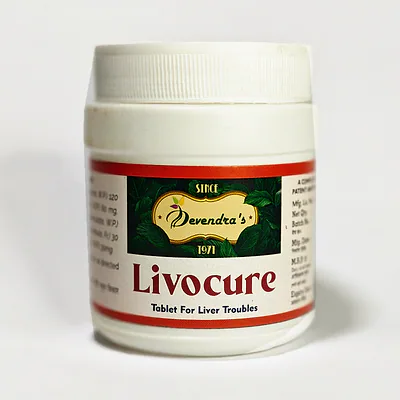
1000 Tab: ₹500
Livocure Tablet is an all-herbal liver formula built around Sarpunkha, the herb Ayurveda calls Pleehari, with Bhringraj and Kalmegh, two classic liver bitters, plus Haritaki and Tulsi. It contains no minerals or bhasmas.
The pack describes it for liver disorders such as an enlarged liver (Yakrit-vriddhi), Pandu and Kamala.
Used for
- Sluggish liver (Yakrit-dourbalya)
- Enlarged liver (Yakrit-vriddhi) — traditional use
- Jaundice (Kamala) — traditional use
- Weak digestion & poor appetite
Why the liver struggles
The liver processes nearly everything we eat, drink and take. Fatty change, alcohol, infections and some medicines inflame liver cells and slow the flow of bile; appetite and digestion weaken, and the liver can swell.
In Ayurveda, the liver (Yakrit) is the seat of Ranjaka Pitta and the root of Raktavaha srotas. When aggravated Pitta and Ama clog it, bile flow and digestion falter and conditions such as Kamala and Pandu follow. Bitter herbs (Tikta rasa) that cool Pitta and clear the channels are the classical answer.
Livocure works in 3 ways
- Hepatoprotective (Yakrit-Rakshaka) — Sarpunkha, Bhringraj and Kalmegh each protected liver cells from chemical and oxidative injury in animal studies; Kalmegh's andrographolide is the best studied of them.
- Choleretic & Digestive (Pitta-Saraka & Deepana) — Kalmegh increased bile flow in animal studies, and bitter herbs whet a poor appetite. Haritaki keeps the bowels regular, Ayurveda's first step in clearing Ama.
- Antioxidant & Rejuvenative (Rasayana) — Haritaki's tannins and Tulsi are antioxidant and anti-inflammatory; in a review of human studies Tulsi had favourable effects on metabolism and stress.
Key ingredients
- Sarpunkha (Tephrosia purpurea, whole plant) — 120 mg. Traditionally used for an enlarged liver and spleen and in Ayurvedic liver preparations. Its flavonoids (quercetin, rutin) and triterpenoids are antioxidant and anti-inflammatory, and its extract lessened arsenic-induced liver damage in rats.
- Bhringraj (Eclipta alba, whole plant) — 60 mg. Best known for hair, Bhringraj is also a classic liver herb (Yakrituttejaka). Its coumestans, such as wedelolactone, are hepatoprotective in experimental models, and in an early study its alcoholic extract protected against chemical (CCl₄) liver damage.
- Kalmegh (Andrographis paniculata, whole plant) — 30 mg. The 'king of bitters'. Its diterpene andrographolide protects liver cells by curbing oxidative stress and inflammation (NF-κB and Nrf2 pathways) and increased bile flow in animal studies — more potently than silymarin. Ayurveda uses it for Kamala and poor appetite.
- Haritaki (Harad) (Terminalia chebula, fruit) — 30 mg. The first of the Triphala fruits and Ayurveda's classic Anulomana: it keeps the bowels regular. Its tannins (chebulagic and chebulinic acids) are antioxidant, anti-inflammatory and hepatoprotective in laboratory studies.
- Tulsi (Holy basil) (Ocimum sanctum, whole plant) — 30 mg. Holy basil is used for cough, cold and fever (Kasa, Pratishyaya, Jwara). A systematic review of 24 human studies found favourable effects on immunity, metabolic markers and stress, with no significant adverse events reported.
Full ingredient list
- Sarpunkha (Tephrosia purpurea, whole plant) — 120 mg
- Bhrangraj (Eclipta alba, whole plant) — 60 mg
- Kalmegh (Andrographis paniculata, whole plant) — 30 mg
- Haritiki (Terminalia chebula, fruit) — 30 mg
- Tulsi (Ocimum sanctum, whole plant) — 30 mg
How to use
Dose: 1–2 tablets twice a day, or as directed by the physician.
- Take your dose — The dose above, or the one your physician gives.
- With water — Swallow with water (or milk, where the pack says so).
- Stay consistent — Take it at the same times each day, for the course advised.
Safety & suitability
- Who it's for: Adults; children only at the dose a physician sets
- Pregnancy & nursing: Ask your physician before use
- Other medicines: Tell your physician what else you take
- Diabetic?: Coated tablet — ask your physician
- Storage: Cool, dry place, away from direct sunlight
- Ingredients: See the full list below
Cautions
- Yellow eyes or skin, dark urine, pale stools, a swollen belly or vomiting blood need a doctor's care — use Livocure alongside it, not instead.
More information
- Net content: 1000 Tab
- Storage: Store below 30 °C in a cool, dry place, in the original pack.
- Country of origin: India
- Manufacturer: Devendra Ayurved Ashram Pvt. Ltd., A-12, Industrial Estate, Sujroo, Muzaffarnagar (U.P.) – 251003. Mfg. Lic. No. A-50/77/94 · GMP-certified company.
References
- Rao AS, Yadav SS, Singh P, et al. A comprehensive review on ethnomedicine, phytochemistry, pharmacology, and toxicity of Tephrosia purpurea (L.) Pers. Phytother Res. 2020;34(8):1902-1925.
- Gora RH, Baxla SL, Kerketta P, et al. Hepatoprotective activity of Tephrosia purpurea against arsenic induced toxicity in rats. Indian J Pharmacol. 2014;46(2):197-200.
- Timalsina D, Devkota HP. Eclipta prostrata (L.) L. (Asteraceae): Ethnomedicinal Uses, Chemical Constituents, and Biological Activities. Biomolecules. 2021;11(11).
- Murthy VN, Reddy BP, Venkateshwarlu V, et al. Antihepatotoxic activity of eclipta alba, tephrosia purpurea and boerhaavia diffusa. Anc Sci Life. 1992;11(3-4):182-6.
- Qin X, Wang X, Tian M, et al. The role of Andrographolide in the prevention and treatment of liver diseases. Phytomedicine. 2023;109:154537.
- Shukla B, Visen PK, Patnaik GK, et al. Choleretic effect of andrographolide in rats and guinea pigs. Planta Med. 1992;58(2):146-9.
- Wang C, Zhang H, Wang X, et al. Comprehensive Review on Fruit of Terminalia chebula: Traditional Uses, Phytochemistry, Pharmacology, Toxicity, and Pharmacokinetics. Molecules. 2024;29(23).
- Jamshidi N, Cohen MM. The Clinical Efficacy and Safety of Tulsi in Humans: A Systematic Review of the Literature. Evid Based Complement Alternat Med. 2017;2017:9217567.
- Cohen MM. Tulsi - Ocimum sanctum: A herb for all reasons. J Ayurveda Integr Med. 2014;5(4):251-9.