Exliv Syrup
Ayurvedic liver tonic syrup with Sarpunkha and Kalmegh
Two of Ayurveda's great liver bitters, in one daily spoonful.
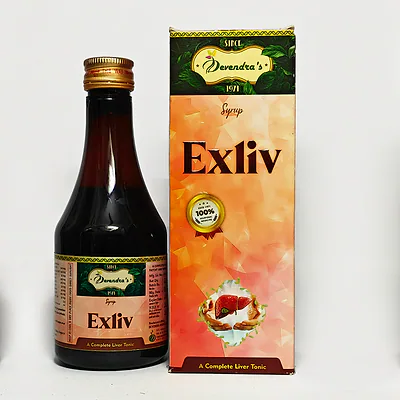
200 mL: ₹180
Exliv is an Ayurvedic liver tonic built on Sarpunkha and Kalmegh — the 'king of bitters' — with Punarnava, Harad, Makoy, Giloy, Tulsi and Rohitak.
The pack describes it as an excellent liver tonic for liver problems, including cirrhosis and hepatitis — conditions that always need a doctor's care, alongside which Exliv is meant to be used.
Used for
- Liver tonic (Yakrit-balya)
- Sluggish liver & poor appetite
- Jaundice (Kamala)
Why the liver needs support
The liver is remarkably resilient, but repeated injury — from viruses, alcohol, fatty change or some medicines — keeps its cells inflamed. Over years, inflammation can scar the liver, and its ability to make bile and clear toxins declines.
Ayurveda places the liver at the root of the blood channels (Raktavaha Srotas) and the seat of Ranjaka Pitta. Aggravated Pitta and Ama inflame it, bringing jaundice (Kamala) and loss of appetite; bitter, cooling herbs are the classical response.
Exliv supports the liver in 3 ways
- Hepatoprotective & Choleretic (Yakrit-rakshaka, Pittasaraka) — Kalmegh's andrographolide protects liver cells and increased bile flow in animal studies, and Sarpunkha lessened toxin-induced liver damage in rats.
- Anti-inflammatory & Antioxidant (Shothahara) — Makoy, Giloy, Rohitak and Tulsi add anti-inflammatory and antioxidant activity, and Harad gently keeps the bowels regular.
- Diuretic (Mutrala) — Punarnava is diuretic and anti-inflammatory in experimental studies.
Key ingredients
- Sarpunkha (Tephrosia purpurea, whole plant) — 300 mg. Traditionally used for an enlarged liver and spleen and in Ayurvedic liver preparations. Its flavonoids (quercetin, rutin) and triterpenoids are antioxidant and anti-inflammatory, and its extract lessened arsenic-induced liver damage in rats.
- Kalmegh (Andrographis paniculata, whole plant) — 150 mg. The 'king of bitters'. Its diterpene andrographolide protects liver cells by curbing oxidative stress and inflammation (NF-κB and Nrf2 pathways) and increased bile flow in animal studies — more potently than silymarin. Ayurveda uses it for Kamala and poor appetite.
- Punarnava (Boerhavia diffusa, whole plant) — 150 mg. Its name means 'renews the body'. Ayurveda uses it for swelling (Shotha), the kidneys and the liver; its rotenoids and flavonoids are diuretic, anti-inflammatory and hepatoprotective in experimental studies.
- Haritaki (Harad) (Terminalia chebula, fruit) — 100 mg. The first of the Triphala fruits and Ayurveda's classic Anulomana: it keeps the bowels regular. Its tannins (chebulagic and chebulinic acids) are antioxidant, anti-inflammatory and hepatoprotective in laboratory studies.
- Kakmachi (Makoy) (Solanum nigrum, whole plant) — 50 mg. Black nightshade, used in Ayurveda and Unani medicine for an enlarged liver and spleen and for swelling. Its steroidal glycoalkaloids, saponins and polyphenols are hepatoprotective, anti-inflammatory and antioxidant in experimental studies.
- Giloy (Guduchi) (Tinospora cordifolia, stem) — 50 mg. A Rasayana for chronic fever and immunity. Its polysaccharides, alkaloids and diterpenoids are immunomodulatory, antipyretic and anti-inflammatory in experimental studies. Rare liver injury has been reported, possibly from mis-identified Tinospora species.
- Rohitak (Desert teak) (Tecomella undulata, stem bark) — 50 mg. Desert-teak bark, Ayurveda's classical remedy for an enlarged spleen and liver (Pleeha-yakrit vriddhi). It is hepatoprotective, antimicrobial and anti-inflammatory in experimental studies, though these effects are only partly validated.
- Tulsi (Holy basil) (Ocimum sanctum, whole plant) — 50 mg. Holy basil is used for cough, cold and fever (Kasa, Pratishyaya, Jwara). A systematic review of 24 human studies found favourable effects on immunity, metabolic markers and stress, with no significant adverse events reported.
Full ingredient list
Liquid extract of
- Sarpunkha (Tephrosia purpurea, whole plant) — 300 mg
- Kalmegh (Andrographis paniculata, whole plant) — 150 mg
- Tulsi (Ocimum sanctum, whole plant) — 50 mg
- Bhangra (Cichorium intybus, root) — 100 mg
- Haritaki (Terminalia chebula, fruit) — 100 mg
- Makoy (Solanum nigrum, whole plant) — 50 mg
- Giloy (Tinospora cordifolia, stem) — 50 mg
- Punarnava (Boerhavia diffusa, whole plant) — 150 mg
- Rohit chaal (Tecomella undulata, stem bark) — 50 mg
- Chini (sugar) — 5 g
- M.P.S., P.P.S., Colour, Flavour (added as per Drug Act) — q.s.
How to use
Dose: 10 mL twice a day with water, or as directed by the physician. Shake well before use.
- Shake well — Shake the bottle before each dose.
- Measure the dose — Use the measuring cap — the dose above, or the one your physician gives.
- Keep a routine — Take it at the same times each day, for as long as advised.
Safety & suitability
- Who it's for: Adults; children only at the dose a physician sets
- Pregnancy & nursing: Ask your physician before use
- Other medicines: Tell your physician what else you take
- Diabetic?: Contains sugar (5 g per 10 mL) — ask your physician
- Storage: Cool, dry place, away from direct sunlight
- Ingredients: See the full list below
Cautions
- Cirrhosis and hepatitis need a doctor's diagnosis and care. Exliv is a supportive tonic, not a replacement for prescribed treatment.
- Contains sugar (5 g per 10 mL) — people with diabetes should ask their physician first.
- Do not use if any precipitate, fungus or foreign particle is found — replace the bottle.
More information
- Net content: 200 mL
- Storage: Keep in a cool, dry place away from direct sunlight. Close the cap tightly after use.
- Country of origin: India
- Manufacturer: Devendra Ayurved Ashram Pvt. Ltd., A-12, Industrial Estate, Sujroo, Muzaffarnagar (U.P.) – 251003. Mfg. Lic. No. A-50/77/94 · GMP-certified company.
References
- Rao AS, Yadav SS, Singh P, et al. A comprehensive review on ethnomedicine, phytochemistry, pharmacology, and toxicity of Tephrosia purpurea (L.) Pers. Phytother Res. 2020;34(8):1902-1925.
- Gora RH, Baxla SL, Kerketta P, et al. Hepatoprotective activity of Tephrosia purpurea against arsenic induced toxicity in rats. Indian J Pharmacol. 2014;46(2):197-200.
- Qin X, Wang X, Tian M, et al. The role of Andrographolide in the prevention and treatment of liver diseases. Phytomedicine. 2023;109:154537.
- Shukla B, Visen PK, Patnaik GK, et al. Choleretic effect of andrographolide in rats and guinea pigs. Planta Med. 1992;58(2):146-9.
- Mishra S, Aeri V, Gaur PK, et al. Phytochemical, therapeutic, and ethnopharmacological overview for a traditionally important herb: Boerhavia diffusa Linn. Biomed Res Int. 2014;2014:808302.
- Wang C, Zhang H, Wang X, et al. Comprehensive Review on Fruit of Terminalia chebula: Traditional Uses, Phytochemistry, Pharmacology, Toxicity, and Pharmacokinetics. Molecules. 2024;29(23).
- Wang J, Pan J, Luan F, et al. Progress in Solanum nigrum L. research: Traditional uses, phytochemistry, pharmacological activities, quality control, and clinical applications. J Ethnopharmacol. 2025;352:120271.
- Yates CR, Bruno EJ, Yates MED. Tinospora Cordifolia: A review of its immunomodulatory properties. J Diet Suppl. 2022;19(2):271-285.
- Kumar P, Kamle M, Mahato DK, et al. Tinospora cordifolia (Giloy): Phytochemistry, Ethnopharmacology, Clinical Application and Conservation Strategies. Curr Pharm Biotechnol. 2020;21(12):1165-1175.
- Philips CA, Theruvath AH. A comprehensive review on the hepatotoxicity of herbs used in the Indian (Ayush) systems of alternative medicine. Medicine (Baltimore). 2024;103(16):e37903.
- Panneer Selvam K, Payyappallimana U, Ravikumar K, et al. Can Guduchi (Tinospora cordifolia), a well-known ayurvedic hepato-protectant cause liver damage?. J Ayurveda Integr Med. 2023;14(1):100658.
- Vats S, Bhandari N, Ganie SA, et al. Ethnomedicinal, phytochemical, pharmacological, and conservation studies of an endangered plant: the desert teak (Tecomella undulata (Sm.) Seem.). Front Pharmacol. 2025;16:1665446.
- Jamshidi N, Cohen MM. The Clinical Efficacy and Safety of Tulsi in Humans: A Systematic Review of the Literature. Evid Based Complement Alternat Med. 2017;2017:9217567.
- Cohen MM. Tulsi - Ocimum sanctum: A herb for all reasons. J Ayurveda Integr Med. 2014;5(4):251-9.