Livocure Syrup
For Liver Troubles — an Ayurvedic liver tonic syrup
Heavy after every meal, no appetite, no energy? Sometimes it's the liver asking for a little support.
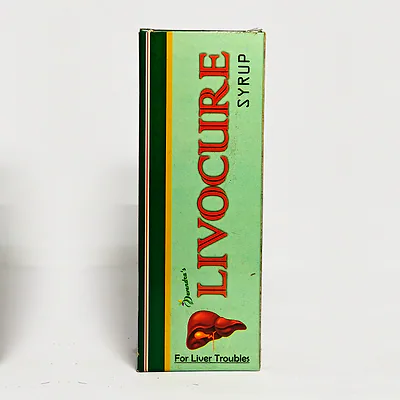
100 mL: ₹75 · 200 mL: ₹150
Livocure is an Ayurvedic syrup for a sluggish liver and the poor appetite, constipation and dull complexion that can come with it. Its five herbs are among Ayurveda's best-known for the liver: Sarpunkha, Bhringraj, Kalmegh, Haritaki and Tulsi.
Used for
- Loss of appetite (anorexia)
- Jaundice
- Pigmentation
- Constipation
- Sluggish liver
- Liver & spleen function
Why the liver slows down
Your liver handles almost everything you eat, drink and take — fats, alcohol, medicines and the by-products of digestion. Rich food, irregular meals, alcohol and infections all add to its load, and a strained liver shows up as poor appetite, heaviness after meals, constipation and, in time, a dull or discoloured complexion.
In Ayurveda, Yakrit (the liver) is the seat of Ranjaka Pitta and the root of Raktavaha Srotas, the channels of the blood. When Agni weakens and Ama accumulates, vitiated Pitta and Kapha obstruct the flow of bile (Pitta-srava), leading to Aruchi (loss of appetite), Vibandha (constipation) and Vaivarnya (discolouration) — and, in its advanced form, Kamala (jaundice). In modern terms: hepatocellular stress, oxidative injury and impaired bile secretion.
Livocure supports the liver in 4 ways
- Hepatoprotective & Antioxidant (Yakrit-Rakshaka) — Kalmegh's andrographolide and Bhringraj's coumestans protected liver cells from toxin-induced injury in laboratory studies, by curbing oxidative stress and inflammatory signalling.
- Choleretic & Appetite-restoring (Pitta-Saraka & Deepana) — Andrographolide increased bile flow, bile salts and bile acids in animal studies; bitter Kalmegh and Sarpunkha are Ayurveda's classic appetisers, and Tulsi kindles digestion.
- Gentle Laxative (Anulomana) — Haritaki — the laxative fruit at the heart of Triphala — keeps the bowels moving, easing the constipation that so often comes with a sluggish liver.
- Anti-inflammatory & Restorative (Shothahara & Rasayana) — Sarpunkha lessened arsenic-induced liver damage in rats, and Tulsi — studied in two dozen human trials — adds antioxidant and adaptogenic support.
Key ingredients
- Sarpunkha (Tephrosia purpurea) — 60 mg. Traditionally used for enlarged liver and spleen and in Ayurvedic liver preparations. Its flavonoids (quercetin, rutin) and triterpenoids are antioxidant and anti-inflammatory, and its extract lessened arsenic-induced liver damage in rats.
- Bhringraj (Eclipta prostrata (E. alba)) — 30 mg. Best known for hair, Bhringraj is also a classic liver herb (Yakrituttejaka). Its coumestans, such as wedelolactone, are hepatoprotective in experimental models, and in an early study its alcoholic extract protected against chemical (CCl₄) liver damage.
- Kalmegh (Andrographis paniculata) — 15 mg. The 'king of bitters'. Its diterpene andrographolide protects liver cells by curbing oxidative stress and inflammation (NF-κB and Nrf2 pathways) and increased bile flow in animal studies — more potently than silymarin. Ayurveda uses it for Kamala and poor appetite.
- Haritaki (Terminalia chebula) — 15 mg. The first of the Triphala fruits and Ayurveda's classic Anulomana: it keeps the bowels regular. Its tannins (chebulagic and chebulinic acids) are antioxidant, anti-inflammatory and hepatoprotective in laboratory studies.
- Tulsi (Holy basil) (Ocimum sanctum) — 15 mg. Holy basil kindles digestion (Deepana-Pachana) and settles Vata in the gut. A systematic review of 24 human studies found favourable effects on metabolic markers, immunity and stress, with no significant adverse events reported.
Full ingredient list
- Sarpunkha (Tephrosia purpurea) — 60 mg
- Bhringraj (Eclipta prostrata) — 30 mg
- Kalmegh (Andrographis paniculata) — 15 mg
- Haritaki (Terminalia chebula) — 15 mg
- Tulsi (Ocimum sanctum) — 15 mg
- Chini (sugar) — 4 g
How to use
Dose: 5–10 mL twice a day, or as directed by the physician.
- Measure 5–10 mL — Use the measuring cap; your physician can tell you where in that range to start.
- Take with water — Follow it with a little water, as the manufacturer's guide suggests.
- Twice a day — Morning and evening, for as long as your physician advises.
Safety & suitability
- Who it's for: Adults; children only as a physician advises
- Pregnancy & nursing: Ask your physician before use
- Other medicines: Tell your physician what you take
- Diabetic?: Contains 4 g sugar per 5 mL — ask your physician
- Storage: Cool, dry place, away from direct sunlight
- Ingredients: Five herbs in a sugar syrup — see the full list
Cautions
- Yellow eyes or skin, dark urine or pale stools need a doctor's assessment — do not rely on self-treatment.
- High in sugar (4 g in every 5 mL): people with diabetes should ask their physician first.
- Do not use if any precipitate, fungus or foreign particle is found — replace the bottle.
More information
- Net content: 100 mL · 200 mL
- Storage: Keep in a cool, dry place away from direct sunlight. Close the cap tightly after use.
- Country of origin: India
- Manufacturer: Devendra Ayurved Ashram Pvt. Ltd., A-12, Industrial Estate, Sujroo, Muzaffarnagar (U.P.) – 251003. Mfg. Lic. No. A-50/77/94 · GMP-certified company.
References
- Rao AS, Yadav SS, Singh P, et al. A comprehensive review on ethnomedicine, phytochemistry, pharmacology, and toxicity of Tephrosia purpurea (L.) Pers. Phytother Res. 2020;34(8):1902-1925.
- Gora RH, Baxla SL, Kerketta P, et al. Hepatoprotective activity of Tephrosia purpurea against arsenic induced toxicity in rats. Indian J Pharmacol. 2014;46(2):197-200.
- Murthy VN, Reddy BP, Venkateshwarlu V, et al. Antihepatotoxic activity of Eclipta alba, Tephrosia purpurea and Boerhaavia diffusa. Anc Sci Life. 1992;11(3-4):182-6.
- Timalsina D, Devkota HP. Eclipta prostrata (L.) L. (Asteraceae): ethnomedicinal uses, chemical constituents, and biological activities. Biomolecules. 2021;11(11):1738.
- Qin X, Wang X, Tian M, et al. The role of andrographolide in the prevention and treatment of liver diseases. Phytomedicine. 2023;109:154537.
- Shukla B, Visen PK, Patnaik GK, et al. Choleretic effect of andrographolide in rats and guinea pigs. Planta Med. 1992;58(2):146-9.
- Wang C, Zhang H, Wang X, et al. Comprehensive review on fruit of Terminalia chebula: traditional uses, phytochemistry, pharmacology, toxicity, and pharmacokinetics. Molecules. 2024;29(23):5547.
- Peterson CT, Denniston K, Chopra D. Therapeutic uses of Triphala in Ayurvedic medicine. J Altern Complement Med. 2017;23(8):607-614.
- Jamshidi N, Cohen MM. The clinical efficacy and safety of Tulsi in humans: a systematic review of the literature. Evid Based Complement Alternat Med. 2017;2017:9217567.
- Cohen MM. Tulsi – Ocimum sanctum: a herb for all reasons. J Ayurveda Integr Med. 2014;5(4):251-9.