Gastron Forte (R) Tablet
Ayurvedic tablets for acidity, gas, bloating and cramps
Acidity. Gas. Bloating. Indigestion. Heaviness. Cramps. Your stomach has a lot to say.
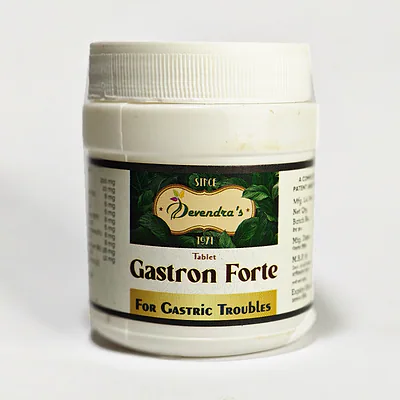
100 Tab: ₹66 · 1000 Tab: ₹600
Gastron Forte is an Ayurvedic formulation traditionally used for common digestive and gastrointestinal complaints. It is designed to target Mahasrotas Vyadhi (gastrointestinal spectrum disorders) such as Amlapitta (hyperacidity/GERD), Apatipachana / Agnimandya (dyspepsia/indigestion), Atopa / Anaha (bloating/flatulence) and Shoola (abdominal colic).
Each tablet is built on Shankh bhasma, a natural antacid, with purified sulphur, Trikatu, ajwain, asafoetida, Vidanga, Madar flowers, garlic extract and the gentle purgative Nisoth, processed in a decoction of Patol leaves.
Used for
- Hyperacidity (Amlapitta)
- Indigestion (Agnimandya)
- Gas & bloating (Atopa, Anaha)
- Abdominal colic (Shoola)
- Constipation
Why your stomach protests
In Ayurvedic pathophysiology, gastrointestinal pathology typically stems from Mandagni (weak digestive fire) leading to the accumulation of Ama (unmetabolised toxic intermediates), combined with Vata-Pitta imbalance in the stomach and intestines.
In modern terms: when digestion is sluggish, food ferments and gas builds up; excess or misplaced acid burns; and the gut's smooth muscle goes into spasm, giving cramps — while a slowed bowel lets stool, and discomfort, pile up.
4 ways Gastron Forte approaches digestive discomfort
- Antacid & Mucoprotective (Pitta-Shamaka & Dahahara) — Shankh bhasma — calcined conch, essentially calcium carbonate — neutralises excess gastric acid and eases burning; a Patol-leaf decoction adds Ayurveda's classic cooling bitter.
- Carminative & Digestive (Deepana-Pachana) — Trikatu's piperine stimulates digestive enzymes, and ajwain and asafoetida increase digestive secretions and relieve flatulence in experimental studies.
- Spasmolytic & Analgesic (Shoolaprashamana) — Asafoetida and ajwain relax intestinal smooth muscle in laboratory studies, easing cramping and colic; Madar flowers are Ayurveda's traditional Vata-clearing addition.
- Purgative & Anthelmintic (Anulomana & Krimighna) — Nisoth relieves constipation, while Vidanga's embelin and garlic's sulphur compounds are anthelmintic and antimicrobial in experimental studies.
Key ingredients
- Shankh bhasma (calcined conch shell) — 200 mg. Conch shell calcined by classical Rasa-shastra methods into fine calcium carbonate (calcite). Like any carbonate antacid it neutralises excess stomach acid; Ayurveda uses it for hyperacidity, indigestion and colic (Amlapitta, Parinama shoola).
- Nisoth (Trivrit) (Operculina turpethum, root) — 28 mg. Turpeth root, Ayurveda's preferred purgative for clearing Pitta and accumulated stool. Its resin glycosides (turpethins) are the purgative principle; in laboratory studies the extract also relaxed intestinal and airway smooth muscle.
- Ajwain (Carom) (Trachyspermum ammi, fruit) — 8 mg. Thymol-rich seeds that Ayurveda uses for wind, colic and indigestion. In experimental studies ajwain relaxes intestinal smooth muscle, increases digestive enzyme and bile secretion and is antibacterial and antifungal.
- Hing (Asafoetida) (Ferula foetida, exudate) — 6 mg. Ayurveda's first remedy for wind and colic (Vatanulomana, Shoolaprashamana). In experimental studies asafoetida relaxes intestinal smooth muscle and stimulates digestive enzymes and bile.
- Vidanga (False black pepper) (Embelia ribes, fruit) — 8 mg. Ayurveda's classic de-worming herb. Its benzoquinone embelin is anthelmintic, antimicrobial, anti-inflammatory and antioxidant in experimental studies.
- Lahsun (Garlic) (Allium sativum, bulb) — 12 mg. Garlic's sulphur compounds (alliin, allicin, ajoene) are antimicrobial, antioxidant and anti-atherosclerotic in experimental studies; in clinical meta-analyses garlic modestly lowered blood pressure and cholesterol.
- Trikatu (three pungents). Dry ginger, black pepper and long pepper in equal parts. Ayurveda adds it to kindle Agni and clear Ama; research suggests piperine-rich Trikatu also raises the absorption of the other ingredients taken with it.
- Patol (Pointed gourd) (Trichosanthes dioica, leaf). Pointed-gourd leaf, a classic Pitta-pacifying bitter in Ayurveda for acidity, fever and the liver; Charaka used it for jaundice. It contains triterpenes, saponins and tannins, and studies describe antipyretic, antiulcer and laxative activity.
- Gandhak (purified sulphur) — 10 mg. Sulphur purified by melting in ghee and milk. Ayurveda uses it inside and out for itching, eczema and other skin disease and as a mild laxative; topical sulphur is a long-established keratolytic and antimicrobial for skin.
- Ark (Madar) (Calotropis procera, whole plant) — 8 mg. Madar flowers, used in small amounts in Ayurveda for colic, indigestion and cough. The plant contains cardiac glycosides and latex proteases; extracts are anti-inflammatory and analgesic in experimental studies, but it is toxic in excess.
Full ingredient list
- Shankh Bhasma (calcined conch shell) — 200 mg
- Shudh Gandhak (purified sulphur) — 10 mg
- Sonth (Zingiber officinale, rhizome) — 8 mg
- Mirch Kali (Piper nigrum, fruit) — 6 mg
- Pipal (Piper longum, fruit) — 6 mg
- Ark Pushpa (Calotropis procera, whole plant) — 8 mg
- Heeng (Ferula foetida, exudate) — 6 mg
- Ajwayan (Trachyspermum ammi, fruit) — 8 mg
- Bay Bidang (Embelia ribes, fruit) — 8 mg
- Nisoth (Operculina turpethum, root) — 28 mg
- Rason Ext. (Allium sativum, bulb) — 12 mg
Processed (bhavana) in a decoction of
- Patol Patra (Trichosanthes dioica, leaf)
How to use
Dose: Adults 1–2 tablets, children ¼–½ tablet by age, two to three times a day after meals with warm water, or as directed by the physician.
- Take your dose — The dose above, or the one your physician gives.
- With water — Swallow with water (or milk, where the pack says so).
- Stay consistent — Take it at the same times each day, for the course advised.
Safety & suitability
- Who it's for: Adults; children only at the dose for their age
- Pregnancy & nursing: Not advised — see the cautions
- Other medicines: Tell your physician what else you take
- Diabetic?: Contains sugar (sugar-coated) — ask your physician
- Storage: Cool, dry place, away from direct sunlight
- Ingredients: See the full list below
Cautions
- Contains the purgative Nisoth: not during pregnancy, and not with abdominal pain of unknown cause or a blocked bowel.
More information
- Net content: 100 Tab · 1000 Tab
- Storage: Store below 30 °C in a cool, dry place, in the original pack.
- Country of origin: India
- Manufacturer: Devendra Ayurved Ashram Pvt. Ltd., A-12, Industrial Estate, Sujroo, Muzaffarnagar (U.P.) – 251003. Mfg. Lic. No. A-50/77/94 · GMP-certified company.
References
- Devendra Ayurved Ashram Pvt. Ltd. Vivran Pustika (product guide).
- Chavan S, Tayade S, Gupta V, et al. Pharmaceutical Standardization and Physicochemical Characterization of Traditional Ayurvedic Marine Drug: Incinerated Conch Shell (Shankha Bhasma). Mar Drugs. 2018;16(11).
- Gupta S, Ved A. Operculina turpethum (Linn.) Silva Manso as a Medicinal Plant Species: A Review on Bioactive Components and Pharmacological Properties. Pharmacogn Rev. 2017;11(22):158-166.
- Shareef H, Rizwani GH, Mandukhail SR, et al. Studies on antidiarrhoeal, antispasmodic and bronchodilator activities of Operculina turpethum Linn. BMC Complement Altern Med. 2014;14:479.
- Boskabady MH, Alitaneh S, Alavinezhad A. Carum copticum L.: a herbal medicine with various pharmacological effects. Biomed Res Int. 2014;2014:569087.
- Amalraj A, Gopi S. Biological activities and medicinal properties of Asafoetida: A review. J Tradit Complement Med. 2017;7(3):347-359.
- Sharma V, Gautam DNS, Radu AF, et al. Reviewing the Traditional/Modern Uses, Phytochemistry, Essential Oils/Extracts and Pharmacology of Embelia ribes Burm. Antioxidants (Basel). 2022;11(7).
- El-Saber Batiha G, Magdy Beshbishy A, G Wasef L, et al. Chemical Constituents and Pharmacological Activities of Garlic (Allium sativum L.): A Review. Nutrients. 2020;12(3).
- Ried K. Garlic Lowers Blood Pressure in Hypertensive Individuals, Regulates Serum Cholesterol, and Stimulates Immunity: An Updated Meta-analysis and Review. J Nutr. 2016;146(2):389S-396S.
- Johri RK, Zutshi U. An Ayurvedic formulation 'Trikatu' and its constituents. J Ethnopharmacol. 1992;37(2):85-91.
- Kumar N, Singh S, Manvi, et al. Trichosanthes dioica Roxb.: An overview. Pharmacogn Rev. 2012;6(11):61-7.
- Joshi N, Dash MK, Upadhyay C, et al. Physico-chemical characterization of kajjali, black sulphide of mercury, with respect to the role of sulfur in its formation and structure. J Ayurveda Integr Med. 2021;12(4):590-600.
- Wadhwani BD, Mali D, Vyas P, et al. A review on phytochemical constituents and pharmacological potential of Calotropis procera. RSC Adv. 2021;11(57):35854-35878.