D.A.Zyme Tablet
Ayurvedic digestive-enzyme tablets for gas, colic and a sluggish liver
When digestion stalls, everything feels heavy. D.A. Zyme gets it moving.
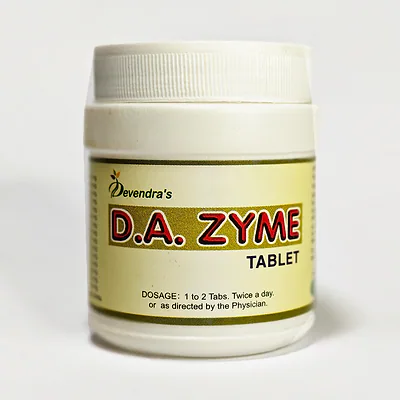
100 Tab: ₹70
D.A. Zyme is a sixteen-ingredient digestive formula that the booklet describes as Deepana, Pachana, Rochaka, Vatanulomaka and Krimighna — kindling digestion, digesting Ama, whetting the appetite, moving wind and clearing worms.
Shell-calcium antacids, Trikatu and asafoetida settle gas and colic; Kutki, Mastagi and Mandoor support the liver and spleen; Amaltas keeps the bowels moving. It is processed in aloe and lemon juice.
Used for
- Indigestion & poor appetite
- Gas, bloating & colic
- Sluggish liver & spleen
- Intestinal worms
- Constipation
Why digestion stalls
Digestion depends on a chain: enough stomach acid, enzymes from the pancreas, bile from the liver and steady movement of the gut. When one link is weak, food lingers and ferments, giving gas, bloating, colic and constipation; a sluggish liver and an enlarged spleen often go with it.
Ayurveda calls the root Mandagni — a weak digestive fire — which lets Ama (undigested residue) clog the channels and turn Vata against its natural downward flow. It can also allow worms (Krimi) and Gulma, a hard, gassy swelling in the belly. Treatment rekindles Agni, digests Ama and restores Vata's direction.
D.A. Zyme works in 4 ways
- Digestive & Secretagogue (Deepana-Pachana) — Trikatu's piperine stimulates digestive enzymes, and asafoetida and ajwain increase digestive secretions and bile in experimental studies.
- Antacid & Carminative (Vatanulomana) — Shankh and Kapardika bhasma neutralise excess acid, and asafoetida relaxes intestinal smooth muscle, easing gas and colic.
- Liver & Spleen Support (Yakrit-pleeha) — Kutki's picrosides are hepatoprotective and choleretic in experimental studies; Mastagi is gastroprotective, and Mandoor supplies iron for the blood.
- Anthelmintic & Laxative (Krimighna, Anulomana) — Vidanga's embelin is anthelmintic in experimental studies, and Amaltas pulp is Ayurveda's gentlest laxative.
Key ingredients
- Trikatu (three pungents) — 45 mg. Dry ginger, black pepper and long pepper in equal parts. Ayurveda adds it to kindle Agni and clear Ama; research suggests piperine-rich Trikatu also raises the absorption of the other ingredients taken with it.
- Hing (Asafoetida) (Ferula asafoetida, oleo-gum resin) — 15 mg. Ayurveda's first remedy for wind and colic (Vatanulomana, Shoolaprashamana). In experimental studies asafoetida relaxes intestinal smooth muscle and stimulates digestive enzymes and bile.
- Ajwain (Carom) (Trachyspermum ammi, fruit) — 10 mg. Thymol-rich seeds that Ayurveda uses for wind, colic and indigestion. In experimental studies ajwain relaxes intestinal smooth muscle, increases digestive enzyme and bile secretion and is antibacterial and antifungal.
- Kutki (Katuki) (Picrorhiza kurroa, rhizome) — 15 mg. A Himalayan bitter for the liver and Kamala (jaundice). Its iridoid glycosides (picroside I and II, kutkoside) are hepatoprotective, choleretic and anti-inflammatory in experimental studies.
- Mastagi (Mastic gum) (Pistacia lentiscus, resin) — 10 mg. The resin of the mastic tree, a Unani stomach remedy for indigestion and ulcers. Reviews describe gastroprotective, anti-inflammatory and anti-Helicobacter pylori activity, with some small clinical studies in dyspepsia.
- Shankh bhasma (calcined conch shell) — 45 mg. Conch shell calcined by classical Rasa-shastra methods into fine calcium carbonate (calcite). Like any carbonate antacid it neutralises excess stomach acid; Ayurveda uses it for hyperacidity, indigestion and colic (Amlapitta, Parinama shoola).
- Kapardika bhasma (calcined cowrie shell) — 45 mg. Cowrie shell calcined to a fine calcium-carbonate powder. Ayurveda prescribes it for hyperacidity, indigestion, colic and an enlarged liver or spleen; its antacid action is that of calcium carbonate, and clinical research is limited.
- Vidanga (False black pepper) (Embelia ribes, fruit) — 15 mg. Ayurveda's classic de-worming herb. Its benzoquinone embelin is anthelmintic, antimicrobial, anti-inflammatory and antioxidant in experimental studies.
- Amaltas (Indian laburnum) (Cassia fistula, fruit pulp) — 50 mg. The sweet pulp of the Indian laburnum pod is Ayurveda's mildest purgative. It contains anthraquinones (rhein, sennosides); a small systematic review found it partly effective for stool pain and consistency in constipated children.
- Mandoor bhasma (calcined iron oxide) — 20 mg. Old iron rust (ferric oxide) purified and calcined. Ayurveda uses it for anaemia, jaundice and an enlarged liver or spleen; it is considered gentler on the stomach than other iron preparations. Studies so far are mainly physicochemical.
- Kajjali (black mercuric sulphide) — 5 mg. Purified mercury rubbed with purified sulphur into black mercuric sulphide — the base of many Rasa-shastra medicines. Mercuric sulphide is poorly absorbed, but mercury toxicity has been reported, so dose and duration matter.
Full ingredient list
- Kajjali (mercury rubbed with sulphur) — 5 mg
- Kapardika bhasma (calcined cowrie shell) — 45 mg
- Shankh bhasma (calcined conch shell) — 45 mg
- Mandoor bhasma (processed iron rust, iron oxide) — 20 mg
- Imli kshar (alkali from tamarind-bark ash) — 20 mg
- Praval pishti (coral, levigated in rose water) — 10 mg
- Kutki (Picrorhiza kurroa, rhizome) — 15 mg
- Vayvidang (Embelia ribes, fruit) — 15 mg
- Ajwain (Trachyspermum ammi, fruit) — 10 mg
- Ark pushpa (Calotropis procera, flower) — 20 mg
- Shuddh gandhak (purified sulphur) — 20 mg
- Shuddh hing (Ferula asafoetida, oleo-gum resin) — 15 mg
- Trikatu (dry ginger, black pepper and long pepper) — 45 mg
- Mastagi (Pistacia lentiscus, resin) — 10 mg
- Amaltas (Cassia fistula, fruit pulp) — 50 mg
Processed (bhavana) in juice of
- Ghritkumari (Aloe barbadensis, leaf pulp)
- Nimbu (Citrus limon, fruit juice)
How to use
Dose: Adults: 1–2 tablets twice a day after meals with warm water, or as directed by the physician.
- Take your dose — The dose above, or the one your physician gives.
- With water — Swallow with water (or milk, where the pack says so).
- Stay consistent — Take it at the same times each day, for the course advised.
Safety & suitability
- Who it's for: Adults; children only as a physician advises (contains Kajjali)
- Pregnancy & nursing: Not advised — see the cautions
- Other medicines: Tell your physician what else you take
- Diabetic?: Sugar-coated tablet — ask your physician
- Storage: Cool, dry place, away from direct sunlight
- Ingredients: See the full list below
Cautions
- Contains purified mercury (a traditional Rasa-shastra ingredient) in Kajjali. Take only at the stated dose and for the advised duration, under an Ayurvedic physician; not during pregnancy or breastfeeding, for children, or with kidney disease.
- Contains processed metal or mineral preparations: Mandoor bhasma. Take only at the stated dose and for the advised duration, under an Ayurvedic physician.
- Contains iron: Mandoor bhasma. Keep it out of children's reach — an iron overdose is dangerous for children.
More information
- Net content: 100 Tab
- Storage: Store below 30 °C in a cool, dry place, in the original pack.
- Country of origin: India
- Manufacturer: Devendra Ayurved Ashram Pvt. Ltd., A-12, Industrial Estate, Sujroo, Muzaffarnagar (U.P.) – 251003. Mfg. Lic. No. A-50/77/94 · GMP-certified company.
References
- Devendra Ayurved Ashram Pvt. Ltd. Vivran Pustika (product guide).
- Johri RK, Zutshi U. An Ayurvedic formulation 'Trikatu' and its constituents. J Ethnopharmacol. 1992;37(2):85-91.
- Amalraj A, Gopi S. Biological activities and medicinal properties of Asafoetida: A review. J Tradit Complement Med. 2017;7(3):347-359.
- Boskabady MH, Alitaneh S, Alavinezhad A. Carum copticum L.: a herbal medicine with various pharmacological effects. Biomed Res Int. 2014;2014:569087.
- Almeleebia TM, Alsayari A, Wahab S. Pharmacological and Clinical Efficacy of Picrorhiza kurroa and Its Secondary Metabolites: A Comprehensive Review. Molecules. 2022;27(23).
- Pachi VK, Mikropoulou EV, Gkiouvetidis P, et al. Traditional uses, phytochemistry and pharmacology of Chios mastic gum (Pistacia lentiscus var. Chia, Anacardiaceae): A review. J Ethnopharmacol. 2020;254:112485.
- Chavan S, Tayade S, Gupta V, et al. Pharmaceutical Standardization and Physicochemical Characterization of Traditional Ayurvedic Marine Drug: Incinerated Conch Shell (Shankha Bhasma). Mar Drugs. 2018;16(11).
- Chavan S, Bhuvad S, Gupta V, et al. Industrial manufacturing method and characterization of Ayurvedic marine drugs: mother pearl, cowry, coral and pearl. Drug Dev Ind Pharm. 2024;50(8):721-734.
- Sharma V, Gautam DNS, Radu AF, et al. Reviewing the Traditional/Modern Uses, Phytochemistry, Essential Oils/Extracts and Pharmacology of Embelia ribes Burm. Antioxidants (Basel). 2022;11(7).
- Mwangi RW, Macharia JM, Wagara IN, et al. The medicinal properties of Cassia fistula L: A review. Biomed Pharmacother. 2021;144:112240.
- Aslam MS. Application of genus Cassia in the treatment of Constipation: A systematic review. F1000Res. 2019;8:256.
- Mulik SB, Jha CB. Physicochemical characterization of an Iron based Indian traditional medicine: Mandura Bhasma. Anc Sci Life. 2011;31(2):52-7.
- Joshi N, Dash MK, Upadhyay C, et al. Physico-chemical characterization of kajjali, black sulphide of mercury, with respect to the role of sulfur in its formation and structure. J Ayurveda Integr Med. 2021;12(4):590-600.
- Kamath SU, Pemiah B, Sekar RK, et al. Mercury-based traditional herbo-metallic preparations: a toxicological perspective. Arch Toxicol. 2012;86(6):831-8.