Gastron Tablet
Ayurvedic digestive tablets for gas, bloating and indigestion
A sluggish stomach makes gas. Gastron gets the fire going again.
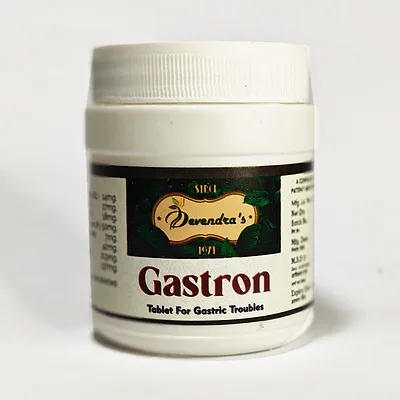
1000 Tab: ₹500
Gastron is a digestive tablet built on Trikatu — dry ginger, black pepper and long pepper — with cumin, rock-salt-style common salt, tartaric acid and a little Narsar. Ayurveda would call it Deepana, Pachana, Ruchya and Vatanulomana: it kindles digestion, digests what is lying heavy, whets the appetite and moves wind down and out.
The booklet lists it for bloating, stomach ache from indigestion, weak digestion, sour belching, nausea and intestinal gas.
Used for
- Gas & bloating (Adhmana)
- Indigestion (Ajirna)
- Poor appetite
- Sour belching & nausea
Why food sits heavy
When the stomach and intestines are slow to secrete acid, enzymes and bile, food lingers. Gut bacteria ferment what is left, producing gas, bloating, belching and a heavy, crampy belly — what doctors call functional dyspepsia.
Ayurveda traces this to Mandagni, a weak digestive fire. Undigested food turns into Ama, which clogs the channels and pushes Vata the wrong way (Pratiloma) as wind and colic. The remedy is to rekindle Agni with pungent spices, digest the Ama and restore Vata's downward flow.
Gastron restarts digestion in 3 ways
- Digestive Stimulant (Deepana-Pachana) — Piperine from black and long pepper stimulates pancreatic digestive enzymes and shortens food transit time in experimental studies, and ginger speeds gastric emptying.
- Carminative (Vatanulomana) — Cumin's cuminaldehyde-rich oil is carminative, easing wind and bloating, and Ayurveda pairs it with salt to move Vata down and out.
- Appetiser (Ruchya) — Salt and citric acid add the salty-sour taste that whets the appetite and, in Ayurveda, settles Vata in the gut.
Key ingredients
- Sonth (Dry ginger) (Zingiber officinale, rhizome) — 14 mg. Ayurveda's 'universal medicine' (Vishwabheshaja) for weak digestion. Its gingerols and shogaols speed gastric emptying and calm nausea; a systematic review of clinical trials found about 1.5 g a day in divided doses relieves nausea.
- Kali mirch (Black pepper) (Piper nigrum, fruit) — 17 mg. Its alkaloid piperine stimulates pancreatic digestive enzymes and shortens food transit time in experimental studies, and famously raises the absorption of other compounds by slowing their breakdown in the gut wall and liver.
- Pippali (Long pepper) (Piper longum, fruit) — 18 mg. A classical Rasayana for the respiratory tract and digestion. Like black pepper it carries piperine, plus piperlongumine; it is anti-inflammatory, bronchoprotective and bioavailability-enhancing in experimental studies.
- Jeera (Cumin) (Cuminum cyminum, fruit) — 50 mg. A classic Deepana-Pachana spice for indigestion, bloating and loose stools. Its essential oil, rich in cuminaldehyde, is carminative, antimicrobial and antioxidant in experimental studies.
- Tatri (tartaric acid) — 42 mg. Tartaric acid adds a sourness that whets the appetite (Ruchya); with an alkali it forms a tartrate.
- Narsar (ammonium chloride) — 7 mg. A classical 'saline expectorant', thought to act by a reflex from the stomach that increases airway secretions and thins phlegm. It is the standard reference expectorant in animal studies; clinical evidence in people is limited.
Full ingredient list
- Sonth (Zingiber officinale, rhizome) — 14 mg
- Mirch Kali (Piper nigrum, fruit) — 17 mg
- Pipal (Piper longum, fruit) — 18 mg
- Jeera (Cuminum cyminum, fruit) — 50 mg
- Narsar (ammonium chloride) — 7 mg
- Tatri (tartaric acid) — 42 mg
- Namak (sodium chloride) — 213 mg
- Sugar — 137 mg
How to use
Dose: Adults: 1–2 tablets twice a day after meals with lukewarm water; children ¼–1 tablet by age. Or as directed by the physician.
- Take your dose — The dose above, or the one your physician gives.
- With water — Swallow with water (or milk, where the pack says so).
- Stay consistent — Take it at the same times each day, for the course advised.
Safety & suitability
- Who it's for: Adults and children, at the dose for their age
- Pregnancy & nursing: Ask your physician before use
- Other medicines: Tell your physician what else you take
- Diabetic?: Contains sugar (137 mg a tablet) — ask your physician
- Storage: Cool, dry place, away from direct sunlight
- Ingredients: See the full list below
Cautions
- Contains sodium salts: Namak (salt). Ask your physician first if you have high blood pressure or kidney disease.
- Contains sugar (137 mg a tablet) — people with diabetes should ask their physician first.
More information
- Net content: 1000 Tab
- Storage: Store below 30 °C in a cool, dry place, in the original pack.
- Country of origin: India
- Manufacturer: Devendra Ayurved Ashram Pvt. Ltd., A-12, Industrial Estate, Sujroo, Muzaffarnagar (U.P.) – 251003. Mfg. Lic. No. A-50/77/94 · GMP-certified company.
References
- Devendra Ayurved Ashram Pvt. Ltd. Vivran Pustika (product guide).
- Nikkhah Bodagh M, Maleki I, Hekmatdoost A. Ginger in gastrointestinal disorders: A systematic review of clinical trials. Food Sci Nutr. 2019;7(1):96-108.
- Srinivasan K. Black pepper and its pungent principle-piperine: a review of diverse physiological effects. Crit Rev Food Sci Nutr. 2007;47(8):735-48.
- Biswas P, Ghorai M, Mishra T, et al. Piper longum L.: A comprehensive review on traditional uses, phytochemistry, pharmacology, and health-promoting activities. Phytother Res. 2022;36(12):4425-4476.
- Johri RK, Zutshi U. An Ayurvedic formulation 'Trikatu' and its constituents. J Ethnopharmacol. 1992;37(2):85-91.
- Singh N, Yadav SS, Kumar S, et al. A review on traditional uses, phytochemistry, pharmacology, and clinical research of dietary spice Cuminum cyminum L. Phytother Res. 2021;35(9):5007-5030.
- Liu W, Wang Y, He DD, et al. Antitussive, expectorant, and bronchodilating effects of quinazoline alkaloids (±)-vasicine, deoxyvasicine, and (±)-vasicinone from aerial parts of Peganum harmala L. Phytomedicine. 2015;22(12):1088-95.