Aspass Capsule
Ayurvedic capsules for gas, acidity and stomach ache
Gas and acidity, sorted in one capsule.
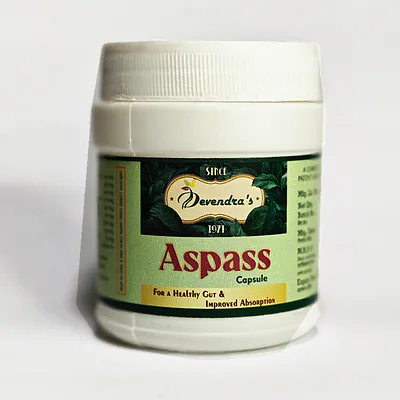
10 Cap: ₹25 · 100 Cap: ₹160
Aspass is an Ayurvedic digestive capsule that pairs fast-acting antacids — Shankh bhasma, Kapardika bhasma and Meetha soda — with Trikatu, Harad, garlic and asafoetida, which kindle digestion and move trapped wind.
The details file lists it for stomach pain, gas, acidity, indigestion and other digestive problems.
Used for
- Gas & bloating
- Acidity & heartburn (Amlapitta)
- Stomach ache from indigestion
- Indigestion (Ajirna)
Why gas and acid team up
When digestion is sluggish, food sits in the stomach and ferments: acid irritates, gas stretches the gut, and the result is a sore, bloated, burning belly. Rich food, irregular meals and stress make it worse.
Ayurveda sees this as Mandagni with Ama — weak digestive fire leaving undigested residue — so that Pitta turns sour (Amlapitta) and Vata is trapped (Adhmana). The remedy neutralises the excess acid, rekindles Agni and moves Vata down.
Aspass works in 3 ways
- Fast Antacid (Amlapitta-shamaka) — Sodium bicarbonate and the calcium carbonate of Shankh and Kapardika bhasma neutralise excess stomach acid within minutes.
- Carminative & Antispasmodic (Vatanulomana) — Asafoetida relaxes intestinal smooth muscle in experimental studies, and garlic is a warming Vata-moving herb.
- Digestive (Deepana-Pachana) — Trikatu's piperine stimulates digestive enzymes, ginger speeds gastric emptying, and Harad keeps the bowels regular.
Key ingredients
- Shankh bhasma (calcined conch shell) — 150 mg. Conch shell calcined by classical Rasa-shastra methods into fine calcium carbonate (calcite). Like any carbonate antacid it neutralises excess stomach acid; Ayurveda uses it for hyperacidity, indigestion and colic (Amlapitta, Parinama shoola).
- Meetha soda (sodium bicarbonate) — 75 mg. Sodium bicarbonate neutralises stomach acid within minutes (HCO₃⁻ + H⁺ → CO₂ + water), easing heartburn and acid indigestion; the released carbon dioxide can cause burping. Not for regular long-term use with high blood pressure or kidney disease.
- Kapardika bhasma (calcined cowrie shell) — 25 mg. Cowrie shell calcined to a fine calcium-carbonate powder. Ayurveda prescribes it for hyperacidity, indigestion, colic and an enlarged liver or spleen; its antacid action is that of calcium carbonate, and clinical research is limited.
- Hing (Asafoetida) (Ferula foetida, exudate) — 10 mg. Ayurveda's first remedy for wind and colic (Vatanulomana, Shoolaprashamana). In experimental studies asafoetida relaxes intestinal smooth muscle and stimulates digestive enzymes and bile.
- Lahsun (Garlic) (Allium sativum, bulb) — 50 mg. Garlic's sulphur compounds (alliin, allicin, ajoene) are antimicrobial, antioxidant and anti-atherosclerotic in experimental studies; in clinical meta-analyses garlic modestly lowered blood pressure and cholesterol.
- Sonth (Dry ginger) (Zingiber officinale, rhizome) — 40 mg. Ayurveda's 'universal medicine' (Vishwabheshaja) for weak digestion. Its gingerols and shogaols speed gastric emptying and calm nausea; a systematic review of clinical trials found about 1.5 g a day in divided doses relieves nausea.
- Kali mirch (Black pepper) (Piper nigrum, fruit) — 40 mg. Its alkaloid piperine stimulates pancreatic digestive enzymes and shortens food transit time in experimental studies, and famously raises the absorption of other compounds by slowing their breakdown in the gut wall and liver.
- Pippali (Long pepper) (Piper longum, fruit) — 40 mg. A classical Rasayana for the respiratory tract and digestion. Like black pepper it carries piperine, plus piperlongumine; it is anti-inflammatory, bronchoprotective and bioavailability-enhancing in experimental studies.
- Haritaki (Harad) (Terminalia chebula, fruit) — 70 mg. The first of the Triphala fruits and Ayurveda's classic Anulomana: it keeps the bowels regular. Its tannins (chebulagic and chebulinic acids) are antioxidant, anti-inflammatory and hepatoprotective in laboratory studies.
Full ingredient list
- Sonth (Zingiber officinale, rhizome) — 40 mg
- Kali mirch (Piper nigrum, fruit) — 40 mg
- Pipal (Piper longum, fruit) — 40 mg
- Haed (Terminalia chebula, fruit) — 70 mg
- Garlic Powder (Allium sativum, bulb) — 50 mg
- Hing (Ferula foetida, exudate) — 10 mg
- Shankh Bhasm (calcined conch shell) — 150 mg
- Kapardika Bhasm (calcined cowrie shell) — 25 mg
- Meetha Soda (sodium bicarbonate) — 75 mg
- Sodium Benzoate (preservative) — 0.5% w/w
How to use
Dose: 1–2 capsules twice a day with water, or as directed by the physician.
- Take your dose — The dose above, or the one your physician gives.
- With water — Swallow with water (or milk, where the pack says so).
- Stay consistent — Take it at the same times each day, for the course advised.
Safety & suitability
- Who it's for: Adults; children only at the dose a physician sets
- Pregnancy & nursing: Ask your physician before use
- Other medicines: Tell your physician what else you take
- Diabetic?: No added sugar — ask your physician
- Storage: Cool, dry place, away from direct sunlight
- Ingredients: See the full list below
Cautions
- Antacids can stop some medicines being absorbed (for example certain antibiotics, iron and thyroid tablets) — take them at least 2 hours apart.
- Diarrhoea lasting more than two weeks, blood in the stool, weight loss or severe pain needs a doctor's check.
- Contains sodium salts: Meetha soda. Ask your physician first if you have high blood pressure or kidney disease.
More information
- Net content: 10 Cap · 100 Cap
- Storage: Store below 30 °C in a cool, dry place, in the original pack.
- Country of origin: India
- Manufacturer: Devendra Ayurved Ashram Pvt. Ltd., A-12, Industrial Estate, Sujroo, Muzaffarnagar (U.P.) – 251003. Mfg. Lic. No. A-50/77/94 · GMP-certified company.
References
- Garg V, Narang P, Taneja R. Antacids revisited: review on contemporary facts and relevance for self-management. J Int Med Res. 2022;50(3):3000605221086457.
- Chavan S, Tayade S, Gupta V, et al. Pharmaceutical Standardization and Physicochemical Characterization of Traditional Ayurvedic Marine Drug: Incinerated Conch Shell (Shankha Bhasma). Mar Drugs. 2018;16(11).
- Chavan S, Bhuvad S, Gupta V, et al. Industrial manufacturing method and characterization of Ayurvedic marine drugs: mother pearl, cowry, coral and pearl. Drug Dev Ind Pharm. 2024;50(8):721-734.
- Amalraj A, Gopi S. Biological activities and medicinal properties of Asafoetida: A review. J Tradit Complement Med. 2017;7(3):347-359.
- El-Saber Batiha G, Magdy Beshbishy A, G Wasef L, et al. Chemical Constituents and Pharmacological Activities of Garlic (Allium sativum L.): A Review. Nutrients. 2020;12(3).
- Ried K. Garlic Lowers Blood Pressure in Hypertensive Individuals, Regulates Serum Cholesterol, and Stimulates Immunity: An Updated Meta-analysis and Review. J Nutr. 2016;146(2):389S-396S.
- Nikkhah Bodagh M, Maleki I, Hekmatdoost A. Ginger in gastrointestinal disorders: A systematic review of clinical trials. Food Sci Nutr. 2019;7(1):96-108.
- Srinivasan K. Black pepper and its pungent principle-piperine: a review of diverse physiological effects. Crit Rev Food Sci Nutr. 2007;47(8):735-48.
- Biswas P, Ghorai M, Mishra T, et al. Piper longum L.: A comprehensive review on traditional uses, phytochemistry, pharmacology, and health-promoting activities. Phytother Res. 2022;36(12):4425-4476.
- Johri RK, Zutshi U. An Ayurvedic formulation 'Trikatu' and its constituents. J Ethnopharmacol. 1992;37(2):85-91.
- Wang C, Zhang H, Wang X, et al. Comprehensive Review on Fruit of Terminalia chebula: Traditional Uses, Phytochemistry, Pharmacology, Toxicity, and Pharmacokinetics. Molecules. 2024;29(23).