Swadishta Pachak Choorn
A tasty Ayurvedic after-meal digestive powder
A pinch after meals for a lighter, happier stomach.
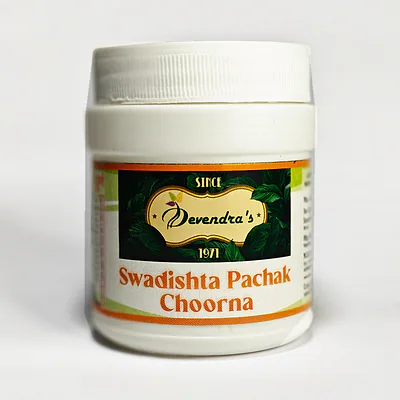
50 g: ₹50
Swadishta Pachak Choorn is a sweet-sour-salty digestive powder in the style of the classical Lavanabhaskara and Hingvashtaka churnas: Trikatu, cumin, Talispatra, Amlavetas, bay leaf and asafoetida with black salt, common salt, citric acid, Narsar and peppermint.
The booklet calls it Deepana, Pachana and Rochaka — it kindles digestion and whets the appetite — and lists it for gas, indigestion, bloating, colic, sour belching, weak digestion and nausea. And, as its name says, it is tasty.
Used for
- Gas & bloating
- Indigestion after heavy meals
- Sour belching & nausea
- Poor appetite
Why a big meal sits heavy
A heavy or rich meal asks a lot of the stomach and intestines. If acid, enzymes and bile can't keep up, food lingers and ferments — the familiar bloating, belching, wind and dull ache after eating.
Ayurveda sees this as Agnimandya, a temporarily weak digestive fire, with Vata trapped by undigested food (Ama). Pungent spices kindle Agni, and the salty and sour tastes — which Ayurveda says pacify Vata — help move the wind down and out.
Swadishta Pachak helps in 3 ways
- Digestive Stimulant (Deepana-Pachana) — Ginger speeds gastric emptying, and the piperine in black and long pepper stimulates digestive enzymes in experimental studies.
- Carminative (Vatanulomana) — Cumin, asafoetida and peppermint relax the gut's smooth muscle and relieve wind; black salt adds Ayurveda's classic Vata-settling taste.
- Appetiser (Ruchya) — Citric acid, Amlavetas and the salts give the sour-salty taste that whets the appetite.
Key ingredients
- Sonth (Dry ginger) (Zingiber officinale, rhizome) — 6 parts. Ayurveda's 'universal medicine' (Vishwabheshaja) for weak digestion. Its gingerols and shogaols speed gastric emptying and calm nausea; a systematic review of clinical trials found about 1.5 g a day in divided doses relieves nausea.
- Kali mirch (Black pepper) (Piper nigrum, fruit) — 3 parts. Its alkaloid piperine stimulates pancreatic digestive enzymes and shortens food transit time in experimental studies, and famously raises the absorption of other compounds by slowing their breakdown in the gut wall and liver.
- Jeera (Cumin) (Cuminum cyminum, fruit) — 5 parts. A classic Deepana-Pachana spice for indigestion, bloating and loose stools. Its essential oil, rich in cuminaldehyde, is carminative, antimicrobial and antioxidant in experimental studies.
- Hing (Asafoetida) (Ferula asafoetida, oleo-gum resin) — 5 parts. Ayurveda's first remedy for wind and colic (Vatanulomana, Shoolaprashamana). In experimental studies asafoetida relaxes intestinal smooth muscle and stimulates digestive enzymes and bile.
- Kala namak (black salt) — 5 parts. A sulphurous rock salt that Ayurveda counts the best salt for digestion: it whets the appetite, eases wind and is mildly laxative (Deepana, Vatanulomana).
- Peppermint (Mentha × piperita) — 0.7 parts. Menthol activates the cold-sensing TRPM8 receptor in the airways and gut, giving a cooling feel, damping the cough reflex and relaxing intestinal smooth muscle; in a human study, menthol vapour raised the cough threshold.
Full ingredient list
- Sonth (Zingiber officinale, rhizome) — 6 parts
- Kali mirch (Piper nigrum, fruit) — 3 parts
- Pippali (Piper longum, fruit) — 1 part
- Jeera (Cuminum cyminum, fruit) — 5 parts
- Talees patra (Abies webbiana, leaf) — 2 parts
- Amalbet (Garcinia pedunculata, fruit rind) — 4 parts
- Namak (common salt) — 1 part
- Tejpat (Cinnamomum tamala, leaf) — 1 part
- Hing (Ferula asafoetida, oleo-gum resin) — 5 parts
- Kala namak (black salt) — 5 parts
- Sat nimbu (citric acid) — 1 part
- Narsar (ammonium chloride) — 4 parts
- Peppermint (Mentha × piperita) — 0.7 parts
- Chini (sugar) — 37 parts
How to use
Dose: 2–4 g two to three times a day, after meals, or as directed by the physician.
- Measure — Take the dose with a clean, dry spoon.
- Mix — Take it with water or milk, as the pack or your physician advises.
- With meals — Usually after meals, or as directed.
Safety & suitability
- Who it's for: Adults; children only at the dose a physician sets
- Pregnancy & nursing: Ask your physician before use
- Other medicines: Tell your physician what else you take
- Diabetic?: Contains sugar (about half of each dose) — ask your physician
- Storage: Cool, dry place, away from direct sunlight
- Ingredients: See the full list below
Cautions
- Contains sodium salts: Namak (salt) and Kala namak. Ask your physician first if you have high blood pressure or kidney disease.
- Contains sugar (about half of each dose) — people with diabetes should ask their physician first.
More information
- Net content: 50 g
- Storage: Keep the jar tightly closed in a cool, dry place. Use a clean, dry spoon.
- Country of origin: India
- Manufacturer: Devendra Ayurved Ashram Pvt. Ltd., A-12, Industrial Estate, Sujroo, Muzaffarnagar (U.P.) – 251003. Mfg. Lic. No. A-50/77/94 · GMP-certified company.
References
- Devendra Ayurved Ashram Pvt. Ltd. Vivran Pustika (product guide).
- Nikkhah Bodagh M, Maleki I, Hekmatdoost A. Ginger in gastrointestinal disorders: A systematic review of clinical trials. Food Sci Nutr. 2019;7(1):96-108.
- Srinivasan K. Black pepper and its pungent principle-piperine: a review of diverse physiological effects. Crit Rev Food Sci Nutr. 2007;47(8):735-48.
- Singh N, Yadav SS, Kumar S, et al. A review on traditional uses, phytochemistry, pharmacology, and clinical research of dietary spice Cuminum cyminum L. Phytother Res. 2021;35(9):5007-5030.
- Amalraj A, Gopi S. Biological activities and medicinal properties of Asafoetida: A review. J Tradit Complement Med. 2017;7(3):347-359.
- Wise PM, Breslin PA, Dalton P. Sweet taste and menthol increase cough reflex thresholds. Pulm Pharmacol Ther. 2012;25(3):236-41.
- Stinson RJ, Morice AH, Sadofsky LR. Modulation of transient receptor potential (TRP) channels by plant derived substances used in over-the-counter cough and cold remedies. Respir Res. 2023;24(1):45.