Acidal Syrup
Ayurvedic syrup for hyperacidity and heartburn
That burn behind your breastbone is Pitta running hot. Acidal helps cool it down.
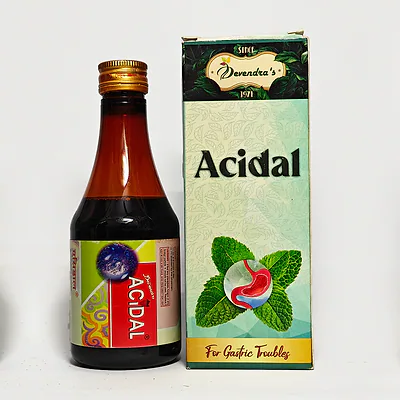
200 mL: ₹140
Acidal is an Ayurvedic syrup for Amlapitta — hyperacidity, heartburn and the sour, heavy indigestion that comes with them. Twelve herbs are steam-distilled into an ark (distillate) and balanced with a little salt and tartaric acid.
Its cooling bitters — Patol, Neem, Giloy and Amla — calm Pitta, while licorice soothes, and fennel, coriander and Nagarmotha settle wind and indigestion.
Used for
- Hyperacidity (Amlapitta)
- Heartburn
- Indigestion
- Sour belching & nausea
Why acidity flares up
Your stomach makes strong acid to digest food, and its lining is built to take it. Trouble starts when acid is made at the wrong time or in excess, or when it washes back up into the food pipe (reflux) — giving heartburn, sour belching, nausea and a heavy, burning upper belly. Spicy, sour or fried food, late or irregular meals, stress, alcohol and painkillers are common triggers.
Ayurveda calls this Amlapitta: Pitta, already aggravated, takes on an excess of its sour (Amla) and liquid (Drava) qualities, while weak digestive fire (Mandagni) lets food sour and ferment into Ama. Treatment cools and calms Pitta (Pittashamana), soothes the inflamed lining and restores clean digestion.
Acidal cools acidity in 4 ways
- Pitta-pacifying & Cooling (Pittashamaka) — Patol, Giloy, Neem bark and Amla are the bitter, cooling herbs Ayurveda pairs with Amlapitta; amla is gastroprotective and anti-inflammatory in experimental studies.
- Soothing & Mucosal Protective (Dahahara) — Licorice coats and soothes the stomach lining; its glycyrrhizin and flavonoids are anti-inflammatory and gastroprotective in laboratory models.
- Carminative & Digestive (Deepana-Pachana) — Fennel, coriander and Nagarmotha relieve wind and sour indigestion, and the three Triphala fruits keep the bowels regular so Ama does not build up.
- Liver & Bile Support (Yakrituttejaka) — Bhringraj, which the booklet credits with regulating bile flow, is hepatoprotective in experimental models.
Key ingredients
- Patol (Pointed gourd) (Trichosanthes dioica, leaf) — 0.16 g. Pointed-gourd leaf, a classic Pitta-pacifying bitter in Ayurveda for acidity, fever and the liver; Charaka used it for jaundice. It contains triterpenes, saponins and tannins, and studies describe antipyretic, antiulcer and laxative activity.
- Amalaki (Amla) (Emblica officinalis, dried fruit) — 0.17 g. Ayurveda's foremost Rasayana and one of the three Triphala fruits. Rich in vitamin C, emblicanins and other tannins, it is strongly antioxidant, anti-inflammatory, gastroprotective and hepatoprotective in experimental studies.
- Giloy (Guduchi) (Tinospora cordifolia, stem) — 0.16 g. A Rasayana for chronic fever and immunity. Its polysaccharides, alkaloids and diterpenoids are immunomodulatory, antipyretic and anti-inflammatory in experimental studies. Rare liver injury has been reported, possibly from mis-identified Tinospora species.
- Neem (Azadirachta indica, stem bark) — 0.16 g. Ayurveda's great bitter for skin disease and Rakta-dushti. Neem's limonoids (nimbin, nimbidin, azadirachtin) are antibacterial, antifungal and anti-inflammatory in experimental studies.
- Mulethi (Yashtimadhu) (Glycyrrhiza glabra, stem) — 0.08 g. Licorice root coats and soothes irritated mucous membranes of the throat and stomach. Glycyrrhizin and licorice flavonoids are anti-inflammatory and gastroprotective in laboratory models. In Ayurveda it is the classic Kanthya — good for the throat and voice.
- Saunf (Fennel) (Foeniculum vulgare, fruit) — 0.16 g. Sweet, cooling seeds for wind, colic and indigestion, long given to infants. Its anethole relaxes intestinal smooth muscle and eases gas in experimental studies; fennel is also a traditional galactagogue.
- Dhaniya (Coriander) (Coriandrum sativum, fruit) — 0.08 g. Cooling seeds Ayurveda pairs with heat-related indigestion, burning and thirst. Coriander's linalool-rich oil is carminative, antimicrobial and antioxidant in experimental studies.
- Nagarmotha (Musta) (Cyperus rotundus, rhizome) — 0.16 g. A fragrant tuber Ayurveda uses for indigestion, diarrhoea, fever and thirst (Pachana, Grahi). Its sesquiterpenes are antidiarrhoeal, antispasmodic, anti-inflammatory and antioxidant in experimental studies.
- Bhringraj (Eclipta alba, whole plant) — 0.16 g. Best known for hair, Bhringraj is also a classic liver herb (Yakrituttejaka). Its coumestans, such as wedelolactone, are hepatoprotective in experimental models, and in an early study its alcoholic extract protected against chemical (CCl₄) liver damage.
Full ingredient list
Distillate (ark) of
- Patol Patra (Trichosanthes dioica, leaf) — 0.16 g
- Her (Terminalia chebula, fruit) — 0.17 g
- Bahera (Terminalia bellirica, fruit) — 0.17 g
- Anwla (Emblica officinalis, dried fruit) — 0.17 g
- Nimb Twak (Azadirachta indica, stem bark) — 0.16 g
- Mustak (Cyperus rotundus, rhizome) — 0.16 g
- Guruchi (Tinospora cordifolia, stem) — 0.16 g
- Madhuyashthi (Glycyrrhiza glabra, stem) — 0.08 g
- Arusa (Adhatoda vasica, leaf) — 0.16 g
- Bhringraj (Eclipta alba, whole plant) — 0.16 g
- Dhaniya (Coriandrum sativum, fruit) — 0.08 g
- Saunf (Foeniculum vulgare, fruit) — 0.16 g
- Namak (sodium chloride) — 0.45 g
- Tatri (tartaric acid) — 0.08 g
- Chini (sugar) — 6.6 g
- Colour (approved red) — q.s.
- Essence (sweet orange) — q.s.
How to use
Dose: 10 mL twice a day with water, or as directed by the physician. Shake well before use.
- Shake well — Shake the bottle before each dose.
- Measure the dose — Use the measuring cap — the dose above, or the one your physician gives.
- Keep a routine — Take it at the same times each day, for as long as advised.
Safety & suitability
- Who it's for: Adults; children only at the dose a physician sets
- Pregnancy & nursing: Ask your physician before use
- Other medicines: Tell your physician what else you take
- Diabetic?: Contains sugar (6.6 g per 10 mL) — ask your physician
- Storage: Cool, dry place, away from direct sunlight
- Ingredients: See the full list below
Cautions
- Heartburn that keeps coming back, trouble swallowing, vomiting blood, black stools or weight loss need a doctor's check — do not self-treat.
- Contains sodium salts: Namak (salt). Ask your physician first if you have high blood pressure or kidney disease.
- Contains sugar (6.6 g per 10 mL) — people with diabetes should ask their physician first.
- Do not use if any precipitate, fungus or foreign particle is found — replace the bottle.
More information
- Net content: 200 mL
- Storage: Keep in a cool, dry place away from direct sunlight. Close the cap tightly after use.
- Country of origin: India
- Manufacturer: Devendra Ayurved Ashram Pvt. Ltd., A-12, Industrial Estate, Sujroo, Muzaffarnagar (U.P.) – 251003. Mfg. Lic. No. A-50/77/94 · GMP-certified company.
References
- Kumar N, Singh S, Manvi, et al. Trichosanthes dioica Roxb.: An overview. Pharmacogn Rev. 2012;6(11):61-7.
- Saini R, Sharma N, Oladeji OS, et al. Traditional uses, bioactive composition, pharmacology, and toxicology of Phyllanthus emblica fruits: A comprehensive review. J Ethnopharmacol. 2022;282:114570.
- Yates CR, Bruno EJ, Yates MED. Tinospora Cordifolia: A review of its immunomodulatory properties. J Diet Suppl. 2022;19(2):271-285.
- Kumar P, Kamle M, Mahato DK, et al. Tinospora cordifolia (Giloy): Phytochemistry, Ethnopharmacology, Clinical Application and Conservation Strategies. Curr Pharm Biotechnol. 2020;21(12):1165-1175.
- Philips CA, Theruvath AH. A comprehensive review on the hepatotoxicity of herbs used in the Indian (Ayush) systems of alternative medicine. Medicine (Baltimore). 2024;103(16):e37903.
- Panneer Selvam K, Payyappallimana U, Ravikumar K, et al. Can Guduchi (Tinospora cordifolia), a well-known ayurvedic hepato-protectant cause liver damage?. J Ayurveda Integr Med. 2023;14(1):100658.
- Mehnaz S, Shamsi Y, Akhtar MW, et al. Therapeutic Applications of Neem (Azadirachta indica): A Narrative Review. Adv Mind Body Med. 2024;38(4):14-18.
- Wahab S, Annadurai S, Abullais SS, et al. Glycyrrhiza glabra (Licorice): A Comprehensive Review on Its Phytochemistry, Biological Activities, Clinical Evidence and Toxicology. Plants (Basel). 2021;10(12).
- Badgujar SB, Patel VV, Bandivdekar AH. Foeniculum vulgare Mill: a review of its botany, phytochemistry, pharmacology, contemporary application, and toxicology. Biomed Res Int. 2014;2014:842674.
- Mahleyuddin NN, Moshawih S, Ming LC, et al. Coriandrum sativum L.: A Review on Ethnopharmacology, Phytochemistry, and Cardiovascular Benefits. Molecules. 2021;27(1).
- Pirzada AM, Ali HH, Naeem M, et al. Cyperus rotundus L.: Traditional uses, phytochemistry, and pharmacological activities. J Ethnopharmacol. 2015;174:540-60.
- Timalsina D, Devkota HP. Eclipta prostrata (L.) L. (Asteraceae): Ethnomedicinal Uses, Chemical Constituents, and Biological Activities. Biomolecules. 2021;11(11).
- Murthy VN, Reddy BP, Venkateshwarlu V, et al. Antihepatotoxic activity of eclipta alba, tephrosia purpurea and boerhaavia diffusa. Anc Sci Life. 1992;11(3-4):182-6.