Stonil Syrup
Ayurvedic urinary syrup traditionally used for Ashmari (stones)
Ayurveda's 'stone-breaker' herbs, in one daily syrup.
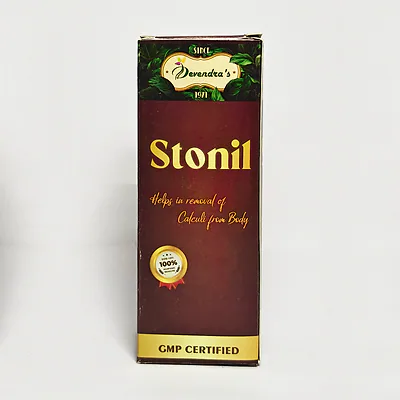
200 mL: ₹150
Stonil is an Ayurvedic syrup in the classical tradition of Ashmari-hara formulas — medicines for urinary stones. It brings together Pashanbhed (literally 'stone-breaker'), Gokshura, Varuna, Kush and Kans roots, Punarnava and Apamarga with Shatavari, Jatamansi and purified Shilajit.
Khurasani ajwain adds a traditional antispasmodic for the urinary tract, and the classical salts Kalmishora and Narsar act as diuretics.
Used for
- Ashmari (urinary stones) — traditional use
- Painful urination (Mutrakrichha)
- Urinary-tract spasm & discomfort
How urinary stones form
Stones form when urine carries more calcium, oxalate, uric acid or phosphate than it can keep dissolved. Tiny crystals stick together and grow, especially when you drink too little. Passing one stretches and spasms the narrow ureter — the severe colic of a kidney stone.
Ayurveda calls this Ashmari: Kapha binds the crystals together, Pitta 'bakes' them hard and Vata dries and moves them. Classical treatment uses diuretic, 'stone-breaking' (Ashmaribhedana) herbs, with antispasmodics for the pain.
Stonil works in 3 ways
- Anti-urolithic (Ashmaribhedana) — Pashanbhed's bergenin and Varuna bark inhibited stone-forming crystals and lowered stone deposits in experimental studies; human evidence is limited.
- Diuretic (Mutrala) — Gokshura, Punarnava and Kush root increase urine flow in experimental studies, helping flush small crystals; the classical salts Kalmishora and Narsar add to this.
- Antispasmodic (Shoolaprashamana) — Khurasani ajwain carries hyoscyamine and scopolamine, the tropane alkaloids behind the antispasmodic drug hyoscine butylbromide, which relax the smooth muscle of the urinary tract.
Key ingredients
- Pashanbhed (Bergenia ciliata, rhizome) — 50 mg. Its name means 'stone-breaker': Ayurveda's leading herb for Ashmari. Its bergenin, arbutin and gallic acid are diuretic, antioxidant and anti-inflammatory, and its extracts inhibited stone-forming crystal growth in experimental studies.
- Gokhru (Gokshura) (Tribulus terrestris, whole plant) — 50 mg. Ayurveda's chief herb for the urinary tract (Mutrala) and a reproductive tonic. Its saponins (protodioscin) and flavonoids are diuretic and anti-urolithic in animal studies; human evidence is limited.
- Varun (Varuna) (Crataeva nurvala, stem bark) — 25 mg. A classical bark for urinary stones and an irritable bladder. In rat studies its decoction lowered the oxalate-forming liver enzyme glycolate oxidase and reduced stone deposits; its triterpene lupeol is thought to contribute.
- Punarnava (Boerhavia diffusa, whole plant) — 50 mg. Its name means 'renews the body'. Ayurveda uses it for swelling (Shotha), the kidneys and the liver; its rotenoids and flavonoids are diuretic, anti-inflammatory and hepatoprotective in experimental studies.
- Khurasani ajwain (Henbane seed) (Hyoscyamus albus, seed) — 50 mg. Henbane seed carries hyoscyamine and scopolamine (hyoscine), the tropane alkaloids behind the antispasmodic drug hyoscine butylbromide used for colic. They relax smooth muscle — including the urinary tract — but are toxic in excess.
- Apamarga (Achyranthes aspera, whole plant) — 50 mg. Valued in Ayurveda for respiratory complaints. In animal studies its extract relaxed constricted airways much as aminophylline does, stabilised mast cells and lowered allergic markers (IgE and Th2 cytokines).
- Shatavari (Asparagus racemosus, root) — 50 mg. Ayurveda's chief Rasayana for women. Its steroidal saponins (shatavarins) are adaptogenic, immunomodulatory and anti-ulcer in experimental studies, and it is traditionally used to support milk supply.
- Shilajit — 10 mg. A Himalayan rock exudate rich in fulvic acid and dibenzo-α-pyrones. Animal and human studies indicate antioxidant, anti-inflammatory and adaptogenic effects, improved sperm counts and less fatigue; its safety is well documented when purified.
Full ingredient list
Liquid extract of
- Pashanbhed (Bergenia ciliata, rhizome) — 50 mg
- Gokhru (Tribulus terrestris, whole plant) — 50 mg
- Satavar (Asparagus racemosus, root) — 50 mg
- Varun chhaal (Crataeva nurvala, stem bark) — 25 mg
- Kush mool (Desmostachya bipinnata, root) — 25 mg
- Kans mool (Saccharum spontaneum, root) — 25 mg
- Beejband (Sida cordifolia, seed) — 25 mg
- Ajvayankhurasani (Hyoscyamus albus, seed) — 50 mg
- Jatamansi (Nardostachys jatamansi, rhizome) — 50 mg
- Punarnava (Boerhavia diffusa, whole plant) — 50 mg
- Giloy (Tinospora cordifolia, stem) — 50 mg
- Apamarg (Achyranthes aspera, whole plant) — 50 mg
- Kalmishora (potassium nitrate) — 25 mg
- Narsar (ammonium chloride) — 25 mg
- Shudhshilajeet (asphaltum punjabium) — 10 mg
- Chini (sugar) — 5 gm
- M.P.S. (preservative, as per Drug Act) — 0.1%
- P.P.S. (preservative, as per Drug Act) — 0.025%
- Colour, Flavour (as per Drug Act) — q.s.
How to use
Dose: 4–8 mL twice a day with water, or as directed by the physician.
- Shake well — Shake the bottle before each dose.
- Measure the dose — Use the measuring cap — the dose above, or the one your physician gives.
- Keep a routine — Take it at the same times each day, for as long as advised.
Safety & suitability
- Who it's for: Adults; children only at the dose a physician sets
- Pregnancy & nursing: Ask your physician before use
- Other medicines: Tell your physician what else you take
- Diabetic?: Contains sugar (5 g per 10 mL) — ask your physician
- Storage: Cool, dry place, away from direct sunlight
- Ingredients: See the full list below
Cautions
- Severe side or groin pain, fever with pain, vomiting, blood in the urine or being unable to pass urine needs a doctor at once.
- Stones larger than about 5–6 mm often need medical treatment to pass; have them assessed by a doctor.
- Contains anticholinergic (tropane) alkaloids, from Khurasani ajwain (henbane). Avoid in glaucoma, urinary retention or an enlarged prostate, and never exceed the dose.
- Contains sugar (5 g per 10 mL) — people with diabetes should ask their physician first.
- Do not use if any precipitate, fungus or foreign particle is found — replace the bottle.
More information
- Net content: 200 mL
- Storage: Keep in a cool, dry place away from direct sunlight. Close the cap tightly after use.
- Country of origin: India
- Manufacturer: Devendra Ayurved Ashram Pvt. Ltd., A-12, Industrial Estate, Sujroo, Muzaffarnagar (U.P.) – 251003. Mfg. Lic. No. A-50/77/94 · GMP-certified company.
References
- Pearle MS, Goldfarb DS, Assimos DG, et al. Medical management of kidney stones: AUA guideline. J Urol. 2014;192(2):316-24.
- Roychoudhury S, Das D, Das S, et al. Clinical Potential of Himalayan Herb Bergenia ligulata: An Evidence-Based Study. Molecules. 2022;27(20).
- Ahmad M, Butt MA, Zhang G, et al. Bergenia ciliata: A comprehensive review of its traditional uses, phytochemistry, pharmacology and safety. Biomed Pharmacother. 2018;97:708-721.
- Ștefănescu R, Tero-Vescan A, Negroiu A, et al. A Comprehensive Review of the Phytochemical, Pharmacological, and Toxicological Properties of Tribulus terrestris L. Biomolecules. 2020;10(5).
- Varalakshmi P, Shamila Y, Latha E. Effect of Crataeva nurvala in experimental urolithiasis. J Ethnopharmacol. 1990;28(3):313-21.
- Agarwal S, Gupta SJ, Saxena AK, et al. Urolithic property of Varuna (Crataeva nurvala): An experimental study. Ayu. 2010;31(3):361-6.
- Mishra S, Aeri V, Gaur PK, et al. Phytochemical, therapeutic, and ethnopharmacological overview for a traditionally important herb: Boerhavia diffusa Linn. Biomed Res Int. 2014;2014:808302.
- Alizadeh A, Moshiri M, Alizadeh J, et al. Black henbane and its toxicity - a descriptive review. Avicenna J Phytomed. 2014;4(5):297-311.
- Shim KH, Kang MJ, Sharma N, et al. Beauty of the beast: anticholinergic tropane alkaloids in therapeutics. Nat Prod Bioprospect. 2022;12(1):33.
- Kaushik A, Singh DP, Sahu M, et al. Protective effect of Achyranthes aspera against compound 48/80, histamine and ovalbumin-induced allergic disorders in murine model. Mol Biol Rep. 2024;51(1):202.
- Singh R. Asparagus racemosus: a review on its phytochemical and therapeutic potential. Nat Prod Res. 2016;30(17):1896-908.
- Singh N, Garg M, Prajapati P, et al. Adaptogenic property of Asparagus racemosus: Future trends and prospects. Heliyon. 2023;9(4):e14932.
- Stohs SJ. Safety and efficacy of shilajit (mumie, moomiyo). Phytother Res. 2014;28(4):475-9.
- Agarwal SP, Khanna R, Karmarkar R, et al. Shilajit: a review. Phytother Res. 2007;21(5):401-5.