Calcurina Tablet
Ayurvedic tablets traditionally used for Ashmari (urinary stones)
Stones form one crystal at a time. Ayurveda's "stone-breaker" herbs, in a tablet.
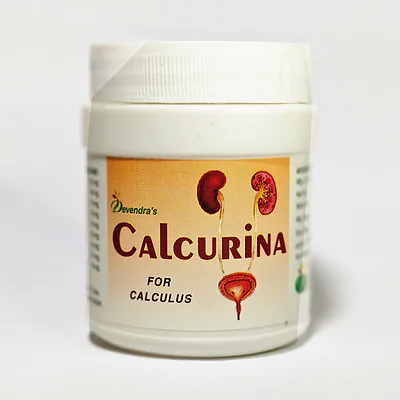
100 Tab: ₹75
Calcurina is an Ayurvedic tablet in the Ashmari-hara tradition, built on two 'stone-breaker' herbs — Patthar phodi and Pashanbhed — with Manjishtha, Nagarmotha, Apamarga, Gojihva and Sahdevi, purified Shilajit and Hajrul yahood bhasma, the Unani mineral for urinary stones.
The booklet describes it as loosening the Kapha that binds stones, breaking them into small pieces and increasing urine so the fragments pass, and as easing stone colic and spasm of the urinary tract.
Used for
- Ashmari (urinary stones) — traditional use
- Painful urination (Mutrakrichha)
- Urinary-tract spasm
How urinary stones form
Stones form when urine is over-saturated with calcium, oxalate, uric acid or phosphate. Crystals nucleate, stick together and grow — fastest in concentrated urine. A stone moving down the ureter causes intense colic and spasm.
In Ayurveda, Ashmari arises when Kapha in the urinary channels binds the crystals, Pitta hardens them and Vata dries and moves them. Classical treatment loosens and breaks the stone (Ashmaribhedana), increases urine (Mutrala) and relaxes spasm.
Calcurina works in 3 ways
- Anti-urolithic (Ashmaribhedana) — Pashanbhed inhibited stone-forming crystals in experimental studies, and in a small randomised, double-blind trial Hajrul yahood shrank calcium kidney stones more than placebo.
- Diuretic & Anti-inflammatory (Mutrala, Shothahara) — Sahdevi and Apamarga are diuretic and anti-inflammatory in experimental studies, and Manjishtha is Ayurveda's urinary blood purifier.
- Soothing (Mutrakrichhahara) — Gojihva's mucilage and Nagarmotha soothe an irritated tract, and Shilajit is Ayurveda's classic Rasayana for the urinary system.
Key ingredients
- Pashanbhed (Bergenia ciliata, rhizome) — 49 mg. Its name means 'stone-breaker': Ayurveda's leading herb for Ashmari. Its bergenin, arbutin and gallic acid are diuretic, antioxidant and anti-inflammatory, and its extracts inhibited stone-forming crystal growth in experimental studies.
- Hajrul yahood bhasma (calcined Jew's stone) — 16 mg. A fossilised sea-urchin spine, mostly calcium carbonate and silica, calcined. A Unani mainstay for urinary stones: in a small randomised, double-blind trial it shrank calcium kidney stones more than placebo, though larger studies are needed.
- Manjishtha (Majeeth) (Rubia cordifolia, root) — 16 mg. Ayurveda's foremost Raktashodhaka for the skin and urinary tract. Its anthraquinones (purpurin, rubiadin) and naphthoquinones are anti-inflammatory, antioxidant and antimicrobial in experimental studies, and it is used to prevent stone formation.
- Sahdevi (Vernonia cinerea, whole plant) — 16 mg. A small herb used in Ayurveda for fever, urinary complaints and swelling. Its sesquiterpene lactones and flavonoids are anti-inflammatory, analgesic and diuretic in experimental studies.
- Apamarga (Achyranthes aspera, whole plant) — 16 mg. Valued in Ayurveda for respiratory complaints. In animal studies its extract relaxed constricted airways much as aminophylline does, stabilised mast cells and lowered allergic markers (IgE and Th2 cytokines).
- Nagarmotha (Musta) (Cyperus rotundus, rhizome) — 16 mg. A fragrant tuber Ayurveda uses for indigestion, diarrhoea, fever and thirst (Pachana, Grahi). Its sesquiterpenes are antidiarrhoeal, antispasmodic, anti-inflammatory and antioxidant in experimental studies.
- Gojihva (Gaozaban) (Onosma bracteatum, leaf) — 16 mg. A Unani and Ayurvedic leaf for cough, sore throat and a restless mind. Its mucilage soothes; its extract damped inflammatory cytokines in a rat arthritis model and showed antimicrobial activity in the laboratory.
- Shilajit — 13 mg. A Himalayan rock exudate rich in fulvic acid and dibenzo-α-pyrones. Animal and human studies indicate antioxidant, anti-inflammatory and adaptogenic effects, improved sperm counts and less fatigue; its safety is well documented when purified.
Full ingredient list
- Patthar phodi — 65 mg
- Pashan bhed (Bergenia ciliata, rhizome) — 49 mg
- Majeeth (Rubia cordifolia, root) — 16 mg
- Nagarmotha (Cyperus rotundus, rhizome) — 16 mg
- Apamarg (Achyranthes aspera, whole plant) — 16 mg
- Gajwan (Gojihva) (Onosma bracteatum, leaf) — 16 mg
- Sahdevi (Vernonia cinerea, whole plant) — 16 mg
- Shuddh shilajeet (purified mineral pitch) — 13 mg
- Hajrul yahood bhasma (calcined Jew's stone, fossil calcium silicate) — 16 mg
How to use
Dose: 1–2 tablets two or three times a day with water, or as directed by the physician.
- Take your dose — The dose above, or the one your physician gives.
- With water — Swallow with water (or milk, where the pack says so).
- Stay consistent — Take it at the same times each day, for the course advised.
Safety & suitability
- Who it's for: Adults; children only at the dose a physician sets
- Pregnancy & nursing: Ask your physician before use
- Other medicines: Tell your physician what else you take
- Diabetic?: Sugar-coated tablet — ask your physician
- Storage: Cool, dry place, away from direct sunlight
- Ingredients: See the full list below
Cautions
- Severe side or groin pain, fever with pain, vomiting, blood in the urine or being unable to pass urine needs a doctor at once.
- Stones larger than about 5–6 mm often need medical treatment to pass; have them assessed by a doctor.
More information
- Net content: 100 Tab
- Storage: Store below 30 °C in a cool, dry place, in the original pack.
- Country of origin: India
- Manufacturer: Devendra Ayurved Ashram Pvt. Ltd., A-12, Industrial Estate, Sujroo, Muzaffarnagar (U.P.) – 251003. Mfg. Lic. No. A-50/77/94 · GMP-certified company.
References
- Devendra Ayurved Ashram Pvt. Ltd. Vivran Pustika (product guide).
- Pearle MS, Goldfarb DS, Assimos DG, et al. Medical management of kidney stones: AUA guideline. J Urol. 2014;192(2):316-24.
- Roychoudhury S, Das D, Das S, et al. Clinical Potential of Himalayan Herb Bergenia ligulata: An Evidence-Based Study. Molecules. 2022;27(20).
- Ahmad M, Butt MA, Zhang G, et al. Bergenia ciliata: A comprehensive review of its traditional uses, phytochemistry, pharmacology and safety. Biomed Pharmacother. 2018;97:708-721.
- Makbul SAA, Jahan N, Ahmad G. Hajrul yahood (Lapis judaicus): An important mineral drug of Unani system of medicine for the management of urolithiasis. J Ethnopharmacol. 2018;222:165-170.
- Faridi P, Seradj H, Mohammadi-Samani S, et al. Randomized and double-blinded clinical trial of the safety and calcium kidney stone dissolving efficacy of Lapis judaicus. J Ethnopharmacol. 2014;156:82-7.
- Wen M, Chen Q, Chen W, et al. A comprehensive review of Rubia cordifolia L.: Traditional uses, phytochemistry, pharmacological activities, and clinical applications. Front Pharmacol. 2022;13:965390.
- Trang NM, Vinh LB, Phong NV, et al. Traditional Uses, Phytochemistry, and Pharmacological Activities of Vernonia cinerea (L.) Less.: An Updated Review. Nutrients. 2024;16(9).
- Kaushik A, Singh DP, Sahu M, et al. Protective effect of Achyranthes aspera against compound 48/80, histamine and ovalbumin-induced allergic disorders in murine model. Mol Biol Rep. 2024;51(1):202.
- Pirzada AM, Ali HH, Naeem M, et al. Cyperus rotundus L.: Traditional uses, phytochemistry, and pharmacological activities. J Ethnopharmacol. 2015;174:540-60.
- Zafar F, Shaheen G, Asif HM, et al. Onosma bracteatum Wall Aqueous-Ethanolic Extract Suppresses Complete Freund's Adjuvant-Induced Arthritis in Rats via Regulation of TNF-α, IL-6, and C-Reactive Protein. Molecules. 2024;29(8).
- Kazmi SY, Baig HA. Extraction and Analysis of Antimicrobial Compounds from Onosma Bracteatum Using Response Surface Methodology. J Pharm Bioallied Sci. 2025;17(Suppl 1):S865-S868.
- Stohs SJ. Safety and efficacy of shilajit (mumie, moomiyo). Phytother Res. 2014;28(4):475-9.
- Agarwal SP, Khanna R, Karmarkar R, et al. Shilajit: a review. Phytother Res. 2007;21(5):401-5.