Shakti Sudha Syrup
Ayurvedic tonic syrup for strength, stamina and a clear mind
Running on empty? Shakti Sudha is Ayurveda's way of refilling the tank.
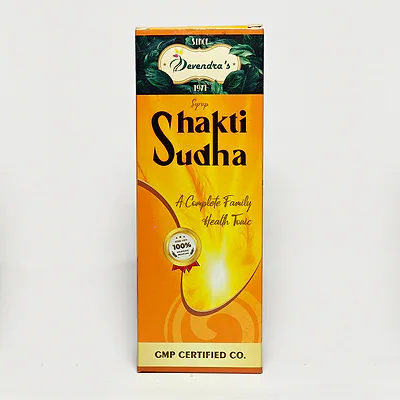
100 mL: ₹75 · 200 mL: ₹140
Shakti Sudha ('nectar of strength') is an Ayurvedic Rasayana syrup: an ark of Ashwagandha, Shatavari and Vidhara for strength, Brahmi and Shankhpushpi for the mind, and cumin, Punarnava, Gokshura, Chitrak, Akarkara and cinnamon to keep digestion and absorption working.
Its Hindi गुणधर्म describes it as Balavardhaka, Buddhivardhaka and Kantijanaka — building strength, intellect and a healthy glow — and as nourishing the body's tissues (Dhatu).
Used for
- Tiredness & low stamina (Balya)
- Mental fatigue & focus (Medhya)
- Weakness after illness
- General vitality (Rasayana)
Why you feel run down
Ongoing tiredness has many causes — poor sleep, stress, a recent illness, low iron or vitamin levels, thyroid problems or simply doing too much. Chronic stress keeps cortisol high, which disturbs sleep, mood and recovery.
Ayurveda describes this as Ojas-kshaya — depletion of the body's vital essence — and Dhatu-kshaya, the wasting of tissues, when digestion is weak and Vata runs high. Rasayana therapy pairs nourishing, strength-giving (Balya) herbs with Medhya herbs for the mind and digestive herbs to make sure the nourishment is absorbed.
Shakti Sudha restores in 3 ways
- Adaptogen & Strength (Balya, Rasayana) — Ashwagandha lowered perceived stress and cortisol and improved strength and sleep in meta-analyses of randomised trials; Shatavari and Vidhara are adaptogenic in experimental studies.
- Mind & Memory (Medhya) — Brahmi improved attention and speed of processing in a meta-analysis of randomised trials, and Shankhpushpi is memory-enhancing and calming in animal studies.
- Digestion & Absorption (Deepana) — Cumin, Chitrak, cinnamon and Akarkara kindle digestion so the tonic herbs are absorbed — in Ayurveda, a Rasayana works only when Agni does.
Key ingredients
- Ashwagandha (Withania somnifera, root) — 200 mg. Ayurveda's best-known Balya-Rasayana. In randomised trials ashwagandha root extract lowered perceived stress and cortisol and improved sleep and muscle strength; its withanolides are the main active constituents.
- Shatavari (Asparagus racemosus, root) — 200 mg. Ayurveda's chief Rasayana for women. Its steroidal saponins (shatavarins) are adaptogenic, immunomodulatory and anti-ulcer in experimental studies, and it is traditionally used to support milk supply.
- Vidhara (Elephant creeper) (Argyreia nervosa, root) — 200 mg. A classical Rasayana root for strength, joints and the nerves. Its root extract was analgesic and anti-inflammatory in animal studies and improved sperm parameters impaired by diabetes in rats; human research is lacking.
- Brahmi (Bacopa monnieri, whole plant) — 200 mg. Ayurveda's best-known Medhya Rasayana. A meta-analysis of randomised trials found Bacopa extract improved attention and speed of processing; its bacosides are antioxidant and neuroprotective in experimental studies.
- Shankhpushpi (Convolvulus pluricaulis, whole plant) — 200 mg. A classical Medhya herb for memory and restful sleep. An umbrella review found memory-enhancing, anxiolytic and neuroprotective effects in animal studies, with a few small clinical studies; its coumarins and flavonoids are antioxidant.
- Gokhru (Gokshura) (Tribulus terrestris, fruit) — 100 mg. Ayurveda's chief herb for the urinary tract (Mutrala) and a reproductive tonic. Its saponins (protodioscin) and flavonoids are diuretic and anti-urolithic in animal studies; human evidence is limited.
- Akarkara (Anacyclus pyrethrum, root) — 25 mg. Pellitory root, a pungent Unani and Ayurvedic stimulant. Its alkylamides (pellitorine) are anti-inflammatory and analgesic, and it improved sperm function in a rat study of cadmium toxicity.
- Chitrak (Plumbago zeylanica, root) — 50 mg. Ayurveda's strongest Agni-kindler, used for indigestion, piles and sluggish metabolism. Its naphthoquinone plumbagin is antioxidant and antibacterial in laboratory studies; the root is irritant and avoided in pregnancy.
- Punarnava (Boerhavia diffusa, whole plant) — 100 mg. Its name means 'renews the body'. Ayurveda uses it for swelling (Shotha), the kidneys and the liver; its rotenoids and flavonoids are diuretic, anti-inflammatory and hepatoprotective in experimental studies.
Full ingredient list
Distillate (ark) of
- Ashwagandha (Withania somnifera, root) — 200 mg
- Shatawar (Asparagus racemosus, root) — 200 mg
- Vidhaaraa (Argyreia nervosa, root) — 200 mg
- Shankh Pushpi (Convolvulus pluricaulis, whole plant) — 200 mg
- Brahmi (Bacopa monnieri, whole plant) — 200 mg
- Jeerak (Cuminum cyminum, seed) — 100 mg
- Punarnava (Boerhavia diffusa, whole plant) — 100 mg
- Gokshroo (Tribulus terrestris, fruit) — 100 mg
- Chitrak (Plumbago zeylanica, root) — 50 mg
- Akarkara (Anacyclus pyrethrum, root) — 25 mg
- Dal Chini (Cinnamomum zeylanicum, bark) — 25 mg
- Chini (sugar) — 5 g
- Colour, Flavour and Preservative (added as approved) — q.s.
How to use
Dose: 10 mL two to three times a day, or as directed by the physician.
- Shake well — Shake the bottle before each dose.
- Measure the dose — Use the measuring cap — the dose above, or the one your physician gives.
- Keep a routine — Take it at the same times each day, for as long as advised.
Safety & suitability
- Who it's for: Adults; children only at the dose a physician sets
- Pregnancy & nursing: Not during pregnancy (contains Chitrak)
- Other medicines: Tell your physician what else you take
- Diabetic?: Contains sugar (5 g per 10 mL) — ask your physician
- Storage: Cool, dry place, away from direct sunlight
- Ingredients: See the full list below
Cautions
- Tiredness that lasts for weeks deserves a check-up — anaemia, thyroid problems and diabetes are common, treatable causes.
- Not to be taken during pregnancy.
- Contains sugar (5 g per 10 mL) — people with diabetes should ask their physician first.
- Do not use if any precipitate, fungus or foreign particle is found — replace the bottle.
More information
- Net content: 100 mL · 200 mL
- Storage: Keep in a cool, dry place away from direct sunlight. Close the cap tightly after use.
- Country of origin: India
- Manufacturer: Devendra Ayurved Ashram Pvt. Ltd., A-12, Industrial Estate, Sujroo, Muzaffarnagar (U.P.) – 251003. Mfg. Lic. No. A-50/77/94 · GMP-certified company.
References
- Akhgarjand C, Asoudeh F, Bagheri A, et al. Does Ashwagandha supplementation have a beneficial effect on the management of anxiety and stress? A systematic review and meta-analysis of randomized controlled trials. Phytother Res. 2022;36(11):4115-4124.
- Bonilla DA, Moreno Y, Gho C, et al. Effects of Ashwagandha (Withania somnifera) on Physical Performance: Systematic Review and Bayesian Meta-Analysis. J Funct Morphol Kinesiol. 2021;6(1).
- Fatima K, Malik J, Muskan F, et al. Safety and efficacy of Withania somnifera for anxiety and insomnia: Systematic review and meta-analysis. Hum Psychopharmacol. 2024;39(6):e2911.
- Singh R. Asparagus racemosus: a review on its phytochemical and therapeutic potential. Nat Prod Res. 2016;30(17):1896-908.
- Singh N, Garg M, Prajapati P, et al. Adaptogenic property of Asparagus racemosus: Future trends and prospects. Heliyon. 2023;9(4):e14932.
- Gori PV, Raval M, Patel S, et al. Argyreia nervosa (Brum.f.) Bojer. alleviates diabetes mellitus-induced male infertility. Mol Biol Rep. 2025;52(1):546.
- Bachhav RS, Gulecha VS, Upasani CD. Analgesic and anti-inflammatory activity of Argyreia speciosa root. Indian J Pharmacol. 2009;41(4):158-61.
- Kongkeaw C, Dilokthornsakul P, Thanarangsarit P, et al. Meta-analysis of randomized controlled trials on cognitive effects of Bacopa monnieri extract. J Ethnopharmacol. 2014;151(1):528-35.
- Sharma R, Singla RK, Banerjee S, et al. Role of Shankhpushpi (Convolvulus pluricaulis) in neurological disorders: An umbrella review covering evidence from ethnopharmacology to clinical studies. Neurosci Biobehav Rev. 2022;140:104795.
- Ștefănescu R, Tero-Vescan A, Negroiu A, et al. A Comprehensive Review of the Phytochemical, Pharmacological, and Toxicological Properties of Tribulus terrestris L. Biomolecules. 2020;10(5).
- Elazzouzi H, Fadili K, Cherrat A, et al. Phytochemistry, Biological and Pharmacological Activities of the Anacyclus pyrethrum (L.) Lag: A Systematic Review. Plants (Basel). 2022;11(19).
- Mahmoud AA, Shaaban MAM, Basal WT. Anacyclus pyrethrum enhances fertility in cadmium-intoxicated male rats by improving sperm functions. BMC Complement Med Ther. 2024;24(1):409.
- Tilak JC, Adhikari S, Devasagayam TP. Antioxidant properties of Plumbago zeylanica, an Indian medicinal plant and its active ingredient, plumbagin. Redox Rep. 2004;9(4):219-27.
- Qais FA, Ahmad I, Husain FM, et al. Interference of quorum sensing regulated bacterial virulence factors and biofilms by Plumbago zeylanica extract. Microsc Res Tech. 2021;84(12):3150-3160.
- Mishra S, Aeri V, Gaur PK, et al. Phytochemical, therapeutic, and ethnopharmacological overview for a traditionally important herb: Boerhavia diffusa Linn. Biomed Res Int. 2014;2014:808302.