Septicure
Ayurvedic antiseptic for boils, pimples and minor wounds
Turmeric, alum and camphor — the old first-aid kit, in one tube.
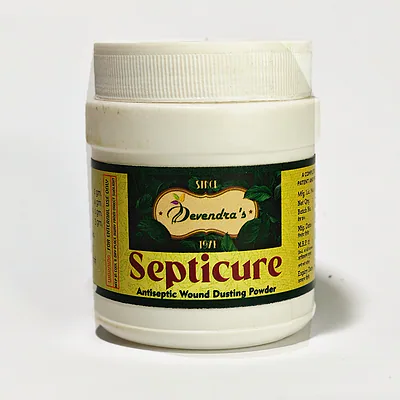
25 g: ₹100
Septicure is an Ayurvedic antiseptic wound dusting powder built on three classic first-aid ingredients — turmeric, alum (Phitkari) and camphor — in a talc base (Sanjasahast) that keeps the area dry.
The pack describes it for old and festering wounds, boils and pimples: to clear the putrefaction and help them heal (Ropana).
Used for
- Boils & pimples
- Minor cuts & scrapes
- Small infected sores
Why small wounds fester
When bacteria — usually staphylococci from the skin — get into a cut or a blocked hair follicle, the body walls them off with inflammation and pus: a boil or a festering sore. Keeping the area clean and dry helps it drain and heal.
Ayurveda calls a wound Vrana and an infected one Dushta Vrana, treated first by cleansing (Shodhana) and then healing (Ropana). Turmeric and alum are its classic Vrana-shodhana and Ropana agents.
Septicure works in 3 ways
- Antiseptic & Wound-healing (Vrana-ropana) — Turmeric's curcumin is antimicrobial and anti-inflammatory and speeds wound healing in experimental studies.
- Astringent & Haemostatic (Stambhana) — Alum (potassium aluminium sulphate) tightens tissue and stops small bleeds — the reason it is used after shaving.
- Soothing (Dahaprashamana) — Camphor is antiseptic and soothes stinging and itching.
Key ingredients
- Haridra (Turmeric) (Curcuma longa, rhizome) — 2 g. Its curcuminoids, chiefly curcumin, damp inflammatory signalling (NF-κB, COX-2) and scavenge free radicals in experimental studies. Ayurveda uses it for cough and cold, skin, wounds and the liver.
- Phitkari (potash alum) — 4 g. Potash alum, purified or heat-dried. It is a strong astringent: it tightens mucous membranes and checks bleeding and secretions, and is antimicrobial. Ayurveda uses it for cough with phlegm, bleeding and, externally, for wounds and eyes.
- Kapoor (Camphor) — 1 g. Applied to skin, camphor activates the warmth and cold receptors TRPV1 and TRPM8 and then desensitises them — a counter-irritant effect that eases muscle and joint pain and itching. Toxic if swallowed.
- Sanjasahast (talc) — 3 g. Purified talc (magnesium silicate), the classic dusting-powder base: it absorbs moisture and reduces friction, keeping the skin around a wound or boil dry.
Full ingredient list
- Haldi (Curcuma longa, rhizome) — 2 g
- Phitkari (potash alum) — 4 g
- Kapoor (camphor) — 1 g
- Sanjasahast (talc) — 3 g
How to use
Dose: Clean and dry the area, then dust a little powder over the wound, boil or pimple as needed — or as directed by the physician.
- Clean first — Rinse the area with clean water and pat it dry.
- Apply — Apply a little over the boil, pimple or sore. Don't squeeze boils.
- Cover & repeat — Cover with a clean dressing if needed, and repeat as often as advised.
Safety & suitability
- Who it's for: Adults; children only as a physician advises
- Pregnancy & nursing: Ask your physician before use
- Other medicines: Tell your physician what else you take
- Sensitive skin: Patch test first
- Storage: Cool, dry place, away from direct sunlight
- Ingredients: See the full list below
Cautions
- See a doctor for a boil on the face, a spreading red area, red streaks, fever, a large or very painful boil, or any wound in a person with diabetes.
- For the skin surface only: do not pack the powder into deep or puncture wounds, and avoid breathing in the dust.
- Contains camphor — never swallow, and keep away from children's nose and mouth.
More information
- Net content: 25 g
- Storage: Store below 30 °C, away from direct sunlight. Keep the cap tightly closed.
- Country of origin: India
- Manufacturer: Devendra Ayurved Ashram Pvt. Ltd., A-12, Industrial Estate, Sujroo, Muzaffarnagar (U.P.) – 251003. Mfg. Lic. No. A-50/77/94 · GMP-certified company.
References
- Devendra Ayurved Ashram Pvt. Ltd. Vivran Pustika (product guide).
- Kumari A, Raina N, Wahi A, et al. Wound-Healing Effects of Curcumin and Its Nanoformulations: A Comprehensive Review. Pharmaceutics. 2022;14(11).
- Hewlings SJ, Kalman DS. Curcumin: A Review of Its Effects on Human Health. Foods. 2017;6(10).
- The Ayurvedic Pharmacopoeia of India, Part I (single drugs) and Part II (formulations). Government of India, Ministry of AYUSH.
- Stinson RJ, Morice AH, Sadofsky LR. Modulation of transient receptor potential (TRP) channels by plant derived substances used in over-the-counter cough and cold remedies. Respir Res. 2023;24(1):45.
- Love JN, Sammon M, Smereck J. Are one or two dangerous? Camphor exposure in toddlers. J Emerg Med. 2004;27(1):49-54.