Burnt Cream
Traditional Ayurvedic ointment for minor cuts, boils and cracked heels
A traditional mineral ointment — for small, minor skin troubles only.
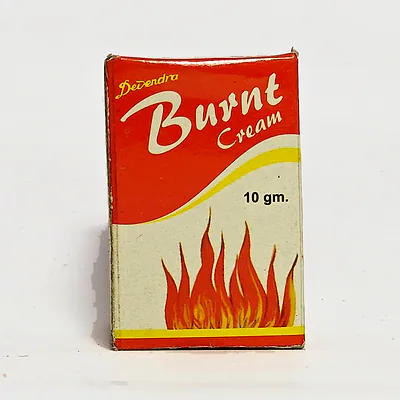
10 g: ₹50
Burnt Cream is a traditional Ayurvedic ointment in an oil-and-beeswax base, with camphor, Dugdh pashan and three classical lead preparations — Sindoor, Safeda kashgari and Murdasang — that were long used to dry and protect sores.
The pack lists it for burns, cuts, boils, pimples, wounds, cracked heels and other skin complaints. Because lead can pass through damaged skin, use it only on small, minor areas for a short time, and see a doctor for any real burn.
Used for
- Small cuts & scrapes
- Boils & pimples
- Cracked heels
- Minor skin irritation
How minor wounds heal
A small cut or blister heals in stages: bleeding stops, inflammation clears debris and germs, new tissue fills the gap and the skin closes over. Keeping it clean, moist and protected lets that happen fastest; infection and repeated rubbing slow it down.
Ayurveda calls a wound Vrana and treats it in two steps — cleansing (Shodhana) and healing (Ropana) — often with ointments that dry discharge and protect the surface.
A traditional ointment, used with care
- Protective, Drying Film (traditional) — The lead oxides and carbonate were classical drying, astringent ointment ingredients; modern medicine no longer uses them because lead is toxic and absorbed through damaged skin.
- Cooling & Soothing — Camphor acts on the skin's temperature receptors to soothe itching and stinging.
- Emollient Base — The oil and beeswax base softens and seals the skin — useful for cracked heels.
Key ingredients
- Kapoor (Camphor) — 5 mg. Applied to skin, camphor activates the warmth and cold receptors TRPV1 and TRPM8 and then desensitises them — a counter-irritant effect that eases muscle and joint pain and itching. Toxic if swallowed.
- Sindoor (red lead) — 5 mg. Red lead oxide, used in traditional ointments to dry and heal ulcers and burns. Lead compounds are toxic and can be absorbed through damaged skin, which is why modern medicine no longer uses them.
- Murdasang (litharge) — 5 mg. Litharge (lead monoxide), a traditional drying, astringent ingredient of ointments for ulcers, eczema and burns. Lead compounds are toxic and can be absorbed through damaged skin.
- Safeda kashgari (white lead) — 5 mg. White lead (basic lead carbonate), once common in ointments for burns and rashes for its drying, soothing film. Lead compounds are toxic and can be absorbed through damaged skin.
Full ingredient list
- Karpoor (camphor) — 5 mg
- Murdasang (lead monoxide) — 5 mg
- Sindoor (red lead oxide) — 5 mg
- Dugdhpashan (processed talc-like mineral) — 5 mg
- Safeda Kasgari (lead carbonate) — 5 mg
- Tel + Mom (oil and beeswax base) — 100 mg
How to use
Dose: Apply a thin layer to the small affected area once or twice a day, for a few days at most.
- Clean first — Rinse the area with clean water and pat it dry.
- A thin layer — Apply a thin layer to small areas only — not to large, deep or weeping wounds.
- Short use — Use for a few days at most, and wash your hands afterwards.
Safety & suitability
- Who it's for: Adults only
- Pregnancy & nursing: Not advised — see the cautions
- Other medicines: Tell your physician what else you take
- Sensitive skin: Patch test first
- Storage: Cool, dry place, away from direct sunlight
- Ingredients: See the full list below
Cautions
- For burns larger than the palm of your hand, burns on the face, hands, feet or genitals, deep or blistering burns, and burns in children: cool under running water for 20 minutes and see a doctor — do not apply this cream.
- For external use only. Do not use on infants or children, or during pregnancy or breastfeeding.
- Contains lead compounds: Murdasang (lead oxide), Sindoor (red lead) and Safeda kashgari (lead carbonate). Lead can be absorbed through broken skin and burns: use on small areas only, for short periods, and not on children, during pregnancy, or on large or deep burns — see a doctor for those.
- Contains camphor — never swallow, and keep away from children's nose and mouth.
More information
- Net content: 10 g
- Storage: Store below 30 °C, away from direct sunlight. Keep the cap tightly closed.
- Country of origin: India
- Manufacturer: Devendra Ayurved Ashram Pvt. Ltd., A-12, Industrial Estate, Sujroo, Muzaffarnagar (U.P.) – 251003. Mfg. Lic. No. A-50/77/94 · GMP-certified company.
References
- Nagarajan S, Sivaji K, Krishnaswamy S, et al. Safety and toxicity issues associated with lead-based traditional herbo-metallic preparations. J Ethnopharmacol. 2014;151(1):1-11.
- Niemeier RT, Maier A, Reichard JF. Rapid Review of Dermal Penetration and Absorption of Inorganic Lead Compounds for Occupational Risk Assessment. Ann Work Expo Health. 2022;66(3):291-311.
- Stinson RJ, Morice AH, Sadofsky LR. Modulation of transient receptor potential (TRP) channels by plant derived substances used in over-the-counter cough and cold remedies. Respir Res. 2023;24(1):45.
- Love JN, Sammon M, Smereck J. Are one or two dangerous? Camphor exposure in toddlers. J Emerg Med. 2004;27(1):49-54.
- McRae A, Vilcins D, Le HHTC, et al. Lead in traditional and complementary medicine: a systematic review. Rev Environ Health. 2024;39(1):111-120.