Satgun Tel
Ayurvedic herbal oil for joint pain and muscle strain
Neem, Nirgundi and Guggul, slowly cooked into a warming massage oil.
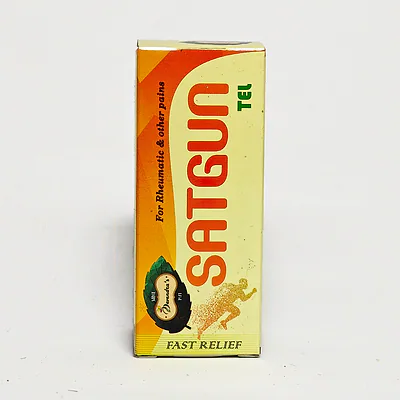
30 mL: ₹95 · 60 mL: ₹180
Satgun Tel is a classical-style Ayurvedic medicated oil (Taila): a decoction of neem leaf, Nirgundi seed, alkanet root and the three Triphala fruits, with Guggul, sal resin and storax, cooked into mustard oil and finished with camphor and eucalyptus, turpentine and wintergreen oils.
The pack lists it for joint pain, backache, muscle strain and Vata pain; the booklet suggests massaging it in and following with warm fomentation.
Used for
- Joint pain (Sandhishoola)
- Backache
- Muscle strain
- Vata pain
Why joints and muscles ache
Joint pain comes from inflamed or worn cartilage and the tissues around it; muscle pain from strain and spasm. Both involve local inflammation that sensitises pain nerves and makes movement stiff and sore.
Ayurveda calls this Vata-vyadhi — cold, dry Vata settling in joints and muscles. Medicated oils (Abhyanga) followed by warmth (Swedana) are its classical treatment: they lubricate, warm and soothe.
Satgun Tel eases pain in 3 ways
- Anti-inflammatory Herbs (Shothahara) — Nirgundi and Guggul are Ayurveda's leading anti-inflammatory herbs for joints, and both are anti-inflammatory and analgesic in experimental studies.
- Warming Counter-irritants — Camphor, turpentine and wintergreen oil warm the skin and distract from deeper pain; salicylate absorbed through the skin is also anti-inflammatory.
- Medicated Massage Oil (Abhyanga) — A warming mustard-oil base carries the herbs into a slow, Vata-calming massage — the heart of Ayurvedic care for pain.
Key ingredients
- Nirgundi (Vitex negundo, seed) — 0.81 g. Ayurveda's foremost herb for Vata pain and swelling, used inside and in oils for joints and muscles. Its flavonoids and iridoids are anti-inflammatory, analgesic and antioxidant in experimental studies.
- Guggul (Commiphora wightii, exudate) — 0.27 g. The purified resin of the guggul tree, Ayurveda's leading remedy for joints (Amavata, Sandhivata) and obesity. Its guggulsterones are anti-inflammatory and lipid-lowering in experimental and some clinical studies; results in people are mixed.
- Neem (Azadirachta indica, leaf) — 0.81 g. Ayurveda's great bitter for skin disease and Rakta-dushti. Neem's limonoids (nimbin, nimbidin, azadirachtin) are antibacterial, antifungal and anti-inflammatory in experimental studies.
- Silaras (Storax) (Liquidambar orientalis, exudate) — 0.27 g. Oriental sweetgum balsam, a traditional antiseptic and warming ingredient of ointments for wounds, scabies and pain. Its cinnamic-acid derivatives are antimicrobial in laboratory studies, and storax is anti-inflammatory in experimental studies.
- Kapoor (Camphor) — 0.27 g. Applied to skin, camphor activates the warmth and cold receptors TRPV1 and TRPM8 and then desensitises them — a counter-irritant effect that eases muscle and joint pain and itching. Toxic if swallowed.
- Gandhpuro tel (Wintergreen oil) (Gaultheria fragrantissima, leaf oil) — 0.27 g. Wintergreen oil is almost pure methyl salicylate, the active ingredient of many pain-relief rubs. On the skin it warms and acts as a counter-irritant, and some is absorbed and converted to salicylate, which is anti-inflammatory — and toxic if swallowed.
- Tarpeen tel (Turpentine oil) (Pinus roxburghii, resin oil) — 0.27 g. Oil distilled from chir-pine resin, long used in liniments for muscle and joint pain. It reddens and warms the skin (a rubefacient), drawing attention away from deeper pain; the pine's resin acids are anti-inflammatory in experimental studies.
Full ingredient list
Decoction (kwath) of
- Nimb Patra (Azadirachta indica, leaf) — 0.81 g
- Nirgundi (Vitex negundo, seed) — 0.81 g
- Raktdala (Alkanna tinctoria, root) — 0.27 g
- Her (Terminalia chebula, fruit) — 0.27 g
- Bahera (Terminalia bellirica, fruit) — 0.27 g
- Amla (Emblica officinalis, fruit) — 0.27 g
- Guggul (Commiphora wightii, exudate) — 0.27 g
- Ral (Shorea robusta, exudate) — 0.27 g
- Silaras (Liquidambar orientalis, exudate) — 0.27 g
- Kapoor (cinnamomum camphora) — 0.27 g
- Tel Nilgiri (Eucalyptus globulus) — 0.27 g
- Tel Tarpeen (Pinus roxburghii) — 0.27 g
- Tel Gandhpuro (Gaultheria fragrantissima) — 0.27 g
- Mustard Refined Oil (Brassica campestris) — 8.9 g
How to use
Dose: Massage gently over the painful area, then apply warm fomentation, once or twice a day.
- Patch test — Try a little on the inner arm first and wait a day.
- Warm and massage — Warm the oil slightly and massage gently over the painful area.
- Foment — Follow with a warm compress, as the booklet advises — never on broken skin.
Safety & suitability
- Who it's for: Adults only
- Pregnancy & nursing: Ask your physician before use
- Other medicines: Tell your physician what else you take
- Sensitive skin: Patch test first
- Storage: Cool, dry place, away from direct sunlight
- Ingredients: See the full list below
Cautions
- For external use only. Keep away from the eyes, mouth and broken skin.
- Contains camphor — never swallow, and keep away from children's nose and mouth.
- Contains wintergreen oil (methyl salicylate). Do not use on children, if you are allergic to aspirin, or with blood-thinning medicines without a doctor's advice; never swallow.
More information
- Net content: 30 mL · 60 mL
- Storage: Store below 30 °C, away from direct sunlight. Keep the cap tightly closed.
- Country of origin: India
- Manufacturer: Devendra Ayurved Ashram Pvt. Ltd., A-12, Industrial Estate, Sujroo, Muzaffarnagar (U.P.) – 251003. Mfg. Lic. No. A-50/77/94 · GMP-certified company.
References
- Pergolizzi JV Jr, Taylor R Jr, LeQuang JA, et al. The role and mechanism of action of menthol in topical analgesic products. J Clin Pharm Ther. 2018;43(3):313-319.
- Zheng CJ, Li HQ, Ren SC, et al. Phytochemical and Pharmacological Profile of Vitex negundo. Phytother Res. 2015;29(5):633-47.
- Garang Z, Feng Q, Luo R, et al. Commiphora mukul (Hook. ex Stocks) Engl.: Historical records, application rules, phytochemistry, pharmacology, clinical research, and adverse reaction. J Ethnopharmacol. 2023;317:116717.
- Ahmad MA, Mujeeb M, Akhtar M, et al. Guggulipid: A Promising Multi-Purpose Herbal Medicinal Agent. Drug Res (Stuttg). 2020;70(4):123-130.
- Mehnaz S, Shamsi Y, Akhtar MW, et al. Therapeutic Applications of Neem (Azadirachta indica): A Narrative Review. Adv Mind Body Med. 2024;38(4):14-18.
- Xu Z, Lu D, Yuan J, et al. Storax, A Promising Botanical Medicine for Treating Cardio-Cerebrovascular Diseases: A Review. Front Pharmacol. 2021;12:785598.
- Guzman JD. Natural cinnamic acids, synthetic derivatives and hybrids with antimicrobial activity. Molecules. 2014;19(12):19292-349.
- Stinson RJ, Morice AH, Sadofsky LR. Modulation of transient receptor potential (TRP) channels by plant derived substances used in over-the-counter cough and cold remedies. Respir Res. 2023;24(1):45.
- Love JN, Sammon M, Smereck J. Are one or two dangerous? Camphor exposure in toddlers. J Emerg Med. 2004;27(1):49-54.
- Michel P, Olszewska MA. Phytochemistry and Biological Profile of Gaultheria procumbens L. and Wintergreen Essential Oil: From Traditional Application to Molecular Mechanisms and Therapeutic Targets. Int J Mol Sci. 2024;25(1).
- Chan TY. Potential dangers from topical preparations containing methyl salicylate. Hum Exp Toxicol. 1996;15(9):747-50.
- Kaushik P, Kaushik D, Khokra SL. Ethnobotany and phytopharmacology of Pinus roxburghii Sargent: a plant review. J Integr Med. 2013;11(6):371-6.