Rumex
Ayurvedic pain-relief liniment for joints, back and sprains
Rub it in, feel the warmth, let the ache go.
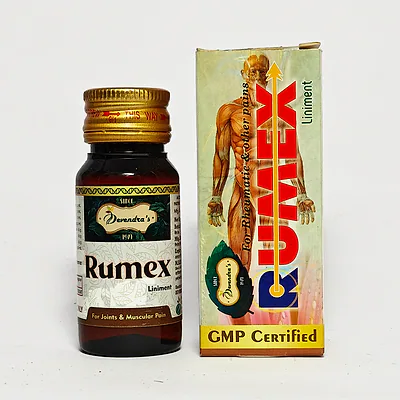
30 mL: ₹95 · 60 mL: ₹180
Rumex is a warming Ayurvedic liniment in a mustard-oil base, with wintergreen, turpentine, eucalyptus and clove oils, camphor, menthol and thymol (the essence of ajwain).
The pack lists it for joint pain, backache, sprains, strains, myositis and fibrositis; the booklet says to massage it in gently and wrap the area to keep it warm.
Used for
- Joint pain & stiffness
- Backache
- Sprains & strains
- Muscle pain (myositis, fibrositis)
Why muscles and joints ache
Strains, overuse, sleeping awkwardly and wear in the joints all trigger local inflammation: prostaglandins sensitise pain nerves, muscles tighten around the sore spot, and stiffness follows.
Ayurveda sees this as Vata — cold, dry and mobile — lodged in the muscles and joints. Warm oils with pungent, aromatic herbs (Snehana and Swedana) are its classical answer: they lubricate, warm and calm Vata.
Rumex eases pain in 3 ways
- Counter-irritant Warmth (Ushna) — Wintergreen's methyl salicylate and turpentine warm and redden the skin, and camphor acts on warmth receptors — counter-irritants that draw attention away from deeper pain.
- Cooling Analgesia — Menthol activates the cold receptor TRPM8, producing a cooling sensation that dulls pain signals — the main mechanism of menthol rubs.
- Anti-inflammatory — Salicylate absorbed through the skin is anti-inflammatory, and clove oil's eugenol is a mild local anaesthetic.
Key ingredients
- Gandhpuro tel (Wintergreen oil) (Gaultheria fragrantissima, leaf oil) — 1 mL. Wintergreen oil is almost pure methyl salicylate, the active ingredient of many pain-relief rubs. On the skin it warms and acts as a counter-irritant, and some is absorbed and converted to salicylate, which is anti-inflammatory — and toxic if swallowed.
- Tarpeen tel (Turpentine oil) (Pinus roxburghii, resin oil) — 1 mL. Oil distilled from chir-pine resin, long used in liniments for muscle and joint pain. It reddens and warms the skin (a rubefacient), drawing attention away from deeper pain; the pine's resin acids are anti-inflammatory in experimental studies.
- Nilgiri tel (Eucalyptus oil) (Eucalyptus globulus, leaf oil) — 1 mL. Eucalyptus oil's 1,8-cineole is antimicrobial and anti-inflammatory and gives a cooling, decongesting feel when inhaled or rubbed on; applied to skin it is a mild counter-irritant. Contact allergy is uncommon but possible.
- Laung tel (Clove oil) (Caryophyllus aromaticus, bud oil) — 0.1 mL. Clove oil is 70–90 % eugenol, a natural local anaesthetic and antiseptic — the reason it is a traditional remedy for toothache and is still used in dentistry. It is also antimicrobial and anti-inflammatory in experimental studies.
- Kapoor (Camphor) — 0.1 g. Applied to skin, camphor activates the warmth and cold receptors TRPV1 and TRPM8 and then desensitises them — a counter-irritant effect that eases muscle and joint pain and itching. Toxic if swallowed.
- Peppermint (Mentha sps.) — 0.1 g. Menthol activates the cold-sensing TRPM8 receptor in the airways and gut, giving a cooling feel, damping the cough reflex and relaxing intestinal smooth muscle; in a human study, menthol vapour raised the cough threshold.
- Ajwain satva (Thymol) — 0.1 g. Thymol, the crystalline essence of ajwain, is antiseptic and antifungal and, like menthol, acts on skin temperature receptors to give a warming counter-irritant effect.
Full ingredient list
- Oil Gultharia (Gaultheria fragrantissima) — 1 mL
- Oil Tarpentine (Pinus roxburghii) — 1 mL
- Oil Neelgiri (Eucalyptus globulus) — 1 mL
- Oil Long (Caryophyllus aromaticus) — 0.1 mL
- Kapoor (cinnamomum camphora) — 0.1 g
- Peppermint (Mentha sps.) — 0.1 g
- Sat Ajvayan (trachyspermum ammi) — 0.1 g
- Mustered Refined Oil (Brassica campestris) — 10 mL
How to use
Dose: Soak a cotton swab, massage gently over the painful area once or twice a day, then cover with a cloth.
- Patch test — Try a little on the inner arm first and wait a day.
- Massage in — Massage gently over the painful area until absorbed — never on broken skin.
- Wrap and wash — Cover with a cloth to keep warm, and wash your hands well afterwards.
Safety & suitability
- Who it's for: Adults only
- Pregnancy & nursing: Ask your physician before use
- Other medicines: Tell your physician what else you take
- Sensitive skin: Patch test first
- Storage: Cool, dry place, away from direct sunlight
- Ingredients: See the full list below
Cautions
- For external use only. Keep away from the eyes, mouth and broken skin, and don't use with a heating pad or under a tight bandage.
- Contains camphor — never swallow, and keep away from children's nose and mouth.
- Contains wintergreen oil (methyl salicylate). Do not use on children, if you are allergic to aspirin, or with blood-thinning medicines without a doctor's advice; never swallow.
More information
- Net content: 30 mL · 60 mL
- Storage: Store below 30 °C, away from direct sunlight. Keep the cap tightly closed.
- Country of origin: India
- Manufacturer: Devendra Ayurved Ashram Pvt. Ltd., A-12, Industrial Estate, Sujroo, Muzaffarnagar (U.P.) – 251003. Mfg. Lic. No. A-50/77/94 · GMP-certified company.
References
- Pergolizzi JV Jr, Taylor R Jr, LeQuang JA, et al. The role and mechanism of action of menthol in topical analgesic products. J Clin Pharm Ther. 2018;43(3):313-319.
- Michel P, Olszewska MA. Phytochemistry and Biological Profile of Gaultheria procumbens L. and Wintergreen Essential Oil: From Traditional Application to Molecular Mechanisms and Therapeutic Targets. Int J Mol Sci. 2024;25(1).
- Chan TY. Potential dangers from topical preparations containing methyl salicylate. Hum Exp Toxicol. 1996;15(9):747-50.
- Kaushik P, Kaushik D, Khokra SL. Ethnobotany and phytopharmacology of Pinus roxburghii Sargent: a plant review. J Integr Med. 2013;11(6):371-6.
- Sadlon AE, Lamson DW. Immune-modifying and antimicrobial effects of Eucalyptus oil and simple inhalation devices. Altern Med Rev. 2010;15(1):33-47.
- Higgins C, Palmer A, Nixon R. Eucalyptus oil: contact allergy and safety. Contact Dermatitis. 2015;72(5):344-6.
- Ulanowska M, Olas B. Biological Properties and Prospects for the Application of Eugenol-A Review. Int J Mol Sci. 2021;22(7).
- Batiha GE, Alkazmi LM, Wasef LG, et al. Syzygium aromaticum L. (Myrtaceae): Traditional Uses, Bioactive Chemical Constituents, Pharmacological and Toxicological Activities. Biomolecules. 2020;10(2).
- Stinson RJ, Morice AH, Sadofsky LR. Modulation of transient receptor potential (TRP) channels by plant derived substances used in over-the-counter cough and cold remedies. Respir Res. 2023;24(1):45.
- Love JN, Sammon M, Smereck J. Are one or two dangerous? Camphor exposure in toddlers. J Emerg Med. 2004;27(1):49-54.
- Wise PM, Breslin PA, Dalton P. Sweet taste and menthol increase cough reflex thresholds. Pulm Pharmacol Ther. 2012;25(3):236-41.
- Boskabady MH, Alitaneh S, Alavinezhad A. Carum copticum L.: a herbal medicine with various pharmacological effects. Biomed Res Int. 2014;2014:569087.