Sarsanil Capsule
Ayurvedic blood-purifier capsules for skin health
Fifty-five classical skin and blood herbs, concentrated into one capsule.
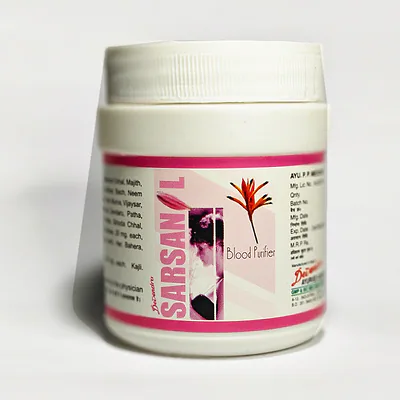
100 Cap: ₹140
Sarsanil Capsules are an extensive Ayurvedic Raktashodhaka formula — fifty-five ingredients led by extracts of Triphala, Nisoth and Chirayata, with Kanchnar, Revat chini, colocynth, Bakuchi, China root, Anantmool, Manjishtha, neem, Khadir, red sandalwood, Karanj, turmeric and many more, with a little Kajjali.
The booklet lists them for blood disorders, itching, boils and pimples, ringworm, eczema, Sheetapitta (hives), facial pimples and dark marks, and swelling and numbness of the limbs; they can be taken with Sarsanil syrup.
Used for
- Blood purifier (Raktashodhaka)
- Boils, pimples & dark marks
- Itching, eczema & ringworm
- Hives (Sheetapitta)
Why skin breaks out
Boils, pimples, itching, eczema and fungal rashes have different causes — bacteria, fungi, allergy, a disturbed skin barrier, hormones — but they often flare with poor digestion, constipation, heat and stress.
Ayurveda sees most chronic skin disease as Rakta-dushti, when aggravated Pitta and Ama circulate in the blood and lodge in the skin. Bitter, cooling blood purifiers, with gentle purgation to clear the gut, are the classical approach.
Sarsanil purifies in 3 ways
- Blood Purifier (Raktashodhaka) — Anantmool, Manjishtha, China root and Khadir are classical blood purifiers, anti-inflammatory and antioxidant in experimental studies.
- Skin Herbs (Kushthaghna) — Bakuchi's psoralens act on pigment cells with sunlight, and neem, Karanj, turmeric and Vidanga are antibacterial and antifungal in experimental studies.
- Gut & Liver Cleansing (Virechana) — Triphala, Nisoth, Amaltas and colocynth clear the bowel, and Kutki and Bhringraj support the liver — Ayurveda's first steps in clearing the skin.
Key ingredients
- Triphala. Amla, Harad and Bahera in equal parts — Ayurveda's best-known bowel regulator and Rasayana. Reviews describe laxative, antioxidant, anti-inflammatory and gut-microbiome-modulating effects, mostly from experimental and small clinical studies.
- Nisoth (Trivrit) (Operculina turpethum, root) — 100 mg. Turpeth root, Ayurveda's preferred purgative for clearing Pitta and accumulated stool. Its resin glycosides (turpethins) are the purgative principle; in laboratory studies the extract also relaxed intestinal and airway smooth muscle.
- Chirayata (Swertia chirayita, whole plant) — 100 mg. One of Ayurveda's strongest bitters, for fever, poor appetite and the liver. Its xanthones and secoiridoids (amarogentin, swertiamarin) are hepatoprotective, antipyretic and hypoglycaemic in experimental studies.
- Anantmool (Indian sarsaparilla) (Hemidesmus indicus, root) — 20 mg. Ayurveda's classic Raktashodhaka for skin, urine and fever. Its root carries 2-hydroxy-4-methoxybenzaldehyde and saponins, with anti-inflammatory, antioxidant, antimicrobial and hepatoprotective activity in experimental studies.
- Manjishtha (Majeeth) (Rubia cordifolia, root) — 20 mg. Ayurveda's foremost Raktashodhaka for the skin and urinary tract. Its anthraquinones (purpurin, rubiadin) and naphthoquinones are anti-inflammatory, antioxidant and antimicrobial in experimental studies, and it is used to prevent stone formation.
- Chopchini (China root) (Smilax china, rhizome) — 40 mg. China root, a Unani and Ayurvedic blood purifier for skin disease and joint pain. Its flavonoids and saponins are anti-inflammatory and antioxidant in experimental studies.
- Bakuchi (Babchi) (Psoralea corylifolia, seed) — 80 mg. Ayurveda's classic seed for Shvitra (white patches). Its psoralen and isopsoralen are furanocoumarins that, with sunlight, stimulate pigment cells — the basis of PUVA therapy — but can also burn the skin; rare liver injury has been reported.
- Katha (Catechu) (Acacia catechu, heartwood extract) — 20 mg. The concentrated heartwood extract of the khair tree, rich in catechins and epicatechin. Strongly astringent, it is antioxidant, anti-inflammatory and antimicrobial in experimental studies; Ayurveda uses it for diarrhoea, the mouth and skin disease.
- Neem (Azadirachta indica, leaf) — 20 mg. Ayurveda's great bitter for skin disease and Rakta-dushti. Neem's limonoids (nimbin, nimbidin, azadirachtin) are antibacterial, antifungal and anti-inflammatory in experimental studies.
- Kajjali (black mercuric sulphide) — 40 mg. Purified mercury rubbed with purified sulphur into black mercuric sulphide — the base of many Rasa-shastra medicines. Mercuric sulphide is poorly absorbed, but mercury toxicity has been reported, so dose and duration matter.
Full ingredient list
Extract of
- Haritaki (Terminalia chebula, fruit) — 100 mg
- Bahera (Terminalia bellirica, fruit) — 100 mg
- Anwla (Emblica officinalis, fruit) — 100 mg
- Nisoth (Operculina turpethum, root) — 100 mg
- Chirayata (Swertia chirayita, whole plant) — 100 mg
- Kanchnar chhal (Bauhinia variegata, stem bark) — 40 mg
- Revat chini (Rheum emodi, root) — 40 mg
- Indrayan (Citrullus colocynthis, fruit) — 40 mg
- Anantmool (Hemidesmus indicus, root) — 20 mg
- Mundi (Sphaeranthus indicus, whole plant) — 20 mg
- Sarpunkha (Tephrosia purpurea, whole plant) — 20 mg
- Unnav (Ziziphus jujuba, fruit) — 20 mg
- Babool chhal (Acacia nilotica, stem bark) — 20 mg
- Majeeth (Rubia cordifolia, root) — 20 mg
- Nagarmotha (Cyperus rotundus, rhizome) — 20 mg
- Kutaj (Holarrhena antidysenterica, stem bark) — 20 mg
- Giloy (Tinospora cordifolia, stem) — 20 mg
- Kooth (Saussurea costus (S. lappa), root) — 20 mg
- Sonth (Zingiber officinale, rhizome) — 20 mg
- Kantkari (Solanum virginianum (S. surattense), whole plant) — 20 mg
- Bharangi (Clerodendrum serratum, root) — 20 mg
- Bach (Acorus calamus, rhizome) — 20 mg
- Neem chhal (Azadirachta indica, leaf) — 20 mg
- Haldi (Curcuma longa, rhizome) — 20 mg
- Daruhaldi (Berberis aristata, stem) — 20 mg
- Pittpapra (Fumaria indica, whole plant) — 20 mg
- Patol patra (Trichosanthes dioica, leaf) — 20 mg
- Kutki (Picrorhiza kurroa, rhizome) — 20 mg
- Murva (Marsdenia tenacissima, root) — 20 mg
- Vijaysar (Pterocarpus marsupium, heartwood) — 20 mg
- Chitrak mool (Plumbago zeylanica, root) — 20 mg
- Satavar (Asparagus racemosus, tuberous root) — 20 mg
- Trayaman (Gentiana kurroo, root) — 20 mg
- Adusa (Adhatoda vasica, leaf) — 20 mg
- Bhringraj (Eclipta prostrata (E. alba), whole plant) — 20 mg
- Devdaru (Cedrus deodara, heartwood) — 20 mg
- Patha (Cissampelos pareira, root) — 20 mg
- Khair chhal (Acacia catechu, heartwood extract) — 20 mg
- Chandan lal (Pterocarpus santalinus, heartwood) — 20 mg
- Barna chhal (Crataeva nurvala, stem bark) — 20 mg
- Amaltas (Cassia fistula, fruit pulp) — 20 mg
- Sihoda chhal (Streblus asper, stem bark) — 20 mg
- Mahanimb chhal (Melia azedarach, leaf) — 20 mg
- Atees (Aconitum heterophyllum, tuberous root) — 20 mg
- Karanj (Pongamia pinnata, seed) — 20 mg
- Netrabala (Pavonia odorata, root) — 20 mg
- Dhamasa (Fagonia cretica, whole plant) — 20 mg
- Vayvidang (Embelia ribes, fruit) — 20 mg
- Pippali (Piper longum, fruit) — 20 mg
- Indrajau (Holarrhena antidysenterica, seed) — 20 mg
- Usba (Smilax ornata, root) — 20 mg
- Kajjali (mercury rubbed with sulphur) — 40 mg
- Chopchini (Smilax china, rhizome) — 40 mg
- Bakuchi (Psoralea corylifolia, seed) — 80 mg
How to use
Dose: 1–2 capsules twice a day with water or Sarsanil syrup, or as directed by the physician.
- Take your dose — The dose above, or the one your physician gives.
- With water — Swallow with water (or milk, where the pack says so).
- Stay consistent — Take it at the same times each day, for the course advised.
Safety & suitability
- Who it's for: Adults
- Pregnancy & nursing: Not advised — see the cautions
- Other medicines: Tell your physician what else you take
- Diabetic?: Check the label and ask your physician
- Storage: Cool, dry place, away from direct sunlight
- Ingredients: See the full list below
Cautions
- Skin infections that spread, ulcers that don't heal, or patches that lose sensation need a doctor's diagnosis.
- Contains purified mercury (a traditional Rasa-shastra ingredient) in Kajjali. Take only at the stated dose and for the advised duration, under an Ayurvedic physician; not during pregnancy or breastfeeding, for children, or with kidney disease.
- Contains purgative herbs: Nisoth and Indrayan (colocynth). Not for pregnancy or young children, or with abdominal pain of unknown cause, intestinal obstruction or inflammatory bowel disease.
- Contains Bach (Acorus calamus): keep to the stated dose and do not use for long periods without a physician.
- Not to be taken during pregnancy.
- Contains Bakuchi (Psoralea seed), which makes skin more sensitive to sunlight: avoid strong sun on treated or exposed skin, and stop if the skin turns red or blisters. Rarely it has been linked to liver injury — stop and see a doctor if you develop yellow eyes or dark urine.
More information
- Net content: 100 Cap
- Storage: Store below 30 °C in a cool, dry place, in the original pack.
- Country of origin: India
- Manufacturer: Devendra Ayurved Ashram Pvt. Ltd., A-12, Industrial Estate, Sujroo, Muzaffarnagar (U.P.) – 251003. Mfg. Lic. No. A-50/77/94 · GMP-certified company.
References
- Devendra Ayurved Ashram Pvt. Ltd. Vivran Pustika (product guide).
- Peterson CT, Denniston K, Chopra D. Therapeutic Uses of Triphala in Ayurvedic Medicine. J Altern Complement Med. 2017;23(8):607-614.
- Gupta S, Ved A. Operculina turpethum (Linn.) Silva Manso as a Medicinal Plant Species: A Review on Bioactive Components and Pharmacological Properties. Pharmacogn Rev. 2017;11(22):158-166.
- Shareef H, Rizwani GH, Mandukhail SR, et al. Studies on antidiarrhoeal, antispasmodic and bronchodilator activities of Operculina turpethum Linn. BMC Complement Altern Med. 2014;14:479.
- Swati K, Bhatt V, Sendri N, et al. Swertia chirayita: A comprehensive review on traditional uses, phytochemistry, quality assessment and pharmacology. J Ethnopharmacol. 2023;300:115714.
- Nandy S, Mukherjee A, Pandey DK, et al. Indian Sarsaparilla (Hemidesmus indicus): Recent progress in research on ethnobotany, phytochemistry and pharmacology. J Ethnopharmacol. 2020;254:112609.
- Wen M, Chen Q, Chen W, et al. A comprehensive review of Rubia cordifolia L.: Traditional uses, phytochemistry, pharmacological activities, and clinical applications. Front Pharmacol. 2022;13:965390.
- Wang M, Bai QX, Zheng XX, et al. Smilax china L.: A review of its botany, ethnopharmacology, phytochemistry, pharmacological activities, actual and potential applications. J Ethnopharmacol. 2024;318(Pt B):116992.
- Chen L, Chen S, Sun P, et al. Psoralea corylifolia L.: a comprehensive review of its botany, traditional uses, phytochemistry, pharmacology, toxicology, quality control and pharmacokinetics. Chin Med. 2023;18(1):4.
- Tripathi N, Bhardwaj N, Kumar S, et al. Phytochemical and Pharmacological Aspects of Psoralen - A Bioactive Furanocoumarin from Psoralea corylifolia Linn. Chem Biodivers. 2023;20(11):e202300867.
- Philips CA, Theruvath AH. A comprehensive review on the hepatotoxicity of herbs used in the Indian (Ayush) systems of alternative medicine. Medicine (Baltimore). 2024;103(16):e37903.
- Kumari M, Radha, Kumar M, et al. Acacia catechu (L.f.) Willd.: A Review on Bioactive Compounds and Their Health Promoting Functionalities. Plants (Basel). 2022;11(22).
- Mehnaz S, Shamsi Y, Akhtar MW, et al. Therapeutic Applications of Neem (Azadirachta indica): A Narrative Review. Adv Mind Body Med. 2024;38(4):14-18.
- Joshi N, Dash MK, Upadhyay C, et al. Physico-chemical characterization of kajjali, black sulphide of mercury, with respect to the role of sulfur in its formation and structure. J Ayurveda Integr Med. 2021;12(4):590-600.
- Kamath SU, Pemiah B, Sekar RK, et al. Mercury-based traditional herbo-metallic preparations: a toxicological perspective. Arch Toxicol. 2012;86(6):831-8.