Malanin Tablet
Ayurvedic Jwara tablets with Mahasudarshan and Godanti
A classical Jwara formula — with a blood test first, because some fevers can't wait.
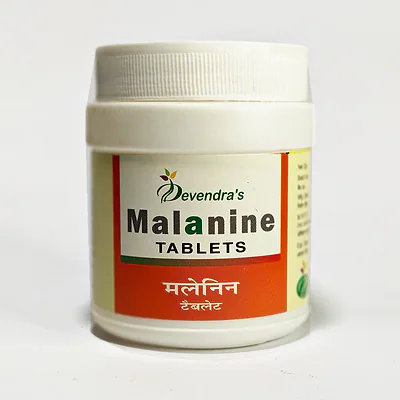
100 Tab: ₹75
Malanin Tablets are built on a concentrated extract of Mahasudarshan churna — Ayurveda's best-known formula for Jwara (fever), led by bitter Chirayata — with Godanti and Shubhra bhasmas, Karanj seed, purified borax and a little Kajjali.
The booklet describes it for old and new fevers with chills, weak digestion, weakness, headache and body ache, and for regaining strength after a fever.
Used for
- Jwara (fever) — traditional use
- Body ache & headache with fever
- Weakness & poor appetite after a fever
What a fever is telling you
Fever is the body raising its thermostat to fight an infection — viral, bacterial or parasitic. In India, a fever with chills can be malaria, dengue or typhoid, which need a blood test and specific treatment; most other fevers settle with rest and fluids.
Ayurveda calls fever Jwara and traces it to Ama: weak digestion lets toxins block the channels, and the displaced digestive fire spreads through the body as heat. Treatment uses bitter herbs (Tikta rasa) that digest Ama and bring the heat down (Jwaraghna), followed by tonics to rebuild strength.
Malanin's traditional approach in 3 parts
- Bitter Antipyretic (Jwaraghna) — Mahasudarshan churna is half Chirayata, whose bitter secoiridoids are antipyretic and hepatoprotective in experimental studies; Karanj is antiplasmodial in the laboratory.
- Cooling & Soothing (Dahaprashamana) — Godanti and Shubhra bhasmas are Ayurveda's classical mineral remedies for feverish heat, headache and body ache; modern research on them is limited.
- Digestion & Recovery (Deepana) — Purified borax and the bitters restore appetite and digestion, which Ayurveda sees as the key to recovering after a fever.
Key ingredients
- Mahasudarshan ghan (Mahasudarshan churna extract) — 200 mg. The concentrated extract of Mahasudarshan churna, Ayurveda's best-known formula for fevers: over fifty herbs led by bitter Chirayata (half the formula). Bitter Swertia compounds such as swertiamarin are its marker constituents.
- Chirayata (Swertia chirayita, whole plant). One of Ayurveda's strongest bitters, for fever, poor appetite and the liver. Its xanthones and secoiridoids (amarogentin, swertiamarin) are hepatoprotective, antipyretic and hypoglycaemic in experimental studies.
- Godanti bhasma (calcined gypsum) — 85 mg. Gypsum heat-processed into anhydrous calcium sulphate. Ayurveda uses Godanti for fever, headache and chronic cough (Jwaraghna, Shirashoolahara) and as a calcium source; laboratory work has characterised the particles, but clinical research is limited.
- Shubhra bhasma (calcined alum) — 75 mg. Another name for calcined alum (Sphatika). A strong astringent that tightens tissue and checks bleeding and discharges; Ayurveda uses it for bleeding piles, heavy periods and leucorrhoea.
- Karanj (Indian beech) (Pongamia pinnata, seed) — 15 mg. Pongam seed and bark, used in Ayurveda for skin disease, wounds, fever and piles. Its furanoflavonoids karanjin and pongamol are anti-inflammatory, antimicrobial and antiplasmodial in experimental studies.
- Tankan bhasma (purified borax) — 40 mg. Borax, heat-dried until it puffs. Ayurveda uses it to liquefy and expel Kapha in cough and asthma and as an emmenagogue. Boron compounds are toxic in excess, so the dose must not be exceeded.
- Kajjali (black mercuric sulphide) — 10 mg. Purified mercury rubbed with purified sulphur into black mercuric sulphide — the base of many Rasa-shastra medicines. Mercuric sulphide is poorly absorbed, but mercury toxicity has been reported, so dose and duration matter.
Full ingredient list
- Mahasudarshan churna ghan satva (concentrated extract of the classical Mahasudarshan churna, led by Chirayata) — 200 mg
- Godanti bhasma (calcined gypsum) — 85 mg
- Shubhra bhasma (calcined alum) — 75 mg
- Karanj giri (Pongamia pinnata, seed) — 15 mg
- Tankan bhasma (purified borax) — 40 mg
- Kajjali (mercury rubbed with sulphur) — 10 mg
How to use
Dose: Adults: 1–2 tablets twice a day, or as directed by the physician.
- Take your dose — The dose above, or the one your physician gives.
- With water — Swallow with water (or milk, where the pack says so).
- Stay consistent — Take it at the same times each day, for the course advised.
Safety & suitability
- Who it's for: Adults; children only as a physician advises (contains Kajjali)
- Pregnancy & nursing: Not advised — see the cautions
- Other medicines: Tell your physician what else you take
- Diabetic?: Sugar-coated tablet — ask your physician
- Storage: Cool, dry place, away from direct sunlight
- Ingredients: See the full list below
Cautions
- A fever with chills, a fever lasting more than 2 days, a very high fever, rash, bleeding, severe headache, confusion or breathlessness needs a doctor and a blood test (malaria, dengue, typhoid). Malanin is not a substitute for antimalarial or antibiotic treatment.
- Contains purified mercury (a traditional Rasa-shastra ingredient) in Kajjali. Take only at the stated dose and for the advised duration, under an Ayurvedic physician; not during pregnancy or breastfeeding, for children, or with kidney disease.
- Contains purified borax (Tankan). Do not exceed the dose, especially in infants and young children.
More information
- Net content: 100 Tab
- Storage: Store below 30 °C in a cool, dry place, in the original pack.
- Country of origin: India
- Manufacturer: Devendra Ayurved Ashram Pvt. Ltd., A-12, Industrial Estate, Sujroo, Muzaffarnagar (U.P.) – 251003. Mfg. Lic. No. A-50/77/94 · GMP-certified company.
References
- Devendra Ayurved Ashram Pvt. Ltd. Vivran Pustika (product guide).
- Kaur P, Gupta RC, Dey A, et al. Validation and quantification of major biomarkers in 'Mahasudarshan Churna'- an ayurvedic polyherbal formulation through high-performance thin-layer chromatography. BMC Complement Med Ther. 2020;20(1):184.
- Swati K, Bhatt V, Sendri N, et al. Swertia chirayita: A comprehensive review on traditional uses, phytochemistry, quality assessment and pharmacology. J Ethnopharmacol. 2023;300:115714.
- Das SK, Joshi A, Bisht L, et al. Godanti bhasma (anhydrous CaSO(4)) induces massive cytoplasmic vacuolation in mammalian cells: A model for phagocytosis assay. Methods. 2024;230:158-168.
- The Ayurvedic Pharmacopoeia of India, Part I (single drugs) and Part II (formulations). Government of India, Ministry of AYUSH.
- Al Muqarrabun LM, Ahmat N, Ruzaina SA, et al. Medicinal uses, phytochemistry and pharmacology of Pongamia pinnata (L.) Pierre: a review. J Ethnopharmacol. 2013;150(2):395-420.
- Singh A, Bhatt G, Gujre N, et al. Karanjin. Phytochemistry. 2021;183:112641.
- Hadrup N, Frederiksen M, Sharma AK. Toxicity of boric acid, borax and other boron containing compounds: A review. Regul Toxicol Pharmacol. 2021;121:104873.
- Siegel E, Wason S. Boric acid toxicity. Pediatr Clin North Am. 1986;33(2):363-7.
- Joshi N, Dash MK, Upadhyay C, et al. Physico-chemical characterization of kajjali, black sulphide of mercury, with respect to the role of sulfur in its formation and structure. J Ayurveda Integr Med. 2021;12(4):590-600.
- Kamath SU, Pemiah B, Sekar RK, et al. Mercury-based traditional herbo-metallic preparations: a toxicological perspective. Arch Toxicol. 2012;86(6):831-8.