Malanin Capsule
Ayurvedic Jwara capsules with Saptaparna, Kalmegh and Giloy
Classical fever herbs in a capsule — after the blood test, not instead of it.
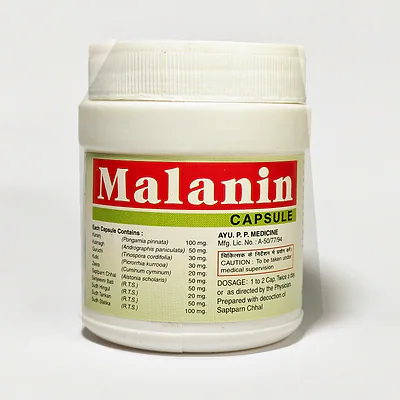
100 Cap: ₹140
Malanin Capsules combine Ayurveda's bitter fever herbs — Karanj, Saptaparna (devil's tree bark), Kalmegh, Giloy and Kutki — with cumin, the classical Sanjeevani vati, purified alum and borax and a little Shuddh hingul, processed in Saptaparna bark.
The booklet calls the formula antipyretic and lists it for intermittent and chilly fevers, fevers of one or two doshas, and back pain.
Used for
- Jwara (fever) — traditional use
- Body ache & back pain with fever
- Weakness after a fever
What a fever is telling you
Fever is the body raising its thermostat to fight an infection. In India, a fever with chills can be malaria, dengue or typhoid, which need a blood test and specific treatment; most other fevers settle with rest and fluids.
Ayurveda traces Jwara to Ama blocking the channels and displacing the digestive fire through the body as heat. Bitter (Tikta) herbs digest the Ama and bring the heat down (Jwaraghna); Rasayanas such as Giloy then rebuild strength.
Malanin's traditional approach in 3 parts
- Bitter Antipyretic (Jwaraghna) — Saptaparna's indole alkaloids are antipyretic in experimental studies, and Karanj's karanjin and pongamol are antiplasmodial in the laboratory.
- Immune & Liver Support (Rasayana) — Giloy is immunomodulatory and antipyretic in experimental studies, and Kalmegh's andrographolide and Kutki's picrosides protect the liver.
- Digestion (Deepana-Pachana) — Cumin and the classical Sanjeevani vati kindle digestion and clear Ama, which Ayurveda sees as the root of fever.
Key ingredients
- Karanj (Indian beech) (Pongamia pinnata, seed) — 100 mg. Pongam seed and bark, used in Ayurveda for skin disease, wounds, fever and piles. Its furanoflavonoids karanjin and pongamol are anti-inflammatory, antimicrobial and antiplasmodial in experimental studies.
- Saptaparna (Devil's tree) (Alstonia scholaris, stem bark) — 50 mg. A bitter bark long used in India and Southeast Asia for fever, including malarial fever. Its indole alkaloids (such as echitamine) are antipyretic and anti-inflammatory in experimental studies.
- Kalmegh (Andrographis paniculata, whole plant) — 50 mg. The 'king of bitters'. Its diterpene andrographolide protects liver cells by curbing oxidative stress and inflammation (NF-κB and Nrf2 pathways) and increased bile flow in animal studies — more potently than silymarin. Ayurveda uses it for Kamala and poor appetite.
- Giloy (Guduchi) (Tinospora cordifolia, stem) — 30 mg. A Rasayana for chronic fever and immunity. Its polysaccharides, alkaloids and diterpenoids are immunomodulatory, antipyretic and anti-inflammatory in experimental studies. Rare liver injury has been reported, possibly from mis-identified Tinospora species.
- Kutki (Katuki) (Picrorhiza kurroa, rhizome) — 30 mg. A Himalayan bitter for the liver and Kamala (jaundice). Its iridoid glycosides (picroside I and II, kutkoside) are hepatoprotective, choleretic and anti-inflammatory in experimental studies.
- Sanjeevani vati — 50 mg. A classical Ayurvedic tablet for fever, indigestion and cholera-like illness. It contains purified Vatsanabha (aconite) and Bhallataka (marking nut) — potent ingredients that are safe only in small, processed doses.
- Hingul (purified cinnabar) — 20 mg. Natural cinnabar (mercuric sulphide), purified. Cinnabar is far less absorbed than other mercury compounds, but mercury can still accumulate, mainly in the kidneys, so it is used only in small doses for short periods.
- Tankan bhasma (purified borax) — 50 mg. Borax, heat-dried until it puffs. Ayurveda uses it to liquefy and expel Kapha in cough and asthma and as an emmenagogue. Boron compounds are toxic in excess, so the dose must not be exceeded.
Full ingredient list
- Karanj (Pongamia pinnata, seed) — 100 mg
- Kalmegh (Andrographis paniculata, whole plant) — 50 mg
- Guduchi (Tinospora cordifolia, stem) — 30 mg
- Kutki (Picrorhiza kurroa, rhizome) — 30 mg
- Jeera (Cuminum cyminum, fruit) — 20 mg
- Saptaparna chhal (Alstonia scholaris, stem bark) — 50 mg
- Sanjeevani vati (classical tablet of Vidanga, Trikatu, Triphala, Vacha, Guduchi, purified Bhallataka and Vatsanabha) — 50 mg
- Shuddh hingul (purified cinnabar, mercuric sulphide) — 20 mg
- Shuddh tankan (purified borax) — 50 mg
- Shuddh sphatika (calcined alum) — 100 mg
Processed (bhavana) in
- Saptaparna chhal (Alstonia scholaris, stem bark)
How to use
Dose: 1–2 capsules twice a day with water, or as directed by the physician.
- Take your dose — The dose above, or the one your physician gives.
- With water — Swallow with water (or milk, where the pack says so).
- Stay consistent — Take it at the same times each day, for the course advised.
Safety & suitability
- Who it's for: Adults
- Pregnancy & nursing: Not advised — see the cautions
- Other medicines: Tell your physician what else you take
- Diabetic?: Check the label and ask your physician
- Storage: Cool, dry place, away from direct sunlight
- Ingredients: See the full list below
Cautions
- A fever with chills, a fever lasting more than 2 days, a very high fever, rash, bleeding, severe headache, confusion or breathlessness needs a doctor and a blood test (malaria, dengue, typhoid). Malanin is not a substitute for antimalarial or antibiotic treatment.
- Contains purified mercury (a traditional Rasa-shastra ingredient) in Hingul. Take only at the stated dose and for the advised duration, under an Ayurvedic physician; not during pregnancy or breastfeeding, for children, or with kidney disease.
- Contains purified borax (Tankan). Do not exceed the dose, especially in infants and young children.
- Contains Sanjeevani vati, which includes purified Vatsanabha (aconite) and Bhallataka (marking nut). Never exceed the dose; not for children or during pregnancy; stop and seek help if you feel tingling of the mouth, palpitations or vomiting.
More information
- Net content: 100 Cap
- Storage: Store below 30 °C in a cool, dry place, in the original pack.
- Country of origin: India
- Manufacturer: Devendra Ayurved Ashram Pvt. Ltd., A-12, Industrial Estate, Sujroo, Muzaffarnagar (U.P.) – 251003. Mfg. Lic. No. A-50/77/94 · GMP-certified company.
References
- Devendra Ayurved Ashram Pvt. Ltd. Vivran Pustika (product guide).
- Al Muqarrabun LM, Ahmat N, Ruzaina SA, et al. Medicinal uses, phytochemistry and pharmacology of Pongamia pinnata (L.) Pierre: a review. J Ethnopharmacol. 2013;150(2):395-420.
- Singh A, Bhatt G, Gujre N, et al. Karanjin. Phytochemistry. 2021;183:112641.
- Khyade MS, Kasote DM, Vaikos NP. Alstonia scholaris (L.) R. Br. and Alstonia macrophylla Wall. ex G. Don: A comparative review on traditional uses, phytochemistry and pharmacology. J Ethnopharmacol. 2014;153(1):1-18.
- Qin X, Wang X, Tian M, et al. The role of Andrographolide in the prevention and treatment of liver diseases. Phytomedicine. 2023;109:154537.
- Shukla B, Visen PK, Patnaik GK, et al. Choleretic effect of andrographolide in rats and guinea pigs. Planta Med. 1992;58(2):146-9.
- Yates CR, Bruno EJ, Yates MED. Tinospora Cordifolia: A review of its immunomodulatory properties. J Diet Suppl. 2022;19(2):271-285.
- Kumar P, Kamle M, Mahato DK, et al. Tinospora cordifolia (Giloy): Phytochemistry, Ethnopharmacology, Clinical Application and Conservation Strategies. Curr Pharm Biotechnol. 2020;21(12):1165-1175.
- Philips CA, Theruvath AH. A comprehensive review on the hepatotoxicity of herbs used in the Indian (Ayush) systems of alternative medicine. Medicine (Baltimore). 2024;103(16):e37903.
- Panneer Selvam K, Payyappallimana U, Ravikumar K, et al. Can Guduchi (Tinospora cordifolia), a well-known ayurvedic hepato-protectant cause liver damage?. J Ayurveda Integr Med. 2023;14(1):100658.
- Almeleebia TM, Alsayari A, Wahab S. Pharmacological and Clinical Efficacy of Picrorhiza kurroa and Its Secondary Metabolites: A Comprehensive Review. Molecules. 2022;27(23).
- Liu J, Shi JZ, Yu LM, et al. Mercury in traditional medicines: is cinnabar toxicologically similar to common mercurials?. Exp Biol Med (Maywood). 2008;233(7):810-7.
- Kamath SU, Pemiah B, Sekar RK, et al. Mercury-based traditional herbo-metallic preparations: a toxicological perspective. Arch Toxicol. 2012;86(6):831-8.
- Hadrup N, Frederiksen M, Sharma AK. Toxicity of boric acid, borax and other boron containing compounds: A review. Regul Toxicol Pharmacol. 2021;121:104873.
- Siegel E, Wason S. Boric acid toxicity. Pediatr Clin North Am. 1986;33(2):363-7.