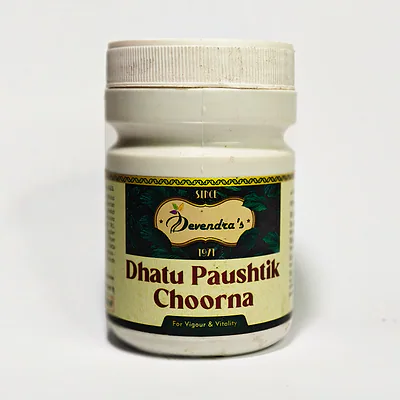
Dhatu Paushtik Choorn
Ayurvedic Dhatu-nourishing powder for strength and vigour
When the body feels drained, it needs rebuilding from the inside.
100 g: ₹150 · 1000 g: ₹1,350
Dhatu Paushtik Choorn is a classical-style Ayurvedic powder from the Ayurveda Sara Sangraha: sixteen nourishing and strengthening herbs in equal parts — Shatavari, Gokshura, Bala seed, Banslochan, Kabab chini, China root, Kaunch beej, white and black musli, Trikatu, Salab, Vidarikand and Ashwagandha — with Nishoth and Mishri.
The jar says it removes bodily weakness and Dhatu complaints and increases vigour (Sphurti). It is taken with milk.
Used for
- Weakness & low vigour (Daurbalya)
- Tissue depletion (Dhatu-kshaya)
- Building strength (Balya, Brimhana)
Why the body runs down
Weakness follows when the body uses more than it takes in — after illness, with poor appetite or digestion, long-term stress, overwork or ageing — and muscle, stamina and drive are the first to go.
Ayurveda calls this Dhatu-kshaya, the depletion of the seven body tissues, and treats it with Brimhana: sweet, nourishing herbs given with milk to rebuild them, with digestive spices so they are absorbed and a gentle purgative to keep the channels clear.
Dhatu Paushtik works in 3 ways
- Adaptogen & Strength (Balya) — Ashwagandha improved muscle strength and lowered stress in meta-analyses of randomised trials, and Shatavari and Safed musli are adaptogenic in experimental studies.
- Nourishing Rasayana (Brimhana) — Vidarikand, Salab and the muslis are Ayurveda's sweet, building roots, and Kaunch beej improved semen quality in randomised trials in men.
- Digestion & Clear Channels (Deepana, Anulomana) — Trikatu kindles digestion and raises absorption, and Nishoth keeps the bowels moving so heavy tonics don't sit undigested.
Key ingredients
- Ashwagandha (Withania somnifera, root) — 0.238 g. Ayurveda's best-known Balya-Rasayana. In randomised trials ashwagandha root extract lowered perceived stress and cortisol and improved sleep and muscle strength; its withanolides are the main active constituents.
- Shatavari (Asparagus racemosus, root) — 0.238 g. Ayurveda's chief Rasayana for women. Its steroidal saponins (shatavarins) are adaptogenic, immunomodulatory and anti-ulcer in experimental studies, and it is traditionally used to support milk supply.
- Kaunch beej (Velvet bean) (Mucuna pruriens, seed) — 0.238 g. Ayurveda's classic seed for strength and male vitality. It is a natural source of L-DOPA; in randomised trials reviewed systematically it improved semen parameters in infertile men, and it is antioxidant in laboratory studies.
- Safed musli (Chlorophytum borivilianum, root) — 0.238 g. A prized Indian tonic root, rich in saponins and polysaccharides. Reviews describe adaptogenic, immunomodulatory and aphrodisiac activity, mostly from animal studies.
- Kali musli (Curculigo orchioides, root) — 0.238 g. Black musli, an Ayurvedic and Chinese tonic for weakness and the reproductive system. Its phenolic glycosides (curculigoside) are antioxidant and protected sperm production in a heat-stress mouse model.
- Vidarikand (Pueraria tuberosa, tuber) — 0.238 g. A sweet, nourishing tuber Ayurveda uses to build strength and weight and as a galactagogue. Its isoflavones (puerarin, daidzein) are antioxidant and cardioprotective in experimental studies.
- Gokhru (Gokshura) (Tribulus terrestris, fruit) — 0.238 g. Ayurveda's chief herb for the urinary tract (Mutrala) and a reproductive tonic. Its saponins (protodioscin) and flavonoids are diuretic and anti-urolithic in animal studies; human evidence is limited.
- Chopchini (China root) (Smilax china, root) — 0.238 g. China root, a Unani and Ayurvedic blood purifier for skin disease and joint pain. Its flavonoids and saponins are anti-inflammatory and antioxidant in experimental studies.
- Nisoth (Trivrit) (Operculina turpethum, root) — 1.431 g. Turpeth root, Ayurveda's preferred purgative for clearing Pitta and accumulated stool. Its resin glycosides (turpethins) are the purgative principle; in laboratory studies the extract also relaxed intestinal and airway smooth muscle.
Full ingredient list
- Shatawari (Asparagus racemosus, root) — 0.238 g
- Gokshru (Tribulus terrestris, fruit) — 0.238 g
- Beejband (Sida cordifolia, seed) — 0.238 g
- Banslochan (bamboo silica) (Bambusa arundinacea, siliceous concretion) — 0.238 g
- Kabab chini (Piper cubeba, fruit) — 0.238 g
- Chop chini (Smilax china, root) — 0.238 g
- Kaunch beej (Mucuna pruriens, seed) — 0.238 g
- Safed musli (Chlorophytum borivilianum, root) — 0.238 g
- Kali musli (Curculigo orchioides, root) — 0.238 g
- Sonth (Zingiber officinale, rhizome) — 0.238 g
- Kalimirch (Piper nigrum, fruit) — 0.238 g
- Pipal (Piper longum, fruit) — 0.238 g
- Salab mishri (Eulophia campestris, tuber) — 0.238 g
- Gatta (Salab) (Orchis latifolia, tuber) — 0.238 g
- Bidarikand (Pueraria tuberosa, tuber) — 0.238 g
- Ashwagandha (Withania somnifera, root) — 0.238 g
- Nishoth (Operculina turpethum, root) — 1.431 g
- Misri (rock sugar) — 4.761 g
How to use
Dose: 6–12 g twice a day with milk, or as directed by the physician.
- Measure — Take the dose with a clean, dry spoon.
- Mix — Take it with water or milk, as the pack or your physician advises.
- With meals — Usually after meals, or as directed.
Safety & suitability
- Who it's for: Adults
- Pregnancy & nursing: Not advised — see the cautions
- Other medicines: Tell your physician what else you take
- Diabetic?: Contains sugar (about 3–6 g per dose) — ask your physician
- Storage: Cool, dry place, away from direct sunlight
- Ingredients: See the full list below
Cautions
- Contains Nishoth, a purgative root: start at the lower dose; reduce it if your stools become loose. Not during pregnancy.
- Contains sugar (about 3–6 g per dose) — people with diabetes should ask their physician first.
More information
- Net content: 100 g · 1000 g
- Storage: Keep the jar tightly closed in a cool, dry place. Use a clean, dry spoon.
- Country of origin: India
- Manufacturer: Devendra Ayurved Ashram Pvt. Ltd., A-12, Industrial Estate, Sujroo, Muzaffarnagar (U.P.) – 251003. Mfg. Lic. No. A-50/77/94 · GMP-certified company.
References
- Akhgarjand C, Asoudeh F, Bagheri A, et al. Does Ashwagandha supplementation have a beneficial effect on the management of anxiety and stress? A systematic review and meta-analysis of randomized controlled trials. Phytother Res. 2022;36(11):4115-4124.
- Bonilla DA, Moreno Y, Gho C, et al. Effects of Ashwagandha (Withania somnifera) on Physical Performance: Systematic Review and Bayesian Meta-Analysis. J Funct Morphol Kinesiol. 2021;6(1).
- Fatima K, Malik J, Muskan F, et al. Safety and efficacy of Withania somnifera for anxiety and insomnia: Systematic review and meta-analysis. Hum Psychopharmacol. 2024;39(6):e2911.
- Singh R. Asparagus racemosus: a review on its phytochemical and therapeutic potential. Nat Prod Res. 2016;30(17):1896-908.
- Singh N, Garg M, Prajapati P, et al. Adaptogenic property of Asparagus racemosus: Future trends and prospects. Heliyon. 2023;9(4):e14932.
- Lampariello LR, Cortelazzo A, Guerranti R, et al. The Magic Velvet Bean of Mucuna pruriens. J Tradit Complement Med. 2012;2(4):331-9.
- Roozbeh N, Amirian A, Abdi F, et al. A Systematic Review on Use of Medicinal Plants for Male Infertility Treatment. J Family Reprod Health. 2021;15(2):74-81.
- Khanam Z, Singh O, Singh R, et al. Safed musli (Chlorophytum borivilianum): a review of its botany, ethnopharmacology and phytochemistry. J Ethnopharmacol. 2013;150(2):421-41.
- Chauhan NS, Sharma V, Thakur M, et al. Curculigo orchioides: the black gold with numerous health benefits. Zhong Xi Yi Jie He Xue Bao. 2010;8(7):613-23.
- Bui-Le TN, Hoang-Tan Q, Hoang-Viet H, et al. Protective Effect of Curculigo orchioides Gaertn. Extract on Heat Stress-Induced Spermatogenesis Complications in Murine Model. Curr Issues Mol Biol. 2023;45(4):3255-3267.
- Bharti R, Chopra BS, Raut S, et al. Pueraria tuberosa: A Review on Traditional Uses, Pharmacology, and Phytochemistry. Front Pharmacol. 2020;11:582506.
- Ștefănescu R, Tero-Vescan A, Negroiu A, et al. A Comprehensive Review of the Phytochemical, Pharmacological, and Toxicological Properties of Tribulus terrestris L. Biomolecules. 2020;10(5).
- Wang M, Bai QX, Zheng XX, et al. Smilax china L.: A review of its botany, ethnopharmacology, phytochemistry, pharmacological activities, actual and potential applications. J Ethnopharmacol. 2024;318(Pt B):116992.
- Gupta S, Ved A. Operculina turpethum (Linn.) Silva Manso as a Medicinal Plant Species: A Review on Bioactive Components and Pharmacological Properties. Pharmacogn Rev. 2017;11(22):158-166.
- Shareef H, Rizwani GH, Mandukhail SR, et al. Studies on antidiarrhoeal, antispasmodic and bronchodilator activities of Operculina turpethum Linn. BMC Complement Altern Med. 2014;14:479.