Welabrain Syrup
Ayurvedic brain-tonic syrup for memory, focus and calm
A busy mind needs nourishing too.
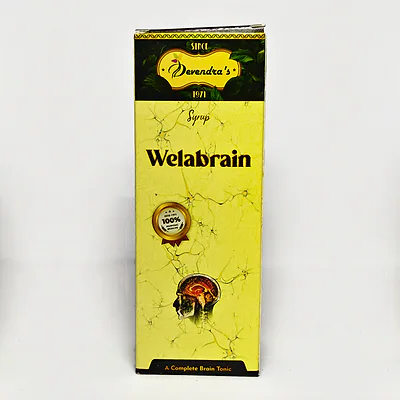
100 mL: ₹90 · 200 mL: ₹180
Welabrain is an Ayurvedic Medhya Rasayana syrup — a tonic for the mind. Every 16 mL carries 1 g of Shankhpushpi with Brahmi and Ashwagandha (500 mg each), Jatamansi and Kooth, and a little Bach, as an ark (distillate).
The pack calls it Buddhivardhaka and Shaktivardhaka: promoting intellect and strength.
Used for
- Memory & concentration (Medhya)
- Mental fatigue & stress
- Restless mind & poor sleep
- Exam-time support
Why the mind gets foggy
Memory and focus depend on sleep, stress levels, nutrition and how much the brain is asked to juggle. Chronic stress floods the body with cortisol, which disturbs sleep and makes it harder to concentrate and remember; poor sleep then makes the next day harder still.
Ayurveda describes three faculties of the mind — Dhi (learning), Dhriti (retention) and Smriti (recall) — governed by Prana Vata and Sadhaka Pitta and steadied by Tarpaka Kapha. When Vata is disturbed, the mind becomes restless and forgetful. Medhya herbs are the classical way to nourish and steady it.
Welabrain nourishes the mind in 3 ways
- Memory & Cognition (Medhya) — Brahmi improved attention and speed of processing in a meta-analysis of randomised trials, and Shankhpushpi is memory-enhancing in animal studies, with a few small clinical studies.
- Stress Relief & Calm (Manasa-shamaka) — Ashwagandha lowered stress and cortisol and improved sleep in meta-analyses of randomised trials; Jatamansi is calming and sleep-promoting in animal studies.
- Neuroprotective & Antioxidant — Bacosides, withanolides and Bach's compounds are antioxidant and neuroprotective in experimental studies, protecting nerve cells from oxidative stress.
Key ingredients
- Shankhpushpi (Convolvulus pluricaulis, whole plant) — 1000 mg. A classical Medhya herb for memory and restful sleep. An umbrella review found memory-enhancing, anxiolytic and neuroprotective effects in animal studies, with a few small clinical studies; its coumarins and flavonoids are antioxidant.
- Brahmi (Bacopa monnieri, whole plant) — 500 mg. Ayurveda's best-known Medhya Rasayana. A meta-analysis of randomised trials found Bacopa extract improved attention and speed of processing; its bacosides are antioxidant and neuroprotective in experimental studies.
- Ashwagandha (Withania somnifera, root) — 500 mg. Ayurveda's best-known Balya-Rasayana. In randomised trials ashwagandha root extract lowered perceived stress and cortisol and improved sleep and muscle strength; its withanolides are the main active constituents.
- Jatamansi (Nardostachys jatamansi, rhizome) — 250 mg. A Himalayan rhizome Ayurveda uses for anxiety, insomnia and headache. Its sesquiterpenes (jatamansone) are sedative, anxiolytic and antioxidant in animal studies.
- Kooth (Kushtha) (Saussurea lappa, root) — 250 mg. Used for asthma and cough in several traditional systems. Its sesquiterpene lactones — costunolide and dehydrocostus lactone — are anti-inflammatory in experimental models.
- Vacha (Bach) (Acorus calamus, rhizome) — 62.5 mg. A pungent rhizome Ayurveda uses for speech, memory and Kapha in the chest. It is anticonvulsant, neuroprotective and antispasmodic in experimental studies; its β-asarone limits long-term use.
Full ingredient list
Distillate (ark) of
- Shankh Pushpi (Convolvulus pluricaulis, whole plant) — 1000 mg
- Ashwagandha (Withania somnifera, root) — 500 mg
- Brahmi (Bacopa monnieri, whole plant) — 500 mg
- Kooth (Saussurea lappa, root) — 250 mg
- Jatamansi (Nardostachys jatamansi, rhizome) — 250 mg
- Bach (Acorus calamus, rhizome) — 62.5 mg
- Chini (sugar) — 8 g
- Colour (approved red) — q.s.
- Essence (sweet orange) — q.s.
- Preservative (as per Drug Act) — q.s.
How to use
Dose: 5–15 mL twice a day with water, or as directed by the physician.
- Shake well — Shake the bottle before each dose.
- Measure the dose — Use the measuring cap — the dose above, or the one your physician gives.
- Keep a routine — Take it at the same times each day, for as long as advised.
Safety & suitability
- Who it's for: Adults; children only at the dose a physician sets
- Pregnancy & nursing: Ask your physician before use
- Other medicines: Tell your physician what else you take
- Diabetic?: Contains sugar (8 g per 16 mL) — ask your physician
- Storage: Cool, dry place, away from direct sunlight
- Ingredients: See the full list below
Cautions
- Memory loss, confusion or a sudden change in thinking in an older person needs a doctor's assessment.
- Contains Bach (Acorus calamus): keep to the stated dose and do not use for long periods without a physician.
- Contains sugar (8 g per 16 mL) — people with diabetes should ask their physician first.
- Do not use if any precipitate, fungus or foreign particle is found — replace the bottle.
More information
- Net content: 100 mL · 200 mL
- Storage: Keep in a cool, dry place away from direct sunlight. Close the cap tightly after use.
- Country of origin: India
- Manufacturer: Devendra Ayurved Ashram Pvt. Ltd., A-12, Industrial Estate, Sujroo, Muzaffarnagar (U.P.) – 251003. Mfg. Lic. No. A-50/77/94 · GMP-certified company.
References
- Sharma R, Singla RK, Banerjee S, et al. Role of Shankhpushpi (Convolvulus pluricaulis) in neurological disorders: An umbrella review covering evidence from ethnopharmacology to clinical studies. Neurosci Biobehav Rev. 2022;140:104795.
- Kongkeaw C, Dilokthornsakul P, Thanarangsarit P, et al. Meta-analysis of randomized controlled trials on cognitive effects of Bacopa monnieri extract. J Ethnopharmacol. 2014;151(1):528-35.
- Akhgarjand C, Asoudeh F, Bagheri A, et al. Does Ashwagandha supplementation have a beneficial effect on the management of anxiety and stress? A systematic review and meta-analysis of randomized controlled trials. Phytother Res. 2022;36(11):4115-4124.
- Bonilla DA, Moreno Y, Gho C, et al. Effects of Ashwagandha (Withania somnifera) on Physical Performance: Systematic Review and Bayesian Meta-Analysis. J Funct Morphol Kinesiol. 2021;6(1).
- Fatima K, Malik J, Muskan F, et al. Safety and efficacy of Withania somnifera for anxiety and insomnia: Systematic review and meta-analysis. Hum Psychopharmacol. 2024;39(6):e2911.
- Pathak S, Godela R. Nardostachys jatamansi: Phytochemistry, ethnomedicinal uses, and pharmacological activities: A comprehensive review. Fitoterapia. 2024;172:105764.
- Pandey MM, Rastogi S, Rawat AK. Saussurea costus: botanical, chemical and pharmacological review of an ayurvedic medicinal plant. J Ethnopharmacol. 2007;110(3):379-90.
- Sharma V, Sharma R, Gautam DS, et al. Role of Vacha (Acorus calamus Linn.) in Neurological and Metabolic Disorders: Evidence from Ethnopharmacology, Phytochemistry, Pharmacology and Clinical Study. J Clin Med. 2020;9(4).
- Rajput SB, Tonge MB, Karuppayil SM. An overview on traditional uses and pharmacological profile of Acorus calamus Linn. (Sweet flag) and other Acorus species. Phytomedicine. 2014;21(3):268-76.