Vednamrit Tablet
Ayurvedic tablets for headache, toothache and cold aches
Vedana means pain; amrit, nectar. Relief for the aches that come with colds and chills.
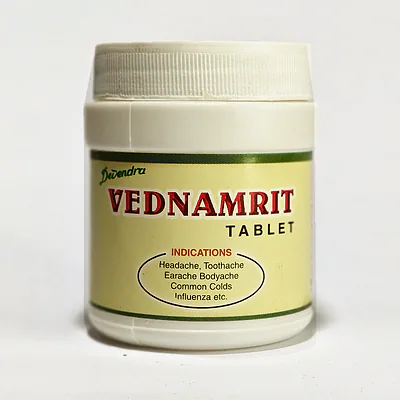
100 Tab: ₹70
Vednamrit — 'nectar for pain' — is an Ayurvedic analgesic built on Godanti and Shubhra bhasmas with purified borax, Shring bhasma (calcined deer horn), Narsar, Swarna gairik, black pepper, long pepper and long-pepper root.
The booklet lists it for coryza, cold, cough, flu, headache and toothache, with feverishness; the details file adds body ache and earache.
Used for
- Headache & toothache
- Body ache & earache
- Cold, cough & flu aches
Why colds bring aches
A viral cold or flu sets off inflammation throughout the body: prostaglandins and cytokines sensitise pain nerves, so the head, teeth, ears and muscles ache, and the blocked sinuses add pressure.
Ayurveda sees these aches as Vata pain with Kapha congestion and, in fever, Pitta heat. Cooling mineral preparations relieve the heat and pain, while pungent spices and Narsar loosen Kapha.
Vednamrit works in 3 ways
- Cooling Analgesic (Vedanasthapana) — Godanti and Shubhra bhasmas are Ayurveda's classical remedies for headache, body ache and feverish heat; modern research on them is limited.
- Expectorant (Kaphanissaraka) — Narsar is a classical saline expectorant, and purified borax and black pepper help loosen Kapha in coughs and colds.
- Warming & Digestive (Deepana) — Black pepper, long pepper and its root are warming and anti-inflammatory; piperine stimulates digestion in experimental studies.
Key ingredients
- Godanti bhasma (calcined gypsum) — 250 mg. Gypsum heat-processed into anhydrous calcium sulphate. Ayurveda uses Godanti for fever, headache and chronic cough (Jwaraghna, Shirashoolahara) and as a calcium source; laboratory work has characterised the particles, but clinical research is limited.
- Shubhra bhasma (calcined alum) — 150 mg. Another name for calcined alum (Sphatika). A strong astringent that tightens tissue and checks bleeding and discharges; Ayurveda uses it for bleeding piles, heavy periods and leucorrhoea.
- Tankan bhasma (purified borax) — 50 mg. Borax, heat-dried until it puffs. Ayurveda uses it to liquefy and expel Kapha in cough and asthma and as an emmenagogue. Boron compounds are toxic in excess, so the dose must not be exceeded.
- Narsar (ammonium chloride) — 60 mg. A classical 'saline expectorant', thought to act by a reflex from the stomach that increases airway secretions and thins phlegm. It is the standard reference expectorant in animal studies; clinical evidence in people is limited.
- Kali mirch (Black pepper) (Piper nigrum, fruit) — 60 mg. Its alkaloid piperine stimulates pancreatic digestive enzymes and shortens food transit time in experimental studies, and famously raises the absorption of other compounds by slowing their breakdown in the gut wall and liver.
- Pippalimool (Long pepper root) (Piper longum, root) — 100 mg. Long-pepper root, a classical Deepana-Pachana herb that Ayurveda uses to kindle digestion, settle Vata and ease pain. Like the fruit it carries piperine, which stimulates digestive enzymes and is anti-inflammatory in experimental studies.
- Swarna gairik (red ochre) — 60 mg. A purified natural iron-oxide earth (haematite-rich ochre). Ayurveda counts it cooling and uses it for acidity, burning sensations, vomiting and bleeding; modern research on its effects is limited.
Full ingredient list
- Godanti bhasma (calcined gypsum) — 250 mg
- Shubhra bhasma (calcined alum) — 150 mg
- Tankan bhasma (purified borax) — 50 mg
- Shring bhasma (calcined deer horn) — 20 mg
- Peeplamool (Piper longum, root) — 100 mg
- Peepal (Piper longum, fruit) — 50 mg
- Swarna gairik (purified red ochre) — 60 mg
- Mirch kali (Piper nigrum, fruit) — 60 mg
- Narsar (ammonium chloride) — 60 mg
How to use
Dose: 1–2 tablets two to three times a day, or as directed by the physician.
- Take your dose — The dose above, or the one your physician gives.
- With water — Swallow with water (or milk, where the pack says so).
- Stay consistent — Take it at the same times each day, for the course advised.
Safety & suitability
- Who it's for: Adults; children only at the dose a physician sets
- Pregnancy & nursing: Ask your physician before use
- Other medicines: Tell your physician what else you take
- Diabetic?: Check the label and ask your physician
- Storage: Cool, dry place, away from direct sunlight
- Ingredients: See the full list below
Cautions
- Breathlessness, chest pain, a high or lasting fever, or a severe headache needs a doctor.
- Contains purified borax (Tankan). Do not exceed the dose, especially in infants and young children.
More information
- Net content: 100 Tab
- Storage: Store below 30 °C in a cool, dry place, in the original pack.
- Country of origin: India
- Manufacturer: Devendra Ayurved Ashram Pvt. Ltd., A-12, Industrial Estate, Sujroo, Muzaffarnagar (U.P.) – 251003. Mfg. Lic. No. A-50/77/94 · GMP-certified company.
References
- Devendra Ayurved Ashram Pvt. Ltd. Vivran Pustika (product guide).
- Das SK, Joshi A, Bisht L, et al. Godanti bhasma (anhydrous CaSO(4)) induces massive cytoplasmic vacuolation in mammalian cells: A model for phagocytosis assay. Methods. 2024;230:158-168.
- The Ayurvedic Pharmacopoeia of India, Part I (single drugs) and Part II (formulations). Government of India, Ministry of AYUSH.
- Hadrup N, Frederiksen M, Sharma AK. Toxicity of boric acid, borax and other boron containing compounds: A review. Regul Toxicol Pharmacol. 2021;121:104873.
- Siegel E, Wason S. Boric acid toxicity. Pediatr Clin North Am. 1986;33(2):363-7.
- Liu W, Wang Y, He DD, et al. Antitussive, expectorant, and bronchodilating effects of quinazoline alkaloids (±)-vasicine, deoxyvasicine, and (±)-vasicinone from aerial parts of Peganum harmala L. Phytomedicine. 2015;22(12):1088-95.
- Srinivasan K. Black pepper and its pungent principle-piperine: a review of diverse physiological effects. Crit Rev Food Sci Nutr. 2007;47(8):735-48.
- Biswas P, Ghorai M, Mishra T, et al. Piper longum L.: A comprehensive review on traditional uses, phytochemistry, pharmacology, and health-promoting activities. Phytother Res. 2022;36(12):4425-4476.