Vardhak Capsule
Ayurvedic strength and stamina capsules with 31 classical herbs
Thirty-one of Ayurveda's strength herbs, packed into one capsule.
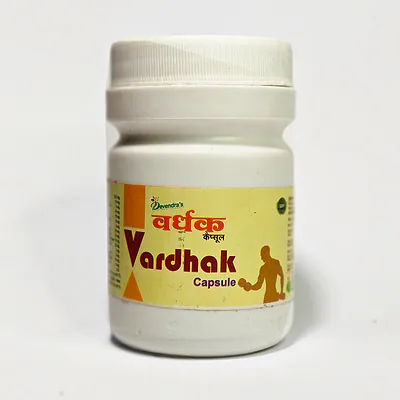
100 Cap: ₹250
Vardhak ('the one that builds up') is an Ayurvedic Rasayana capsule for Dhatu-kshaya — depletion of the body's tissues and strength. It combines Ashwagandha, Shatavari, Kaunch beej, white and black musli, Vidarikand, Vidhara and Talmakhana with Shankhpushpi and Brahmdandi for the nerves, gums and fibres such as Isabgol and Palash gum, and small amounts of purified Shilajit and mineral bhasmas.
The label says these herbs relieve Dhatu depletion and strengthen the heart and brain.
Used for
- Low strength & stamina (Balya)
- Weakness & tissue depletion (Dhatu-kshaya)
- Nervous exhaustion (Medhya)
Why strength fades
Strength and stamina depend on muscle, healthy hormones, good sleep and enough fuel. Long-term stress, poor sleep, illness, poor diet and age chip away at all of them, and fatigue follows.
Ayurveda describes seven Dhatus — tissues from plasma (Rasa) to reproductive tissue (Shukra) — each nourishing the next. When digestion weakens or Vata runs high, the later Dhatus are starved (Dhatu-kshaya) and Ojas, the essence of vitality, declines. Rasayana and Balya herbs aim to rebuild them.
Vardhak restores in 3 ways
- Adaptogen & Strength (Balya, Rasayana) — Ashwagandha improved muscle strength and lowered stress in meta-analyses of randomised trials; Shatavari and Safed musli are adaptogenic in experimental studies.
- Reproductive Vitality (Shukra-dhatu) — Kaunch beej — a natural source of L-DOPA — improved semen quality in randomised trials in men, and Shilajit improved sperm counts and reduced fatigue in human and animal studies.
- Nerve & Mind Support (Medhya) — Shankhpushpi is memory-enhancing and calming in animal studies, and Brahmdandi and Utangan are traditional nerve tonics.
Key ingredients
- Ashwagandha (Withania somnifera, root) — 50 mg. Ayurveda's best-known Balya-Rasayana. In randomised trials ashwagandha root extract lowered perceived stress and cortisol and improved sleep and muscle strength; its withanolides are the main active constituents.
- Shatavari (Asparagus racemosus, tuberous root) — 50 mg. Ayurveda's chief Rasayana for women. Its steroidal saponins (shatavarins) are adaptogenic, immunomodulatory and anti-ulcer in experimental studies, and it is traditionally used to support milk supply.
- Kaunch beej (Velvet bean) (Mucuna pruriens, seed) — 30 mg. Ayurveda's classic seed for strength and male vitality. It is a natural source of L-DOPA; in randomised trials reviewed systematically it improved semen parameters in infertile men, and it is antioxidant in laboratory studies.
- Safed musli (Chlorophytum borivilianum, tuberous root) — 15 mg. A prized Indian tonic root, rich in saponins and polysaccharides. Reviews describe adaptogenic, immunomodulatory and aphrodisiac activity, mostly from animal studies.
- Kali musli (Curculigo orchioides, rhizome) — 25 mg. Black musli, an Ayurvedic and Chinese tonic for weakness and the reproductive system. Its phenolic glycosides (curculigoside) are antioxidant and protected sperm production in a heat-stress mouse model.
- Vidarikand (Pueraria tuberosa, tuber) — 16.5 mg. A sweet, nourishing tuber Ayurveda uses to build strength and weight and as a galactagogue. Its isoflavones (puerarin, daidzein) are antioxidant and cardioprotective in experimental studies.
- Vidhara (Elephant creeper) (Argyreia nervosa, root) — 25 mg. A classical Rasayana root for strength, joints and the nerves. Its root extract was analgesic and anti-inflammatory in animal studies and improved sperm parameters impaired by diabetes in rats; human research is lacking.
- Talmakhana (Hygrophila auriculata (Asteracantha longifolia), seed) — 27.5 mg. Kokilaksha seeds, an Ayurvedic tonic for strength and the urinary tract. Reviews describe diuretic, antioxidant, haematinic and aphrodisiac activity in experimental studies.
- Shankhpushpi (Convolvulus pluricaulis, whole plant) — 30 mg. A classical Medhya herb for memory and restful sleep. An umbrella review found memory-enhancing, anxiolytic and neuroprotective effects in animal studies, with a few small clinical studies; its coumarins and flavonoids are antioxidant.
- Shilajit — 10 mg. A Himalayan rock exudate rich in fulvic acid and dibenzo-α-pyrones. Animal and human studies indicate antioxidant, anti-inflammatory and adaptogenic effects, improved sperm counts and less fatigue; its safety is well documented when purified.
- Hingul (purified cinnabar) — 5 mg. Natural cinnabar (mercuric sulphide), purified. Cinnabar is far less absorbed than other mercury compounds, but mercury can still accumulate, mainly in the kidneys, so it is used only in small doses for short periods.
Full ingredient list
- Ashwagandha (Withania somnifera) — 50 mg
- Satavar (Asparagus racemosus) — 50 mg
- Bidhara (Argyreia nervosa) — 25 mg
- Lajvanti (Mimosa pudica) — 25 mg
- Talamakhana (Hygrophila auriculata (Asteracantha longifolia)) — 27.5 mg
- Balabeej (Sida cordifolia) — 15 mg
- Imli Beej (Tamarindus indica) — 15 mg
- Konch Beej (Mucuna pruriens) — 30 mg
- Moosli Safed (Chlorophytum borivilianum) — 15 mg
- Kabad Chini (Piper cubeba) — 6.5 mg
- Moosli Kali (Curculigo orchioides) — 25 mg
- Gond Babool (Acacia nilotica) — 6.5 mg
- Palas (Butea monosperma) — 15 mg
- Isabgol (Plantago ovata) — 25 mg
- Banslochan (bamboo silica) (Bambusa arundinacea) — 6.5 mg
- Ilaychi Badi (Amomum subulatum) — 6.5 mg
- Bidarikand (Pueraria tuberosa) — 16.5 mg
- Gangeran — 10 mg
- Guruchi Satva (starch extract of Giloy) (Tinospora cordifolia) — 5 mg
- Mochras (Bombax ceiba) — 10 mg
- Sonth (Zingiber officinale) — 10 mg
- Brahmdandi (Tricholepis glaberrima) — 10 mg
- Kuljnan (Alpinia galanga) — 5 mg
- Shalabpanja (Dactylorhiza hatagirea) — 10 mg
- Moosli Semal (Bombax ceiba) — 10 mg
- Muktashukti Bhasam (pearl oyster shell) — 15 mg
- Shankhpushpi (Convolvulus pluricaulis) — 30 mg
- Utangan (Blepharis edulis) — 5 mg
- Bang Bhasam (processed tin) — 5 mg
- Shudh Shilajeet (purified mineral pitch) — 10 mg
- Shudh Hingul (purified cinnabar, mercuric sulphide) — 5 mg
- Excipients — q.s.
How to use
Dose: 1–2 capsules twice a day, or as directed by the physician.
- Take your dose — The dose above, or the one your physician gives.
- With water — Swallow with water (or milk, where the pack says so).
- Stay consistent — Take it at the same times each day, for the course advised.
Safety & suitability
- Who it's for: Adults
- Pregnancy & nursing: Not advised — see the cautions
- Other medicines: Tell your physician what else you take
- Diabetic?: Check the label and ask your physician
- Storage: Cool, dry place, away from direct sunlight
- Ingredients: See the full list below
Cautions
- Contains purified mercury (a traditional Rasa-shastra ingredient) in Hingul. Take only at the stated dose and for the advised duration, under an Ayurvedic physician; not during pregnancy or breastfeeding, for children, or with kidney disease.
- Contains processed metal or mineral preparations: Bang bhasma. Take only at the stated dose and for the advised duration, under an Ayurvedic physician.
More information
- Net content: 100 Cap
- Storage: Store below 30 °C in a cool, dry place, in the original pack.
- Country of origin: India
- Manufacturer: Devendra Ayurved Ashram Pvt. Ltd., A-12, Industrial Estate, Sujroo, Muzaffarnagar (U.P.) – 251003. Mfg. Lic. No. A-50/77/94 · GMP-certified company.
References
- Akhgarjand C, Asoudeh F, Bagheri A, et al. Does Ashwagandha supplementation have a beneficial effect on the management of anxiety and stress? A systematic review and meta-analysis of randomized controlled trials. Phytother Res. 2022;36(11):4115-4124.
- Bonilla DA, Moreno Y, Gho C, et al. Effects of Ashwagandha (Withania somnifera) on Physical Performance: Systematic Review and Bayesian Meta-Analysis. J Funct Morphol Kinesiol. 2021;6(1).
- Fatima K, Malik J, Muskan F, et al. Safety and efficacy of Withania somnifera for anxiety and insomnia: Systematic review and meta-analysis. Hum Psychopharmacol. 2024;39(6):e2911.
- Singh R. Asparagus racemosus: a review on its phytochemical and therapeutic potential. Nat Prod Res. 2016;30(17):1896-908.
- Singh N, Garg M, Prajapati P, et al. Adaptogenic property of Asparagus racemosus: Future trends and prospects. Heliyon. 2023;9(4):e14932.
- Lampariello LR, Cortelazzo A, Guerranti R, et al. The Magic Velvet Bean of Mucuna pruriens. J Tradit Complement Med. 2012;2(4):331-9.
- Roozbeh N, Amirian A, Abdi F, et al. A Systematic Review on Use of Medicinal Plants for Male Infertility Treatment. J Family Reprod Health. 2021;15(2):74-81.
- Khanam Z, Singh O, Singh R, et al. Safed musli (Chlorophytum borivilianum): a review of its botany, ethnopharmacology and phytochemistry. J Ethnopharmacol. 2013;150(2):421-41.
- Chauhan NS, Sharma V, Thakur M, et al. Curculigo orchioides: the black gold with numerous health benefits. Zhong Xi Yi Jie He Xue Bao. 2010;8(7):613-23.
- Bui-Le TN, Hoang-Tan Q, Hoang-Viet H, et al. Protective Effect of Curculigo orchioides Gaertn. Extract on Heat Stress-Induced Spermatogenesis Complications in Murine Model. Curr Issues Mol Biol. 2023;45(4):3255-3267.
- Bharti R, Chopra BS, Raut S, et al. Pueraria tuberosa: A Review on Traditional Uses, Pharmacology, and Phytochemistry. Front Pharmacol. 2020;11:582506.
- Gori PV, Raval M, Patel S, et al. Argyreia nervosa (Brum.f.) Bojer. alleviates diabetes mellitus-induced male infertility. Mol Biol Rep. 2025;52(1):546.
- Bachhav RS, Gulecha VS, Upasani CD. Analgesic and anti-inflammatory activity of Argyreia speciosa root. Indian J Pharmacol. 2009;41(4):158-61.
- Sethiya NK, Ahmed NM, Shekh RM, et al. Ethnomedicinal, phytochemical and pharmacological updates on Hygrophila auriculata (Schum.) Hiene: an overview. J Integr Med. 2018;16(5):299-311.
- Sharma R, Singla RK, Banerjee S, et al. Role of Shankhpushpi (Convolvulus pluricaulis) in neurological disorders: An umbrella review covering evidence from ethnopharmacology to clinical studies. Neurosci Biobehav Rev. 2022;140:104795.
- Stohs SJ. Safety and efficacy of shilajit (mumie, moomiyo). Phytother Res. 2014;28(4):475-9.
- Agarwal SP, Khanna R, Karmarkar R, et al. Shilajit: a review. Phytother Res. 2007;21(5):401-5.
- Liu J, Shi JZ, Yu LM, et al. Mercury in traditional medicines: is cinnabar toxicologically similar to common mercurials?. Exp Biol Med (Maywood). 2008;233(7):810-7.
- Kamath SU, Pemiah B, Sekar RK, et al. Mercury-based traditional herbo-metallic preparations: a toxicological perspective. Arch Toxicol. 2012;86(6):831-8.