Tephron Plus Capsule
Ayurvedic iron and calcium capsules
Tired, pale and breathless on the stairs? Your blood may be running low on iron.
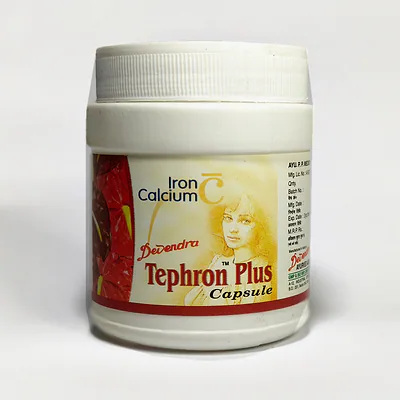
30 Cap: ₹90 · 100 Cap: ₹140
Tephron Plus is an Ayurvedic iron-and-calcium capsule: Kasees bhasma (an Ayurvedic iron preparation) with three calcium-rich preparations — coral (Praval), conch (Shankh) and pearl-oyster shell (Mukta shukti) — and Sarpunkha, a liver and spleen herb.
It is meant for Pandu — the pallor, tiredness and weakness of low blood — and for calcium support.
Used for
- Anaemia & pallor (Pandu)
- Tiredness & weakness
- Calcium support
Why iron runs low
Iron makes haemoglobin, which carries oxygen in red blood cells. Heavy periods, pregnancy, a diet low in iron, poor absorption and hidden bleeding drain the body's stores; when they run out, haemoglobin falls, bringing tiredness, pallor, breathlessness and brittle nails.
Ayurveda calls this Pandu: weak digestion and aggravated Pitta impair the formation of Rakta (blood), so the body turns pale. Classical treatment uses processed iron (Lauha kalpa) with herbs that support the liver and spleen, where Rakta is said to be made.
Tephron Plus works in 3 ways
- Iron (Raktavardhaka) — Kasees bhasma is processed ferrous sulphate; in a small randomised study in iron-deficiency anaemia, 125 mg three times a day for 30 days raised haemoglobin.
- Calcium (Asthi-poshaka) — Praval, Shankh and Mukta shukti are natural calcium carbonate; Ayurveda counts them cooling, and they also neutralise acid, which can settle the stomach upset iron sometimes causes.
- Liver & Spleen Support (Yakrit-pleehahara) — Sarpunkha is Ayurveda's traditional herb for the liver and spleen, hepatoprotective in experimental studies.
Key ingredients
- Kasees bhasma (calcined ferrous sulphate) — 200 mg. Green vitriol (ferrous sulphate) processed into an Ayurvedic iron preparation. In a small randomised study in iron-deficiency anaemia, Kasisa bhasma 125 mg three times a day for 30 days raised haemoglobin.
- Praval pishti (coral powder) — 100 mg. Red coral ground fine with rose water. It is almost pure calcium carbonate; Ayurveda counts it a cooling Pitta-shamaka for acidity, burning, bleeding and calcium needs. Research on it is mainly physicochemical.
- Shankh bhasma (calcined conch shell) — 75 mg. Conch shell calcined by classical Rasa-shastra methods into fine calcium carbonate (calcite). Like any carbonate antacid it neutralises excess stomach acid; Ayurveda uses it for hyperacidity, indigestion and colic (Amlapitta, Parinama shoola).
- Mukta shukti pishti (pearl oyster shell) — 50 mg. Mother-of-pearl shell, calcium carbonate with a little protein. Ayurveda uses it as a cooling antacid for hyperacidity, heartburn and Pitta disorders; research on it is mainly physicochemical.
- Sarpunkha (Tephrosia purpurea, whole plant) — 75 mg. Traditionally used for an enlarged liver and spleen and in Ayurvedic liver preparations. Its flavonoids (quercetin, rutin) and triterpenoids are antioxidant and anti-inflammatory, and its extract lessened arsenic-induced liver damage in rats.
Full ingredient list
- Kasees bhasma (processed green vitriol, ferrous sulphate) — 200 mg
- Praval pishti (coral, levigated in rose water) — 100 mg
- Sarpunkha (Tephrosia purpurea, whole plant) — 75 mg
- Shankh bhasma (calcined conch shell) — 75 mg
- Mukta shukti pishti (pearl oyster shell) — 50 mg
How to use
Dose: 1–2 capsules twice a day, or as directed by the physician.
- Take your dose — The dose above, or the one your physician gives.
- With water — Swallow with water (or milk, where the pack says so).
- Stay consistent — Take it at the same times each day, for the course advised.
Safety & suitability
- Who it's for: Adults; children only at the dose a physician sets
- Pregnancy & nursing: Ask your physician before use
- Other medicines: Tell your physician what else you take
- Diabetic?: No added sugar — ask your physician
- Storage: Cool, dry place, away from direct sunlight
- Ingredients: See the full list below
Cautions
- Have the cause of anaemia checked — especially heavy periods, or any bleeding from the gut — and recheck your haemoglobin after a few weeks.
- Calcium and antacids reduce the absorption of some medicines (for example thyroid tablets and certain antibiotics) — take them at least 2 hours apart.
- Contains processed metal or mineral preparations: Kasees bhasma. Take only at the stated dose and for the advised duration, under an Ayurvedic physician.
- Contains iron: Kasees bhasma. Keep it out of children's reach — an iron overdose is dangerous for children.
More information
- Net content: 30 Cap · 100 Cap
- Storage: Store below 30 °C in a cool, dry place, in the original pack.
- Country of origin: India
- Manufacturer: Devendra Ayurved Ashram Pvt. Ltd., A-12, Industrial Estate, Sujroo, Muzaffarnagar (U.P.) – 251003. Mfg. Lic. No. A-50/77/94 · GMP-certified company.
References
- Snook J, Bhala N, Beales ILP, et al. British Society of Gastroenterology guidelines for the management of iron deficiency anaemia in adults. Gut. 2021;70(11):2030-2051.
- Tubaki BR, Benni JM, Rao N, et al. Effect of Ayurveda Medications (Kasīsa Bhasma and Dhātrī Avaleha) on Iron Deficiency Anaemia: A Randomized Controlled Study. Anc Sci Life. 2016;36(1):48-55.
- Chavan S, Bhuvad S, Gupta V, et al. Industrial manufacturing method and characterization of Ayurvedic marine drugs: mother pearl, cowry, coral and pearl. Drug Dev Ind Pharm. 2024;50(8):721-734.
- Chavan S, Tayade S, Gupta V, et al. Pharmaceutical Standardization and Physicochemical Characterization of Traditional Ayurvedic Marine Drug: Incinerated Conch Shell (Shankha Bhasma). Mar Drugs. 2018;16(11).
- Rao AS, Yadav SS, Singh P, et al. A comprehensive review on ethnomedicine, phytochemistry, pharmacology, and toxicity of Tephrosia purpurea (L.) Pers. Phytother Res. 2020;34(8):1902-1925.
- Gora RH, Baxla SL, Kerketta P, et al. Hepatoprotective activity of Tephrosia purpurea against arsenic induced toxicity in rats. Indian J Pharmacol. 2014;46(2):197-200.