Shishupal Syrup
Ayurvedic digestive tonic for babies and young children
Good digestion is how little ones grow. Shishupal keeps it on track.
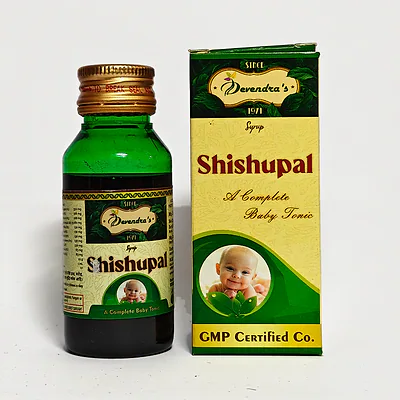
60 mL: ₹50 · 100 mL: ₹75
Shishupal is an Ayurvedic baby tonic: an ark of fennel, cumin, ajwain and mint for the tummy, Punarnava for the liver, and Brahmi, Shankhpushpi, Ashwagandha, lotus and Bach — classical Medhya and Balya herbs for the mind and strength — in a sweet syrup with lime water.
The pack lists it for indigestion, bringing up milk, green-yellow loose stools, griping, colds, liver complaints and Sukha rog (poor weight gain), and as a tonic for strength and intellect.
Used for
- Indigestion & bringing up milk
- Gas, colic & griping
- Green-yellow loose stools
- Poor appetite & weight gain
Why little tummies struggle
An infant's gut is still learning to digest. Milk that doesn't settle, swallowed air, teething and new foods can bring spit-ups, wind, colic and loose or green stools — and a child who isn't digesting well may not gain weight as expected.
Ayurveda describes childhood as the Kapha phase, with a delicate digestive fire (Agni). Children's tonics therefore pair gentle Deepana-Pachana herbs, which kindle digestion without heat, with Balya and Medhya herbs that Ayurveda uses to support strength and the developing mind.
Shishupal helps in 3 ways
- Carminative & Digestive (Deepana-Pachana) — Fennel, cumin, ajwain and mint relax the gut and relieve wind in experimental studies; fennel extract showed encouraging, though limited, results for infant colic.
- Growth & Strength (Balya) — Ashwagandha is Ayurveda's foremost strength-promoting herb, and Punarnava supports the liver; lime water adds a little calcium and settles acidity.
- Calming & Medhya (Medhya Rasayana) — Brahmi and Shankhpushpi are classical Medhya herbs, with memory-supporting and calming effects in animal studies and adult trials; lotus is Ayurveda's cooling, calming flower.
Key ingredients
- Saunf (Fennel) (Foeniculum vulgare, fruit) — 330 mg. Sweet, cooling seeds for wind, colic and indigestion, long given to infants. Anethole relaxes intestinal smooth muscle in experimental studies, and a systematic review found encouraging, though limited, trial results for fennel in infant colic.
- Jeera (Cumin) (Cuminum cyminum, fruit) — 166 mg. A classic Deepana-Pachana spice for indigestion, bloating and loose stools. Its essential oil, rich in cuminaldehyde, is carminative, antimicrobial and antioxidant in experimental studies.
- Ajwain (Carom) (Trachyspermum ammi, fruit) — 130 mg. Thymol-rich seeds that Ayurveda uses for wind, colic and indigestion. In experimental studies ajwain relaxes intestinal smooth muscle, increases digestive enzyme and bile secretion and is antibacterial and antifungal.
- Pudina (Mint) (Mentha viridis, aerial parts) — 130 mg. Mint's menthol activates the cold-sensing TRPM8 receptor and relaxes intestinal smooth muscle — the basis of peppermint's use for colic and wind, and of its cooling, cough-calming feel.
- Punarnava (Boerhavia diffusa, root) — 130 mg. Its name means 'renews the body'. Ayurveda uses it for swelling (Shotha), the kidneys and the liver; its rotenoids and flavonoids are diuretic, anti-inflammatory and hepatoprotective in experimental studies.
- Ashwagandha (Withania somnifera, root) — 130 mg. Ayurveda's best-known Balya-Rasayana. In randomised trials ashwagandha root extract lowered perceived stress and cortisol and improved sleep and muscle strength; its withanolides are the main active constituents.
- Brahmi (Bacopa monnieri, whole plant) — 130 mg. Ayurveda's best-known Medhya Rasayana. A meta-analysis of randomised trials found Bacopa extract improved attention and speed of processing; its bacosides are antioxidant and neuroprotective in experimental studies.
- Shankhpushpi (Convolvulus pluricaulis, whole plant) — 160 mg. A classical Medhya herb for memory and restful sleep. An umbrella review found memory-enhancing, anxiolytic and neuroprotective effects in animal studies, with a few small clinical studies; its coumarins and flavonoids are antioxidant.
- Kamal (Lotus) (Nelumbo nucifera, flower) — 83 mg. The sacred lotus, cooling and calming in Ayurveda. Its flowers and seeds carry flavonoids and alkaloids (such as neferine and nuciferine) with antioxidant, anti-inflammatory and mild sedative activity in experimental studies.
- Vacha (Bach) (Acorus calamus, rhizome) — 83 mg. A pungent rhizome Ayurveda uses for speech, memory and Kapha in the chest. It is anticonvulsant, neuroprotective and antispasmodic in experimental studies; its β-asarone limits long-term use.
Full ingredient list
Distillate (ark) of
- Saunf (Foeniculum vulgare, fruit) — 330 mg
- Pushkar Mool (Inula racemosa, root) — 166 mg
- Jeerak (Cuminum cyminum, fruit) — 166 mg
- Shankh Pushpi (Convolvulus pluricaulis, whole plant) — 160 mg
- Ashwaganddha (Withania somnifera, root) — 130 mg
- Punarnawa (Boerhavia diffusa, root) — 130 mg
- Brhami (Bacopa monnieri, whole plant) — 130 mg
- Ajwayan (Trachyspermum ammi, fruit) — 130 mg
- Podina (Mentha viridis, aerial parts) — 130 mg
- Kamal Pushpa (Nelumbo nucifera, flower) — 83 mg
- Buch (Acorus calamus, rhizome) — 83 mg
- Chini (sugar) — 10 g
- Lime Water (calcium hydroxide solution) — 1 mL
- Colour (approved red) — q.s.
- Essence (raspberry) — q.s.
How to use
Dose: ¼ to 1 teaspoon two to three times a day, or as directed by the physician.
- Shake well — Shake the bottle before each dose.
- Measure the dose — Use the measuring cap — the dose above, or the one your physician gives.
- Keep a routine — Take it at the same times each day, for as long as advised.
Safety & suitability
- Who it's for: Infants and children — at the dose for their age
- Pregnancy & nursing: Ask your physician before use
- Other medicines: Tell your physician what else you take
- Diabetic?: Contains sugar (10 g per 20 mL) — ask your physician
- Storage: Cool, dry place, away from direct sunlight
- Ingredients: See the full list below
Cautions
- A baby who is feeding poorly, vomiting, has a fever, blood in the stool, fewer wet nappies, or is not gaining weight needs a doctor — do not rely on a tonic.
- Contains Bach (Acorus calamus): keep to the stated dose and do not use for long periods without a physician.
- Contains sugar (10 g per 20 mL) — people with diabetes should ask their physician first.
- Do not use if any precipitate, fungus or foreign particle is found — replace the bottle.
More information
- Net content: 60 mL · 100 mL
- Storage: Keep in a cool, dry place away from direct sunlight. Close the cap tightly after use.
- Country of origin: India
- Manufacturer: Devendra Ayurved Ashram Pvt. Ltd., A-12, Industrial Estate, Sujroo, Muzaffarnagar (U.P.) – 251003. Mfg. Lic. No. A-50/77/94 · GMP-certified company.
References
- Perry R, Hunt K, Ernst E. Nutritional supplements and other complementary medicines for infantile colic: a systematic review. Pediatrics. 2011;127(4):720-33.
- Badgujar SB, Patel VV, Bandivdekar AH. Foeniculum vulgare Mill: a review of its botany, phytochemistry, pharmacology, contemporary application, and toxicology. Biomed Res Int. 2014;2014:842674.
- Singh N, Yadav SS, Kumar S, et al. A review on traditional uses, phytochemistry, pharmacology, and clinical research of dietary spice Cuminum cyminum L. Phytother Res. 2021;35(9):5007-5030.
- Boskabady MH, Alitaneh S, Alavinezhad A. Carum copticum L.: a herbal medicine with various pharmacological effects. Biomed Res Int. 2014;2014:569087.
- Stinson RJ, Morice AH, Sadofsky LR. Modulation of transient receptor potential (TRP) channels by plant derived substances used in over-the-counter cough and cold remedies. Respir Res. 2023;24(1):45.
- Mishra S, Aeri V, Gaur PK, et al. Phytochemical, therapeutic, and ethnopharmacological overview for a traditionally important herb: Boerhavia diffusa Linn. Biomed Res Int. 2014;2014:808302.
- Akhgarjand C, Asoudeh F, Bagheri A, et al. Does Ashwagandha supplementation have a beneficial effect on the management of anxiety and stress? A systematic review and meta-analysis of randomized controlled trials. Phytother Res. 2022;36(11):4115-4124.
- Bonilla DA, Moreno Y, Gho C, et al. Effects of Ashwagandha (Withania somnifera) on Physical Performance: Systematic Review and Bayesian Meta-Analysis. J Funct Morphol Kinesiol. 2021;6(1).
- Fatima K, Malik J, Muskan F, et al. Safety and efficacy of Withania somnifera for anxiety and insomnia: Systematic review and meta-analysis. Hum Psychopharmacol. 2024;39(6):e2911.
- Kongkeaw C, Dilokthornsakul P, Thanarangsarit P, et al. Meta-analysis of randomized controlled trials on cognitive effects of Bacopa monnieri extract. J Ethnopharmacol. 2014;151(1):528-35.
- Sharma R, Singla RK, Banerjee S, et al. Role of Shankhpushpi (Convolvulus pluricaulis) in neurological disorders: An umbrella review covering evidence from ethnopharmacology to clinical studies. Neurosci Biobehav Rev. 2022;140:104795.
- Paudel KR, Panth N. Phytochemical Profile and Biological Activity of Nelumbo nucifera. Evid Based Complement Alternat Med. 2015;2015:789124.
- Sharma V, Sharma R, Gautam DS, et al. Role of Vacha (Acorus calamus Linn.) in Neurological and Metabolic Disorders: Evidence from Ethnopharmacology, Phytochemistry, Pharmacology and Clinical Study. J Clin Med. 2020;9(4).
- Rajput SB, Tonge MB, Karuppayil SM. An overview on traditional uses and pharmacological profile of Acorus calamus Linn. (Sweet flag) and other Acorus species. Phytomedicine. 2014;21(3):268-76.