Retex Special Capsule
Ayurvedic Rasayana capsules for strength, stamina and vitality
A classic Rasa-shastra Rasayana — herbs, minerals and saffron in one capsule.
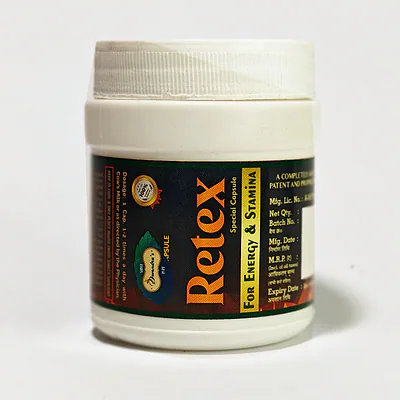
30 Cap: ₹360
Retex Special is a rich Ayurvedic Rasayana capsule that the label describes simply as Shaktivardhaka and Paushtika — strengthening and nourishing. Kaunch beej, purified Shilajit and Akarkara lead more than twenty herbs, including nutmeg, clove, cinnamon, musk mallow, Ashwagandha, Shatavari and Gokshura, with saffron.
In the Rasa-shastra tradition it adds small amounts of Ras sindoor and Bang, Abhrak, Swarna makshik and Loh bhasmas, Praval pishti, ambergris and the Ashtavarga herbs, processed in a decoction of nine herbs including betel leaf and licorice.
Used for
- Low strength & stamina (Balya)
- Weakness & fatigue
- General vitality (Rasayana)
Why vitality dips
Energy, stamina and drive depend on sleep, stress, fitness, nutrition and hormones. Chronic stress and poor sleep raise cortisol and sap energy; ageing, illness and some medicines lower it further.
Ayurveda speaks of Ojas — the essence of all tissues — and Shukra, the last and most refined Dhatu. When Agni is weak and Vata high, they are the first to be depleted. Vajikarana and Rasayana medicines aim to replenish them, traditionally taken with warm cow's milk.
Retex Special works in 3 ways
- Strength & Vitality (Balya, Rasayana) — Shilajit reduced fatigue and improved sperm counts in human and animal studies, and Ashwagandha improved strength and lowered stress in meta-analyses of randomised trials.
- Reproductive Tonic (Shukra-dhatu) — Kaunch beej improved semen quality in randomised trials in men, and Akarkara improved sperm function in a rat study.
- Warming Stimulants (Deepana) — Nutmeg, clove, cinnamon and saffron are warming aromatics that Ayurveda adds to kindle Agni so the tonic is absorbed; saffron also lifted mild-to-moderate low mood in a meta-analysis.
Key ingredients
- Kaunch beej (Velvet bean) (Mucuna pruriens, seed) — 40 mg. Ayurveda's classic seed for strength and male vitality. It is a natural source of L-DOPA; in randomised trials reviewed systematically it improved semen parameters in infertile men, and it is antioxidant in laboratory studies.
- Shilajit — 30 mg. A Himalayan rock exudate rich in fulvic acid and dibenzo-α-pyrones. Animal and human studies indicate antioxidant, anti-inflammatory and adaptogenic effects, improved sperm counts and less fatigue; its safety is well documented when purified.
- Akarkara (Anacyclus pyrethrum, root) — 30 mg. Pellitory root, a pungent Unani and Ayurvedic stimulant. Its alkylamides (pellitorine) are anti-inflammatory and analgesic, and it improved sperm function in a rat study of cadmium toxicity.
- Ashwagandha (Withania somnifera, root) — 10 mg. Ayurveda's best-known Balya-Rasayana. In randomised trials ashwagandha root extract lowered perceived stress and cortisol and improved sleep and muscle strength; its withanolides are the main active constituents.
- Jaiphal (Nutmeg) (Myristica fragrans, seed) — 20 mg. A warming seed Ayurveda uses for loose stools, wind and sleeplessness. Its lignans and myristicin are antidiarrhoeal, anti-inflammatory and mildly sedative in experimental studies; large doses are toxic.
- Lavang (Clove) (Syzygium aromaticum, flower bud) — 20 mg. Clove's eugenol is antiseptic, antispasmodic, antioxidant and locally anaesthetic — the reason clove oil is a traditional toothache remedy — and Ayurveda uses it for indigestion and cough.
- Kesar (Saffron) (Crocus sativus, stigma) — 5 mg. The stigmas of the saffron crocus. Its crocin and safranal are antioxidant, and in a meta-analysis of clinical trials saffron improved mild-to-moderate depression; Ayurveda counts it a complexion-enhancer (Varnya) and Rasayana.
- Shatavari (Asparagus racemosus, root) — 10 mg. Ayurveda's chief Rasayana for women. Its steroidal saponins (shatavarins) are adaptogenic, immunomodulatory and anti-ulcer in experimental studies, and it is traditionally used to support milk supply.
- Ras sindoor (purified mercuric sulphide) — 20 mg. Mercury and sulphur sublimed together into red mercuric sulphide, a classical Rasa-shastra catalyst said to potentiate the herbs it is given with. Mercuric sulphide is poorly absorbed, but mercury toxicity has been reported, so dose and duration matter.
Full ingredient list
- Konch beej (Mucuna pruriens, seed) — 40 mg
- Shudha shilajeet (purified mineral pitch) — 30 mg
- Akarkara (Anacyclus pyrethrum, root) — 30 mg
- Long (Syzygium aromaticum, flower bud) — 20 mg
- Jayphal (Myristica fragrans, seed) — 20 mg
- Babool phali (Acacia nilotica, fruit) — 20 mg
- Vat tantoo (Ficus benghalensis, aerial root) — 20 mg
- Lata kasturi (Abelmoschus moschatus, seed) — 20 mg
- Dal chini (Cinnamomum zeylanicum, bark) — 20 mg
- Ral shwet (Shorea robusta, exudate) — 10 mg
- Piplamool (Piper longum, stem) — 10 mg
- Javitri (Myristica fragrans, aril) — 10 mg
- Supari chikani (Areca catechu, fruit) — 10 mg
- Tamaal patra (Cinnamomum tamala, leaf) — 10 mg
- Ashwagandha (Withania somnifera, root) — 10 mg
- Beej band (Sida cordifolia, seed) — 10 mg
- Samundra sokh (Argyreia nervosa, seed) — 10 mg
- Taal makhana (Hygrophila auriculata, whole plant) — 10 mg
- Satavar (Asparagus racemosus, root) — 10 mg
- Gokhru (Tribulus terrestris, fruit) — 10 mg
- Bidhara (Argyreia nervosa, root) — 10 mg
- Moosli simbhal (Bombax ceiba, bark) — 10 mg
- Shalab mishri (Polygonatum cirrhifolium, rhizome) — 10 mg
- Kapoor (camphor) — 5 mg
- Keshar (Crocus sativus, stigma) — 5 mg
- Bang bhasma (processed tin) — 30 mg
- Ras sindoor (processed red mercuric sulphide) — 20 mg
- Swarna makshik bhasma (processed copper–iron pyrite) — 20 mg
- Abhrak bhasma (processed biotite mica) — 15 mg
- Loh bhasma (processed iron) — 10 mg
- Praval pishti (coral, levigated in rose water) — 10 mg
- Ambar (ambergris) — 10 mg
- Ashtwarg (the eight classical Rasayana herbs) — 10 mg
Processed in a decoction of
- Asgandh (Withania somnifera, root)
- Satavar (Asparagus racemosus, root)
- Paan (Piper betle, leaf)
- Tamal patra (Cinnamomum tamala, leaf)
- Babool phali (Acacia nilotica, fruit)
- Gokhru (Tribulus terrestris, fruit)
- Bidhara (Argyreia nervosa, root)
- Bat tantoo (Ficus benghalensis, aerial root)
- Madhu yashti (Glycyrrhiza glabra, root)
How to use
Dose: 1 capsule once or twice a day with cow's milk, or as directed by the physician.
- Take your dose — The dose above, or the one your physician gives.
- With water — Swallow with water (or milk, where the pack says so).
- Stay consistent — Take it at the same times each day, for the course advised.
Safety & suitability
- Who it's for: Adults
- Pregnancy & nursing: Not advised — see the cautions
- Other medicines: Tell your physician what else you take
- Diabetic?: Check the label and ask your physician
- Storage: Cool, dry place, away from direct sunlight
- Ingredients: See the full list below
Cautions
- Contains purified mercury (a traditional Rasa-shastra ingredient) in Ras sindoor. Take only at the stated dose and for the advised duration, under an Ayurvedic physician; not during pregnancy or breastfeeding, for children, or with kidney disease.
- Contains processed metal or mineral preparations: Bang bhasma, Swarna makshik bhasma, Abhrak bhasma and Loh bhasma. Take only at the stated dose and for the advised duration, under an Ayurvedic physician.
- Contains iron: Loh bhasma. Keep it out of children's reach — an iron overdose is dangerous for children.
- Contains a small amount of camphor (Kapoor). Keep strictly to the dose and out of children's reach — camphor is poisonous in overdose, especially for young children.
- Contains Supari (areca nut). Long-term use of areca nut is linked to oral disease, including oral submucous fibrosis — do not take it for long periods without a physician.
More information
- Net content: 30 Cap
- Storage: Store below 30 °C in a cool, dry place, in the original pack.
- Country of origin: India
- Manufacturer: Devendra Ayurved Ashram Pvt. Ltd., A-12, Industrial Estate, Sujroo, Muzaffarnagar (U.P.) – 251003. Mfg. Lic. No. A-50/77/94 · GMP-certified company.
References
- Tóth B, Hegyi P, Lantos T, et al. The Efficacy of Saffron in the Treatment of Mild to Moderate Depression: A Meta-analysis. Planta Med. 2019;85(1):24-31.
- Lampariello LR, Cortelazzo A, Guerranti R, et al. The Magic Velvet Bean of Mucuna pruriens. J Tradit Complement Med. 2012;2(4):331-9.
- Roozbeh N, Amirian A, Abdi F, et al. A Systematic Review on Use of Medicinal Plants for Male Infertility Treatment. J Family Reprod Health. 2021;15(2):74-81.
- Stohs SJ. Safety and efficacy of shilajit (mumie, moomiyo). Phytother Res. 2014;28(4):475-9.
- Agarwal SP, Khanna R, Karmarkar R, et al. Shilajit: a review. Phytother Res. 2007;21(5):401-5.
- Elazzouzi H, Fadili K, Cherrat A, et al. Phytochemistry, Biological and Pharmacological Activities of the Anacyclus pyrethrum (L.) Lag: A Systematic Review. Plants (Basel). 2022;11(19).
- Mahmoud AA, Shaaban MAM, Basal WT. Anacyclus pyrethrum enhances fertility in cadmium-intoxicated male rats by improving sperm functions. BMC Complement Med Ther. 2024;24(1):409.
- Akhgarjand C, Asoudeh F, Bagheri A, et al. Does Ashwagandha supplementation have a beneficial effect on the management of anxiety and stress? A systematic review and meta-analysis of randomized controlled trials. Phytother Res. 2022;36(11):4115-4124.
- Bonilla DA, Moreno Y, Gho C, et al. Effects of Ashwagandha (Withania somnifera) on Physical Performance: Systematic Review and Bayesian Meta-Analysis. J Funct Morphol Kinesiol. 2021;6(1).
- Fatima K, Malik J, Muskan F, et al. Safety and efficacy of Withania somnifera for anxiety and insomnia: Systematic review and meta-analysis. Hum Psychopharmacol. 2024;39(6):e2911.
- Ha MT, Vu NK, Tran TH, et al. Phytochemical and pharmacological properties of Myristica fragrans Houtt.: an updated review. Arch Pharm Res. 2020;43(11):1067-1092.
- Batiha GE, Alkazmi LM, Wasef LG, et al. Syzygium aromaticum L. (Myrtaceae): Traditional Uses, Bioactive Chemical Constituents, Pharmacological and Toxicological Activities. Biomolecules. 2020;10(2).
- Singh R. Asparagus racemosus: a review on its phytochemical and therapeutic potential. Nat Prod Res. 2016;30(17):1896-908.
- Singh N, Garg M, Prajapati P, et al. Adaptogenic property of Asparagus racemosus: Future trends and prospects. Heliyon. 2023;9(4):e14932.
- Kamath SU, Pemiah B, Sekar RK, et al. Mercury-based traditional herbo-metallic preparations: a toxicological perspective. Arch Toxicol. 2012;86(6):831-8.
- Liu J, Shi JZ, Yu LM, et al. Mercury in traditional medicines: is cinnabar toxicologically similar to common mercurials?. Exp Biol Med (Maywood). 2008;233(7):810-7.