P.D. Capsule
Ayurvedic capsules for painful and irregular periods
Period pain shouldn't be something you just put up with every month.
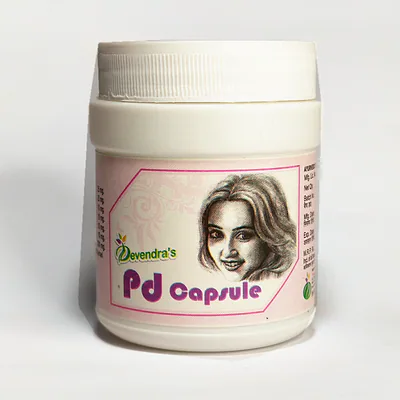
30 Cap: ₹120 · 100 Cap: ₹250
P.D. Capsule is an Ayurvedic formula traditionally used for Kashtartava (painful periods) and irregular cycles. Kutki leads it at 200 mg, with Triphala, Revat chini, Amaltas and aloe latex to keep the bowels clear, purified Guggul, Shilajit and Chitrak, Trikatu, and small amounts of Kajjali and Abhrak, Tamra and Loh bhasmas.
Ayurveda links menstrual pain closely to constipation and Ama in the pelvis, which is why so many of its herbs act on the bowel as well as the uterus.
Used for
- Painful periods (Kashtartava) — traditional use
- Irregular periods — traditional use
- White discharge (Shweta pradara)
Why periods hurt
Before and during a period, the lining of the womb releases prostaglandins, which make the uterine muscle contract to shed it. When levels are high, contractions squeeze the blood supply and cause cramping pain — sometimes with backache, nausea and loose stools. Endometriosis, fibroids and infection can make pain worse.
Ayurveda calls painful menstruation Kashtartava and sees it as Apana Vata — the downward-moving Vata — turning against its course (Pratiloma) when blocked by Ama and constipation. Treatment clears the bowel, digests Ama and restores Apana's downward flow (Vatanulomana).
P.D. Capsule's traditional approach in 3 parts
- Clearing Apana Vata (Anulomana) — Triphala, Revat chini, Amaltas and aloe latex keep the bowels moving — in Ayurveda, the first step in relieving menstrual pain.
- Anti-inflammatory (Shothahara) — Kutki's picroside II and Guggul's guggulsterones are anti-inflammatory in experimental studies.
- Digesting Ama (Deepana-Pachana) — Trikatu and Chitrak kindle digestive fire, and Shilajit is Ayurveda's classic Rasayana for the lower body.
Key ingredients
- Kutki (Katuki) (Picrorhiza kurroa, rhizome) — 200 mg. A Himalayan bitter for the liver and Kamala (jaundice). Its iridoid glycosides (picroside I and II, kutkoside) are hepatoprotective, choleretic and anti-inflammatory in experimental studies.
- Guggul (Commiphora wightii, oleo-gum resin) — 25 mg. The purified resin of the guggul tree, Ayurveda's leading remedy for joints (Amavata, Sandhivata) and obesity. Its guggulsterones are anti-inflammatory and lipid-lowering in experimental and some clinical studies; results in people are mixed.
- Triphala. Amla, Harad and Bahera in equal parts — Ayurveda's best-known bowel regulator and Rasayana. Reviews describe laxative, antioxidant, anti-inflammatory and gut-microbiome-modulating effects, mostly from experimental and small clinical studies.
- Revat chini (Himalayan rhubarb) (Rheum emodi, root) — 15 mg. Himalayan rhubarb root: in small doses its tannins are astringent, in larger doses its anthraquinones (emodin, rhein, sennosides) are laxative. Reviews also describe anti-inflammatory and hepatoprotective activity in experimental studies.
- Amaltas (Indian laburnum) (Cassia fistula, fruit pulp) — 25 mg. The sweet pulp of the Indian laburnum pod is Ayurveda's mildest purgative. It contains anthraquinones (rhein, sennosides); a small systematic review found it partly effective for stool pain and consistency in constipated children.
- Chitrak (Plumbago zeylanica, root) — 25 mg. Ayurveda's strongest Agni-kindler, used for indigestion, piles and sluggish metabolism. Its naphthoquinone plumbagin is antioxidant and antibacterial in laboratory studies; the root is irritant and avoided in pregnancy.
- Shilajit — 25 mg. A Himalayan rock exudate rich in fulvic acid and dibenzo-α-pyrones. Animal and human studies indicate antioxidant, anti-inflammatory and adaptogenic effects, improved sperm counts and less fatigue; its safety is well documented when purified.
- Elva (Aloe latex) (Aloe barbadensis, dried leaf latex) — 10 mg. The dried bitter latex of aloe leaves. Its anthraquinones (aloin, aloe-emodin) are stimulant laxatives; Ayurveda also uses it to bring on delayed periods, so it is avoided in pregnancy. Overuse can cause diarrhoea and low potassium.
- Kajjali (black mercuric sulphide). Purified mercury rubbed with purified sulphur into black mercuric sulphide — the base of many Rasa-shastra medicines. Mercuric sulphide is poorly absorbed, but mercury toxicity has been reported, so dose and duration matter.
Full ingredient list
- Shuddh parad (purified mercury) — 5 mg
- Shuddh gandhak (purified sulphur) — 5 mg
- Abhrak bhasma (processed biotite mica) — 5 mg
- Tamra bhasma (processed copper) — 5 mg
- Loh bhasma (processed iron) — 5 mg
- Hed badi (Terminalia chebula, fruit) — 15 mg
- Baheda (Terminalia bellirica, fruit) — 15 mg
- Amla (Emblica officinalis, fruit) — 15 mg
- Revat chini (Rheum emodi, root) — 15 mg
- Amaltas (Cassia fistula, fruit pulp) — 25 mg
- Chitrak chhal (Plumbago zeylanica, root) — 25 mg
- Shuddh guggul (Commiphora wightii, oleo-gum resin) — 25 mg
- Shuddh shilajeet (purified mineral pitch) — 25 mg
- Elva (Aloe barbadensis, dried leaf latex) — 10 mg
- Sonth (Zingiber officinale, rhizome) — 10 mg
- Mirch kali (Piper nigrum, fruit) — 10 mg
- Peepal (Piper longum, fruit) — 10 mg
- Kutki (Picrorhiza kurroa, rhizome) — 200 mg
Processed (bhavana) in
- Ghrit kumari swaras (Aloe barbadensis, leaf pulp)
How to use
Dose: 1–2 capsules twice a day with cow's milk, or as directed by the physician.
- Take your dose — The dose above, or the one your physician gives.
- With water — Swallow with water (or milk, where the pack says so).
- Stay consistent — Take it at the same times each day, for the course advised.
Safety & suitability
- Who it's for: Adult women
- Pregnancy & nursing: Not advised — see the cautions
- Other medicines: Tell your physician what else you take
- Diabetic?: Check the label and ask your physician
- Storage: Cool, dry place, away from direct sunlight
- Ingredients: See the full list below
Cautions
- Severe period pain, pain that is getting worse, very heavy bleeding or pain between periods should be checked by a gynaecologist — it can be a sign of endometriosis or fibroids.
- Contains purified mercury (a traditional Rasa-shastra ingredient) in Parad. Take only at the stated dose and for the advised duration, under an Ayurvedic physician; not during pregnancy or breastfeeding, for children, or with kidney disease.
- Contains processed metal or mineral preparations: Abhrak bhasma, Tamra bhasma and Loh bhasma. Take only at the stated dose and for the advised duration, under an Ayurvedic physician.
- Contains iron: Loh bhasma. Keep it out of children's reach — an iron overdose is dangerous for children.
- Contains purgative herbs: Elva (aloe latex). Not for pregnancy or young children, or with abdominal pain of unknown cause, intestinal obstruction or inflammatory bowel disease.
- Not to be taken during pregnancy.
More information
- Net content: 30 Cap · 100 Cap
- Storage: Store below 30 °C in a cool, dry place, in the original pack.
- Country of origin: India
- Manufacturer: Devendra Ayurved Ashram Pvt. Ltd., A-12, Industrial Estate, Sujroo, Muzaffarnagar (U.P.) – 251003. Mfg. Lic. No. A-50/77/94 · GMP-certified company.
References
- Devendra Ayurved Ashram Pvt. Ltd. Vivran Pustika (product guide).
- Ren Y, Liu Z, Wei L, et al. Picroside II as a Potential Anti-Inflammatory Agent. Pharmaceutics. 2026;18(4).
- Almeleebia TM, Alsayari A, Wahab S. Pharmacological and Clinical Efficacy of Picrorhiza kurroa and Its Secondary Metabolites: A Comprehensive Review. Molecules. 2022;27(23).
- Garang Z, Feng Q, Luo R, et al. Commiphora mukul (Hook. ex Stocks) Engl.: Historical records, application rules, phytochemistry, pharmacology, clinical research, and adverse reaction. J Ethnopharmacol. 2023;317:116717.
- Ahmad MA, Mujeeb M, Akhtar M, et al. Guggulipid: A Promising Multi-Purpose Herbal Medicinal Agent. Drug Res (Stuttg). 2020;70(4):123-130.
- Peterson CT, Denniston K, Chopra D. Therapeutic Uses of Triphala in Ayurvedic Medicine. J Altern Complement Med. 2017;23(8):607-614.
- Rokaya MB, Münzbergová Z, Timsina B, et al. Rheum australe D. Don: a review of its botany, ethnobotany, phytochemistry and pharmacology. J Ethnopharmacol. 2012;141(3):761-74.
- Semwal RB, Semwal DK, Combrinck S, et al. Emodin - A natural anthraquinone derivative with diverse pharmacological activities. Phytochemistry. 2021;190:112854.
- Mwangi RW, Macharia JM, Wagara IN, et al. The medicinal properties of Cassia fistula L: A review. Biomed Pharmacother. 2021;144:112240.
- Aslam MS. Application of genus Cassia in the treatment of Constipation: A systematic review. F1000Res. 2019;8:256.
- Tilak JC, Adhikari S, Devasagayam TP. Antioxidant properties of Plumbago zeylanica, an Indian medicinal plant and its active ingredient, plumbagin. Redox Rep. 2004;9(4):219-27.
- Qais FA, Ahmad I, Husain FM, et al. Interference of quorum sensing regulated bacterial virulence factors and biofilms by Plumbago zeylanica extract. Microsc Res Tech. 2021;84(12):3150-3160.
- Stohs SJ. Safety and efficacy of shilajit (mumie, moomiyo). Phytother Res. 2014;28(4):475-9.
- Agarwal SP, Khanna R, Karmarkar R, et al. Shilajit: a review. Phytother Res. 2007;21(5):401-5.
- Dong X, Zeng Y, Liu Y, et al. Aloe-emodin: A review of its pharmacology, toxicity, and pharmacokinetics. Phytother Res. 2020;34(2):270-281.
- Guo X, Mei N. Aloe vera: A review of toxicity and adverse clinical effects. J Environ Sci Health C Environ Carcinog Ecotoxicol Rev. 2016;34(2):77-96.
- Joshi N, Dash MK, Upadhyay C, et al. Physico-chemical characterization of kajjali, black sulphide of mercury, with respect to the role of sulfur in its formation and structure. J Ayurveda Integr Med. 2021;12(4):590-600.
- Kamath SU, Pemiah B, Sekar RK, et al. Mercury-based traditional herbo-metallic preparations: a toxicological perspective. Arch Toxicol. 2012;86(6):831-8.