Naynamrit
Ayurvedic herbal eye drops for tired, burning eyes
Rose, pomegranate and barberry — cooling drops for eyes that burn and itch.
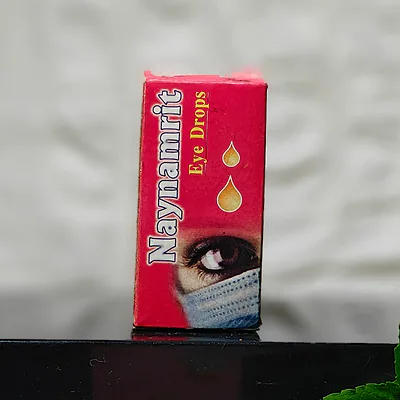
10 mL: ₹50
Naynamrit ('nectar for the eyes') is an Ayurvedic eye drop: an ark of rose petals, pomegranate buds, Daruharidra (Indian barberry), the three Triphala fruits and Punarnava, with a little potassium nitrate and Rasot.
The booklet uses it for mild conjunctival irritation, burning, aching and watering eyes and itchy lids.
Used for
- Burning, tired eyes (Netra-daha)
- Itchy, watering eyes
- Mild eye irritation
Why eyes burn and itch
Screens, dust, smoke, sun and air-conditioning dry and irritate the surface of the eye; allergies and mild infections inflame the conjunctiva. The result is burning, itching, watering and red, tired eyes.
Ayurveda sees the eyes as the seat of Alochaka Pitta, easily inflamed by heat, dust and strain. Cooling, astringent herbs applied as drops (Ashchyotana) are the classical first remedy.
Naynamrit soothes in 3 ways
- Cooling (Netra-daha-prashamana) — Rose and pomegranate buds are Ayurveda's classic cooling, soothing herbs for burning eyes; rose is anti-inflammatory and antioxidant in experimental studies.
- Antimicrobial & Anti-inflammatory — Daruharidra and Rasot carry berberine, which is antimicrobial and anti-inflammatory; an umbrella review of berberine summarises these effects.
- Astringent (Triphala) — The tannins of the Triphala fruits gently tighten irritated tissue; Triphala eyewash is a classical Ayurvedic practice.
Key ingredients
- Gulab (Rose) (Rosa centifolia, flower) — 333 mg. Rose petals are cooling and calming in Ayurveda. Rose (R. damascena) is antioxidant and anti-inflammatory in experimental studies, and a meta-analysis of randomised trials found it improved sleep quality.
- Anar twak (Pomegranate) (Punica granatum, fruit rind) — 333 mg. Pomegranate is rich in ellagitannins (punicalagins) with strong antioxidant and anti-inflammatory potential — extracts of its peel, seeds and flowers have shown benefits in laboratory and animal studies — and Ayurveda counts it among the herbs for cough and loose stools.
- Daruharidra (Indian barberry) (Berberis aristata, stem) — 333 mg. A bitter, yellow wood rich in the alkaloid berberine, which is antimicrobial, anti-inflammatory and hepatoprotective and improves glucose and lipid handling in studies. Ayurveda uses it for the liver, skin, eyes and wounds.
- Triphala. Amla, Harad and Bahera in equal parts — Ayurveda's best-known bowel regulator and Rasayana. Reviews describe laxative, antioxidant, anti-inflammatory and gut-microbiome-modulating effects, mostly from experimental and small clinical studies.
- Punarnava (Boerhavia diffusa, whole plant) — 333 mg. Its name means 'renews the body'. Ayurveda uses it for swelling (Shotha), the kidneys and the liver; its rotenoids and flavonoids are diuretic, anti-inflammatory and hepatoprotective in experimental studies.
- Kalmishora (potassium nitrate) — 25 mg. A classical alkaline salt used in Ayurveda to liquefy Kapha and as a diuretic (Mutrala); here it partners Narsar. There is little modern research on this use.
Full ingredient list
- Gulab Pushpa (Rosa centifolia) — 333 mg
- Anar Ki Kali (Punica granatum) — 333 mg
- Daru Haldi (Berberis aristata) — 333 mg
- Her (Terminalia chebula) — 111 mg
- Bahera (Terminalia bellirica) — 111 mg
- Anwla (Emblica officinalis) — 111 mg
- Punarnava (Boerhavia diffusa) — 333 mg
- Surya Kshar (potassium nitrate) — 25 mg
- Rasot (Berberis aristata) — 12.5 mg
How to use
Dose: 1–2 drops in the affected eye two to four times a day, as needed.
- Clean hands — Wash your hands and don't let the dropper tip touch your eye or anything else.
- 1–2 drops — Tilt your head back, pull down the lower lid, and put 1–2 drops in the pocket.
- Close and wait — Close your eyes for a minute. Throw the bottle away a month after opening.
Safety & suitability
- Who it's for: Adults; children only as a physician advises
- Pregnancy & nursing: Ask your physician before use
- Other medicines: Tell your physician what else you take
- Sensitive skin: Patch test first
- Storage: Cool, dry place, away from direct sunlight
- Ingredients: See the full list below
Cautions
- If irritation persists or increases, stop and see a doctor (as the pack says). See an eye doctor at once for eye pain, sensitivity to light, blurred vision, a coloured or sticky discharge, or after an injury or chemical splash.
- Do not use with contact lenses in, and do not use if the seal is broken.
More information
- Net content: 10 mL
- Storage: Store below 30 °C, away from direct sunlight. Keep the cap tightly closed.
- Country of origin: India
- Manufacturer: Devendra Ayurved Ashram Pvt. Ltd., A-12, Industrial Estate, Sujroo, Muzaffarnagar (U.P.) – 251003. Mfg. Lic. No. A-50/77/94 · GMP-certified company.
References
- Li Z, Wang Y, Xu Q, et al. Berberine and health outcomes: An umbrella review. Phytother Res. 2023;37(5):2051-2066.
- Akram M, Riaz M, Munir N, et al. Chemical constituents, experimental and clinical pharmacology of Rosa damascena: a literature review. J Pharm Pharmacol. 2020;72(2):161-174.
- Ghorbani Rami MS, Nasiri M, Aghili Nasab MS, et al. Effect of Rosa damascena on improvement of adults' sleep quality: a systematic review and meta-analysis of randomized controlled trials. Sleep Med. 2021;87:8-19.
- Vučić V, Grabež M, Trchounian A, et al. Composition and Potential Health Benefits of Pomegranate: A Review. Curr Pharm Des. 2019;25(16):1817-1827.
- Marchelak A, Gieleta M, Krasocka W, et al. Berberis aristata DC. (Indian barberry): Current insight into botanical, phytochemical, and pharmacological aspects, pharmacokinetics, safety of use and modern therapeutic applications. Fitoterapia. 2025;183:106539.
- Peterson CT, Denniston K, Chopra D. Therapeutic Uses of Triphala in Ayurvedic Medicine. J Altern Complement Med. 2017;23(8):607-614.
- Mishra S, Aeri V, Gaur PK, et al. Phytochemical, therapeutic, and ethnopharmacological overview for a traditionally important herb: Boerhavia diffusa Linn. Biomed Res Int. 2014;2014:808302.