Multivit Capsule
Ayurvedic daily wellness capsules for digestion and vitality
A daily herbal top-up for appetite, digestion and everyday energy.
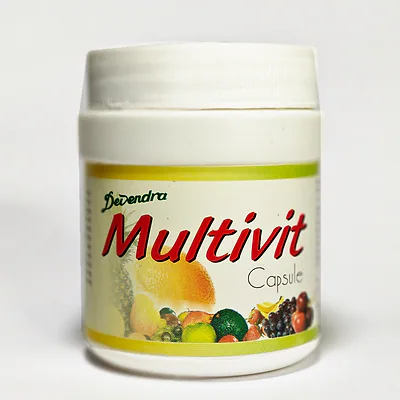
30 Cap: ₹125 · 100 Cap: ₹250 · 300 Cap: ₹700
Multivit is an Ayurvedic daily health capsule built around amla, with fenugreek, turmeric, cumin, ajwain, clove, raisins, licorice, Kakmachi, Semal musli and Ashwagandha, processed in Arjuna, licorice, pineapple, Ashwagandha and Jatamansi.
The booklet calls it health-promoting and digestive, and lists it for general bodily weakness.
Used for
- General weakness
- Poor appetite & digestion
- Everyday vitality (Rasayana)
Why everyday energy dips
A busy life, irregular meals, poor sleep and stress gradually wear down appetite, digestion and energy. When digestion is weak, even a good diet isn't fully absorbed.
Ayurveda puts digestion (Agni) at the centre of health: when it falters, the body's tissues are under-nourished and Ojas — vitality and resistance — declines. A daily Rasayana pairs nourishing, antioxidant herbs with digestive spices to keep both going.
Multivit supports you in 3 ways
- Antioxidant Rasayana — Amla — rich in vitamin C and tannins — and turmeric's curcumin are strongly antioxidant and anti-inflammatory in experimental studies.
- Digestive (Deepana-Pachana) — Cumin, ajwain, clove and fenugreek are classic digestive spices that ease wind and indigestion.
- Strength & Calm (Balya) — Ashwagandha lowered stress and improved strength in meta-analyses of randomised trials, and raisins add natural sugars and polyphenols.
Key ingredients
- Amalaki (Amla) (Emblica officinalis, fruit) — 150 mg. Ayurveda's foremost Rasayana and one of the three Triphala fruits. Rich in vitamin C, emblicanins and other tannins, it is strongly antioxidant, anti-inflammatory, gastroprotective and hepatoprotective in experimental studies.
- Haridra (Turmeric) (Curcuma longa, rhizome) — 50 mg. Its curcuminoids, chiefly curcumin, damp inflammatory signalling (NF-κB, COX-2) and scavenge free radicals in experimental studies. Ayurveda uses it for cough and cold, skin, wounds and the liver.
- Methi (Fenugreek) (Trigonella foenum-graecum, seed) — 50 mg. Fibre-rich seeds that slow carbohydrate absorption. In meta-analyses of clinical trials fenugreek lowered fasting glucose and HbA1c in people with diabetes or prediabetes; its galactomannan fibre and 4-hydroxyisoleucine are thought responsible.
- Jeera (Cumin) (Cuminum cyminum, fruit) — 50 mg. A classic Deepana-Pachana spice for indigestion, bloating and loose stools. Its essential oil, rich in cuminaldehyde, is carminative, antimicrobial and antioxidant in experimental studies.
- Ajwain (Carom) (Trachyspermum ammi, fruit) — 25 mg. Thymol-rich seeds that Ayurveda uses for wind, colic and indigestion. In experimental studies ajwain relaxes intestinal smooth muscle, increases digestive enzyme and bile secretion and is antibacterial and antifungal.
- Lavang (Clove) (Syzygium aromaticum, flower bud) — 25 mg. Clove's eugenol is antiseptic, antispasmodic, antioxidant and locally anaesthetic — the reason clove oil is a traditional toothache remedy — and Ayurveda uses it for indigestion and cough.
- Draksha (Raisins) (Vitis vinifera, dried fruit) — 50 mg. Raisins supply natural sugars and grape polyphenols such as resveratrol, which raise the body's antioxidant defences in experimental studies. Ayurveda considers Draksha cooling, nourishing and mildly laxative.
- Ashwagandha (Withania somnifera, root) — 25 mg. Ayurveda's best-known Balya-Rasayana. In randomised trials ashwagandha root extract lowered perceived stress and cortisol and improved sleep and muscle strength; its withanolides are the main active constituents.
- Mulethi (Yashtimadhu) (Glycyrrhiza glabra, root) — 25 mg. Licorice root coats and soothes irritated mucous membranes of the throat and stomach. Glycyrrhizin and licorice flavonoids are anti-inflammatory and gastroprotective in laboratory models. In Ayurveda it is the classic Kanthya — good for the throat and voice.
Full ingredient list
- Madhuyashti (Glycyrrhiza glabra, root) — 25 mg
- Jeera (Cuminum cyminum, fruit) — 50 mg
- Amla (Emblica officinalis, fruit) — 150 mg
- Methi (Trigonella foenum-graecum, seed) — 50 mg
- Kakmachi (Solanum nigrum, whole plant) — 50 mg
- Munakka (Vitis vinifera, dried fruit) — 50 mg
- Ashwagandha (Withania somnifera, root) — 25 mg
- Semal moosli (Bombax ceiba, root) — 25 mg
- Ajwain (Trachyspermum ammi, fruit) — 25 mg
- Long (Syzygium aromaticum, flower bud) — 25 mg
- Haridra (Curcuma longa, rhizome) — 50 mg
Processed (bhavana) in
- Arjun chhal (Terminalia arjuna, stem bark)
- Madhuyashti (Glycyrrhiza glabra, root)
- Ananas (Ananas comosus, fruit)
- Ashwagandha (Withania somnifera, root)
- Jatamansi (Nardostachys jatamansi, rhizome)
How to use
Dose: 1 capsule twice a day with water, or as directed by the physician.
- Take your dose — The dose above, or the one your physician gives.
- With water — Swallow with water (or milk, where the pack says so).
- Stay consistent — Take it at the same times each day, for the course advised.
Safety & suitability
- Who it's for: Adults; children only at the dose a physician sets
- Pregnancy & nursing: Ask your physician before use
- Other medicines: Tell your physician what else you take
- Diabetic?: No added sugar — ask your physician
- Storage: Cool, dry place, away from direct sunlight
- Ingredients: See the full list below
Cautions
- A herbal capsule is not a substitute for a balanced diet or for vitamin and iron supplements your doctor prescribes. Tiredness that lasts for weeks deserves a check-up.
More information
- Net content: 30 Cap · 100 Cap · 300 Cap
- Storage: Store below 30 °C in a cool, dry place, in the original pack.
- Country of origin: India
- Manufacturer: Devendra Ayurved Ashram Pvt. Ltd., A-12, Industrial Estate, Sujroo, Muzaffarnagar (U.P.) – 251003. Mfg. Lic. No. A-50/77/94 · GMP-certified company.
References
- Devendra Ayurved Ashram Pvt. Ltd. Vivran Pustika (product guide).
- Saini R, Sharma N, Oladeji OS, et al. Traditional uses, bioactive composition, pharmacology, and toxicology of Phyllanthus emblica fruits: A comprehensive review. J Ethnopharmacol. 2022;282:114570.
- Hewlings SJ, Kalman DS. Curcumin: A Review of Its Effects on Human Health. Foods. 2017;6(10).
- Shabil M, Bushi G, Bodige PK, et al. Effect of Fenugreek on Hyperglycemia: A Systematic Review and Meta-Analysis. Medicina (Kaunas). 2023;59(2).
- Gong J, Fang K, Dong H, et al. Effect of fenugreek on hyperglycaemia and hyperlipidemia in diabetes and prediabetes: A meta-analysis. J Ethnopharmacol. 2016;194:260-268.
- Singh N, Yadav SS, Kumar S, et al. A review on traditional uses, phytochemistry, pharmacology, and clinical research of dietary spice Cuminum cyminum L. Phytother Res. 2021;35(9):5007-5030.
- Boskabady MH, Alitaneh S, Alavinezhad A. Carum copticum L.: a herbal medicine with various pharmacological effects. Biomed Res Int. 2014;2014:569087.
- Batiha GE, Alkazmi LM, Wasef LG, et al. Syzygium aromaticum L. (Myrtaceae): Traditional Uses, Bioactive Chemical Constituents, Pharmacological and Toxicological Activities. Biomolecules. 2020;10(2).
- Tabeshpour J, Mehri S, Shaebani Behbahani F, et al. Protective effects of Vitis vinifera (grapes) and one of its biologically active constituents, resveratrol, against natural and chemical toxicities: A comprehensive review. Phytother Res. 2018;32(11):2164-2190.
- Akhgarjand C, Asoudeh F, Bagheri A, et al. Does Ashwagandha supplementation have a beneficial effect on the management of anxiety and stress? A systematic review and meta-analysis of randomized controlled trials. Phytother Res. 2022;36(11):4115-4124.
- Bonilla DA, Moreno Y, Gho C, et al. Effects of Ashwagandha (Withania somnifera) on Physical Performance: Systematic Review and Bayesian Meta-Analysis. J Funct Morphol Kinesiol. 2021;6(1).
- Fatima K, Malik J, Muskan F, et al. Safety and efficacy of Withania somnifera for anxiety and insomnia: Systematic review and meta-analysis. Hum Psychopharmacol. 2024;39(6):e2911.
- Wahab S, Annadurai S, Abullais SS, et al. Glycyrrhiza glabra (Licorice): A Comprehensive Review on Its Phytochemistry, Biological Activities, Clinical Evidence and Toxicology. Plants (Basel). 2021;10(12).