Madhumehari Capsule
Ayurvedic Prameha capsules with Gudmar, Jamun and Salacia
Ayurveda's 'sugar-destroyer' herbs — to be used alongside your diabetes care, never instead of it.
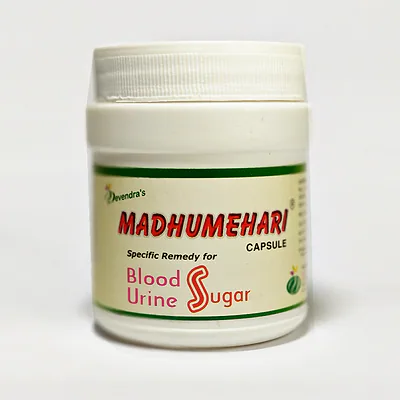
100 Cap: ₹250
Madhumehari is a traditional Ayurvedic formula for Prameha and Madhumeha — the classical names for conditions of excess urine and sugar. Gudmar ('sugar-destroyer'), Jamun seed, Saptrangi (Salacia), bitter gourd, chicory seed and Babool pods are combined with purified Shilajit and Tribang bhasma and processed in Vijaysar and Gudmar decoctions.
Several of these herbs have been studied for blood-glucose control. Madhumehari is meant as a supportive, physician-supervised addition to diet, exercise and prescribed treatment.
Used for
- Prameha & Madhumeha — traditional use
- Excess urination (Bahumutrata)
- Support alongside prescribed diabetes care
Why blood sugar rises
In type 2 diabetes the body's cells respond poorly to insulin (insulin resistance) and, over time, the pancreas can't make enough to compensate. Glucose builds up in the blood and spills into the urine, bringing thirst, frequent urination and tiredness — and, over years, damage to nerves, kidneys, eyes and blood vessels.
Ayurveda describes Prameha as a disorder of Kapha and Meda (fat tissue) arising from heavy, sweet food and inactivity, which weakens Agni and spoils the body's fluids; Madhumeha ('honey urine') is its most serious form, in which Vata depletes the tissues. Bitter, astringent herbs (Tikta-Kashaya) are the classical response.
Madhumehari's herbs work in 3 ways
- Slows Sugar Absorption (Madhumehahara) — Salacia's salacinol inhibits the gut enzymes that release glucose from starch — like the drug acarbose — and Gudmar's gymnemic acids slow sugar absorption; a meta-analysis of Gymnema studies found lower glucose and HbA1c.
- Glucose-lowering Herbs (Pramehaghna) — Bitter gourd and Jamun seed have insulin-like and glucose-lowering effects in experimental studies; clinical evidence is mixed, and a Vijaysar trial in newly diagnosed diabetes was encouraging.
- Strength & Vitality (Rasayana) — Shilajit, the classical Rasayana for Prameha, is antioxidant and reduces fatigue in human and animal studies.
Key ingredients
- Gudmar (Gymnema) (Gymnema sylvestre, leaf) — 100 mg. Its Hindi name means 'sugar destroyer': gymnemic acids briefly block sweet taste and slow sugar absorption in the gut. A meta-analysis of 10 studies in type 2 diabetes found lower fasting and after-meal glucose and HbA1c, though the studies were small.
- Saptrangi (Casearia esculenta) (Casearia esculenta, root) — 100 mg. A South Indian folk remedy for diabetes. In diabetic rats, the root extract lowered blood glucose and improved antioxidant status — animal studies only so far, with no human trials.
- Jamun (Java plum) (Syzygium cumini, seed) — 100 mg. Jamun seed is a traditional Indian remedy for Prameha. Its jamboline, ellagitannins and other polyphenols lowered blood glucose in many animal studies; clinical evidence is limited and mixed.
- Karela (Bitter gourd) (Momordica charantia, fruit) — 25 mg. Bitter gourd's charantin, polypeptide-p and vicine have insulin-like effects in experimental studies. One meta-analysis found it lowered glucose in type 2 diabetes; another concluded the clinical evidence is still too weak to be sure.
- Vijaysar (Indian kino) (Pterocarpus marsupium, heartwood). The heartwood traditionally soaked in water overnight for Prameha. In an open, uncontrolled ICMR trial in 97 people with newly diagnosed type 2 diabetes, 2–4 g of the extract a day controlled blood glucose in 69% within 12 weeks.
- Kasni (Chicory) (Cichorium intybus, seed) — 20 mg. Chicory, a Unani and Ayurvedic liver herb rich in inulin, sesquiterpene lactones and phenolic acids. In a meta-analysis of five small trials in fatty liver disease, chicory lowered the liver enzymes ALT and AST.
- Shilajit — 40 mg. A Himalayan rock exudate rich in fulvic acid and dibenzo-α-pyrones. Animal and human studies indicate antioxidant, anti-inflammatory and adaptogenic effects, improved sperm counts and less fatigue; its safety is well documented when purified.
- Tribang bhasma — 40 mg. Lead, tin and zinc processed together into an ash. Ayurveda uses it in Prameha (urinary disorders including diabetes) and for weakness; it contains lead, so it must be taken only at the stated dose under a physician.
Full ingredient list
- Gudmar (Gymnema sylvestre, leaf) — 100 mg
- Babool phali (Acacia nilotica, fruit) — 75 mg
- Jamun giri (Syzygium cumini, seed) — 100 mg
- Saptrangi (Casearia esculenta, root) — 100 mg
- Kasni beej (Cichorium intybus, seed) — 20 mg
- Karela phal (Momordica charantia, fruit) — 25 mg
- Tribang bhasma (lead, tin and zinc processed together) — 40 mg
- Shuddh shilajeet (purified mineral pitch) — 40 mg
Processed (bhavana) in a decoction of
- Vijaysar (Pterocarpus marsupium, heartwood)
- Gudmar (Gymnema sylvestre, leaf)
How to use
Dose: 1–2 capsules twice a day with water, or as directed by the physician.
- Take your dose — The dose above, or the one your physician gives.
- With water — Swallow with water (or milk, where the pack says so).
- Stay consistent — Take it at the same times each day, for the course advised.
Safety & suitability
- Who it's for: Adults with diabetes, under their doctor's care
- Pregnancy & nursing: Not advised — see the cautions
- Other medicines: Tell your physician what else you take
- Diabetic?: Made for Prameha — use only with your doctor's advice
- Storage: Cool, dry place, away from direct sunlight
- Ingredients: See the full list below
Cautions
- Do not stop or reduce insulin or other diabetes medicines on your own. These herbs can add to their effect — check your blood glucose more often when you start, and watch for signs of low sugar (shakiness, sweating, confusion).
- Diabetes needs regular check-ups for HbA1c, kidneys, eyes and feet.
- Contains processed lead in Tribang bhasma. Take only at the stated dose and for the advised duration, under an Ayurvedic physician; not during pregnancy or breastfeeding, or for children.
More information
- Net content: 100 Cap
- Storage: Store below 30 °C in a cool, dry place, in the original pack.
- Country of origin: India
- Manufacturer: Devendra Ayurved Ashram Pvt. Ltd., A-12, Industrial Estate, Sujroo, Muzaffarnagar (U.P.) – 251003. Mfg. Lic. No. A-50/77/94 · GMP-certified company.
References
- Devendra Ayurved Ashram Pvt. Ltd. Vivran Pustika (product guide).
- Nagarajan S, Sivaji K, Krishnaswamy S, et al. Safety and toxicity issues associated with lead-based traditional herbo-metallic preparations. J Ethnopharmacol. 2014;151(1):1-11.
- Devangan S, Varghese B, Johny E, et al. The effect of Gymnema sylvestre supplementation on glycemic control in type 2 diabetes patients: A systematic review and meta-analysis. Phytother Res. 2021;35(12):6802-6812.
- Khan F, Sarker MMR, Ming LC, et al. Comprehensive Review on Phytochemicals, Pharmacological and Clinical Potentials of Gymnema sylvestre. Front Pharmacol. 2019;10:1223.
- Prakasam A, Sethupathy S, Pugalendi KV. Antihyperglycaemic effect of Casearia esculenta root extracts in streptozotocin-induced diabetic rats. Pharmazie. 2002;57(11):758-60.
- Prakasam A, Sethupathy S, Pugalendi KV. Effect of Casearia esculenta root extract on blood glucose and plasma antioxidant status in streptozotocin diabetic rats. Pol J Pharmacol. 2003;55(1):43-9.
- Ayyanar M, Subash-Babu P, Ignacimuthu S. Syzygium cumini (L.) Skeels., a novel therapeutic agent for diabetes: folk medicinal and pharmacological evidences. Complement Ther Med. 2013;21(3):232-43.
- Rizvi MK, Rabail R, Munir S, et al. Astounding Health Benefits of Jamun (Syzygium cumini) toward Metabolic Syndrome. Molecules. 2022;27(21).
- Peter EL, Kasali FM, Deyno S, et al. Momordica charantia L. lowers elevated glycaemia in type 2 diabetes mellitus patients: Systematic review and meta-analysis. J Ethnopharmacol. 2019;231:311-324.
- Laczkó-Zöld E, Csupor-Löffler B, Kolcsár EB, et al. The metabolic effect of Momordica charantia cannot be determined based on the available clinical evidence: a systematic review and meta-analysis of randomized clinical trials. Front Nutr. 2023;10:1200801.
- Flexible dose open trial of Vijayasar in cases of newly-diagnosed non-insulin-dependent diabetes mellitus. Indian Council of Medical Research (ICMR), Collaborating Centres, New Delhi. Indian J Med Res. 1998;108:24-9.
- Saxena A, Vikram NK. Role of selected Indian plants in management of type 2 diabetes: a review. J Altern Complement Med. 2004;10(2):369-78.
- Street RA, Sidana J, Prinsloo G. Cichorium intybus: Traditional Uses, Phytochemistry, Pharmacology, and Toxicology. Evid Based Complement Alternat Med. 2013;2013:579319.
- Maleki E, Sadeghpour A, Taherifard E, et al. The effects of chicory supplementation on liver enzymes and lipid profiles in patients with non-alcoholic fatty liver disease: A systematic review and meta-analysis of clinical evidence. Clin Nutr ESPEN. 2023;55:447-454.
- Stohs SJ. Safety and efficacy of shilajit (mumie, moomiyo). Phytother Res. 2014;28(4):475-9.
- Agarwal SP, Khanna R, Karmarkar R, et al. Shilajit: a review. Phytother Res. 2007;21(5):401-5.