Lukonil Capsule
Ayurvedic capsules for white discharge and the weakness it brings
Discharge, backache, tiredness — they often come together. Lukonil addresses them together.
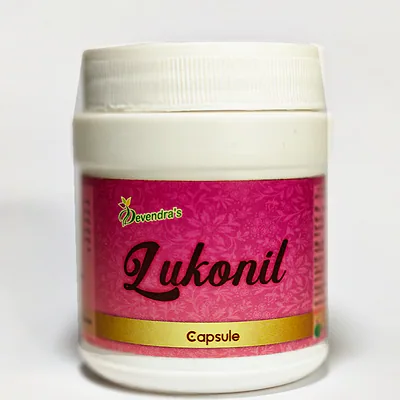
30 Cap: ₹90 · 100 Cap: ₹400
Lukonil is an Ayurvedic formula for Pradara — white (Shweta) and red (Rakta) discharge — built on astringent herbs (oak gall, areca nut, Lodhra, Mochras, Nagkeshar and sal resin) and calcium- and iron-rich mineral preparations: eggshell, coral and cowrie bhasmas, Swarna gairik and Loh bhasma.
The booklet says it strengthens the uterus and eases the backache, lower-abdominal pain, mild headache, giddiness, burning palms and soles and anaemia that can accompany discharge. It can be taken with Dee Compound.
Used for
- White discharge (Shweta pradara) — traditional use
- Backache & lower-abdominal heaviness
- Weakness & low iron
Why discharge drags you down
Some vaginal discharge is normal. When it becomes heavy, persistent, coloured or smelly, it is usually an infection (such as bacterial vaginosis, thrush or trichomonas) or cervical inflammation — and it often comes with backache, lower-abdominal heaviness and fatigue.
Ayurveda calls this Shweta pradara: Kapha, aggravated by weak digestion, flows from the reproductive channels, draining Rasa and Rakta and leaving weakness. The classical approach dries and checks the discharge with astringents (Stambhana) and rebuilds strength with minerals and Rasayanas.
Lukonil works in 3 ways
- Astringent (Stambhana) — Oak gall is among the richest natural sources of gallotannins, and Lodhra and Mochras tannins tighten tissue — astringent and antimicrobial in experimental studies.
- Calcium & Iron (Balya) — Calcined eggshell, coral and cowrie supply calcium carbonate, and Loh bhasma supplies iron for the anaemia that heavy discharge or bleeding can bring.
- Uterine Support (Garbhashaya-balya) — Nagkeshar and Lodhra are Ayurveda's classical herbs for uterine weakness and bleeding; modern clinical evidence is limited.
Key ingredients
- Majuphal (Oak gall) (Quercus infectoria, gall) — 50 mg. Oak galls, among the richest natural sources of gallotannins. Traditional medicine uses them for diarrhoea and bleeding and, externally, for the gums and vaginal tone; reviews describe antimicrobial, antioxidant and anti-inflammatory activity.
- Lodhra (Symplocos racemosa, stem bark) — 35 mg. A bark Ayurveda uses for heavy periods, leucorrhoea, loose stools and the skin. Its tannins, flavonoids and loturine alkaloids are astringent, anti-inflammatory and antimicrobial in experimental studies.
- Mochras (Semal gum) (Bombax ceiba, gum) — 30 mg. The astringent gum of the silk-cotton tree, used in Ayurveda for diarrhoea, dysentery and bleeding. Its tannins and mucilage bind and soothe; the gum reduced gastric acidity and ulceration in a rat study, though clinical research is lacking.
- Nagkesar (Mesua ferrea, stamen) — 50 mg. Fragrant stamens Ayurveda uses for bleeding piles and heavy periods (Raktastambhana). They are rich in coumarins and xanthones; laboratory studies report antimicrobial and antioxidant activity, and a subacute rat study of the flower extract found no toxicity.
- Kukkutand twak bhasma (calcined eggshell) — 100 mg. Calcined hen's eggshell, a natural calcium carbonate also carrying traces of strontium. Eggshell calcium was at least as well absorbed as purified calcium carbonate in animal studies and supported bone density in small clinical studies.
- Praval pishti (coral powder) — 40 mg. Red coral ground fine with rose water. It is almost pure calcium carbonate; Ayurveda counts it a cooling Pitta-shamaka for acidity, burning, bleeding and calcium needs. Research on it is mainly physicochemical.
- Loh bhasma (calcined iron) — 20 mg. Iron converted by repeated heating and herbal processing into fine iron-oxide (magnetite-type) particles. It is Ayurveda's main haematinic for anaemia (Pandu); in a rat study it showed no signs of toxicity at therapeutic doses.
- Supari (Areca nut) (Areca catechu, seed) — 50 mg. Areca nut is strongly astringent and is used in small amounts in Ayurveda for discharges and to tone tissue. Its alkaloid arecoline is the main active and toxic principle; heavy, long-term use is linked to oral disease.
Full ingredient list
- Kukkutandtwak bhasma (calcined eggshell) — 100 mg
- Supari (Areca catechu, seed) — 50 mg
- Majuphal (Quercus infectoria, gall) — 50 mg
- Shuddh swarna gairik (purified red ochre) — 50 mg
- Praval pishti (coral, levigated in rose water) — 40 mg
- Lodh (Symplocos racemosa, stem bark) — 35 mg
- Mochras (Bombax ceiba, gum) — 30 mg
- Nagkeshar (Mesua ferrea, stamen) — 50 mg
- Ral shwet (Shorea robusta, resin) — 25 mg
- Dugdhpashan bhasma (processed talc-like mineral) — 25 mg
- Kapardika bhasma (calcined cowrie shell) — 25 mg
- Loh bhasma (processed iron) — 20 mg
How to use
Dose: 1–2 capsules twice a day with fresh water or cow's milk, or as directed by the physician. The booklet suggests taking it with Dee Compound.
- Take your dose — The dose above, or the one your physician gives.
- With water — Swallow with water (or milk, where the pack says so).
- Stay consistent — Take it at the same times each day, for the course advised.
Safety & suitability
- Who it's for: Adults; children only at the dose a physician sets
- Pregnancy & nursing: Ask your physician before use
- Other medicines: Tell your physician what else you take
- Diabetic?: Check the label and ask your physician
- Storage: Cool, dry place, away from direct sunlight
- Ingredients: See the full list below
Cautions
- Discharge that is foul-smelling, green-yellow, blood-stained, itchy, or comes with fever or pelvic pain usually needs treatment for an infection — see a doctor.
- Contains processed metal or mineral preparations: Loh bhasma. Take only at the stated dose and for the advised duration, under an Ayurvedic physician.
- Contains iron: Loh bhasma. Keep it out of children's reach — an iron overdose is dangerous for children.
- Contains Supari (areca nut). Long-term use of areca nut is linked to oral disease, including oral submucous fibrosis — do not take it for long periods without a physician.
More information
- Net content: 30 Cap · 100 Cap
- Storage: Store below 30 °C in a cool, dry place, in the original pack.
- Country of origin: India
- Manufacturer: Devendra Ayurved Ashram Pvt. Ltd., A-12, Industrial Estate, Sujroo, Muzaffarnagar (U.P.) – 251003. Mfg. Lic. No. A-50/77/94 · GMP-certified company.
References
- Devendra Ayurved Ashram Pvt. Ltd. Vivran Pustika (product guide).
- Elham A, Arken M, Kalimanjan G, et al. A review of the phytochemical, pharmacological, pharmacokinetic, and toxicological evaluation of Quercus Infectoria galls. J Ethnopharmacol. 2021;273:113592.
- Acharya N, Acharya S, Shah U, et al. A comprehensive analysis on Symplocos racemosa Roxb.: Traditional uses, botany, phytochemistry and pharmacological activities. J Ethnopharmacol. 2016;181:236-51.
- Upadhyay SS, Parate SS, D'Souza UP, et al. An Integrative Omics and Network Pharmacology Approach to Evaluate the Antiulcer Activity of Bombax ceiba L. Gum in Rats. ACS Omega. 2025;10(48):59044-59055.
- Konyanee A, Chaniad P, Phuwajaroanpong A, et al. Exploring the potential antimalarial properties, safety profile, and phytochemical composition of Mesua ferrea Linn. PLoS One. 2024;19(12):e0312047.
- Shirsat P, A R Z, Kashikar R, et al. Subacute toxicity study of the ethanolic extract of Mesua ferrea (L.) flowers in rats. Drug Chem Toxicol. 2022;45(4):1570-1577.
- Rovenský J, Stancíková M, Masaryk P, et al. Eggshell calcium in the prevention and treatment of osteoporosis. Int J Clin Pharmacol Res. 2003;23(2-3):83-92.
- Chavan S, Bhuvad S, Gupta V, et al. Industrial manufacturing method and characterization of Ayurvedic marine drugs: mother pearl, cowry, coral and pearl. Drug Dev Ind Pharm. 2024;50(8):721-734.
- Tiwari MK, Singh A, Khooha A, et al. Structural investigation of Ayurveda Lauha (Iron) Bhasma. J Ayurveda Integr Med. 2023;14(2):100690.
- Joshi N, Dash MK, Dwivedi L, et al. Toxicity study of Lauha Bhasma (calcined iron) in albino rats. Anc Sci Life. 2016;35(3):159-66.
- Peng W, Liu YJ, Wu N, et al. Areca catechu L. (Arecaceae): a review of its traditional uses, botany, phytochemistry, pharmacology and toxicology. J Ethnopharmacol. 2015;164:340-56.