Laxanil Tablet
Ayurvedic laxative tablets for constipation
Some things are not worth holding on to. Let it go with Laxanil.
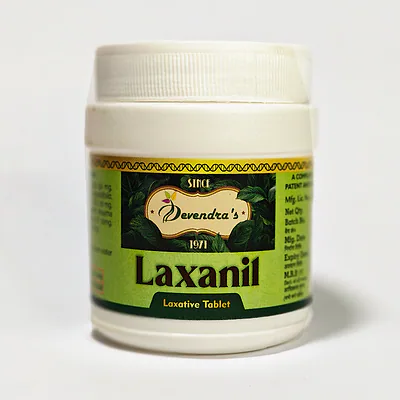
100 Tab: ₹75
Laxanil is an Ayurvedic laxative tablet for constipation, including the indigestion that comes with long-standing constipation. It combines senna, Nisoth and aloe latex — three classic purgatives — with nutmeg, dry ginger, Shankh bhasma and purified borax, processed in lemon juice.
It is taken at bedtime, so it works by morning.
Used for
- Constipation (Vibandha)
- Hard, dry stools
- Bloating with constipation
Why the bowel gets stuck
Feeling heavy, bloated, having to strain and dealing with an irregular bowel routine? Low fibre and water, too much sitting, travel, stress and some medicines slow the colon. The longer stool sits, the more water is drawn out of it, and the harder it is to pass.
In Ayurvedic pathophysiology, constipation is caused by Apana Vayu Vaishamya — dysfunction of the downward-moving intestinal air — leading to excessive drying of stool (Shushka Mala) and loss of peristaltic drive in the Pakwashaya (large intestine).
Laxanil works in 4 ways
- Stimulant Laxative Action (Rechana) — Senna's sennosides, aloe's anthraquinones and Nisoth's resin glycosides stimulate peristalsis and fluid secretion into the bowel; senna is a well-evidenced first-line laxative.
- Antispasmodic & Carminative (Shoolaprashamana & Vatanulomana) — Dry ginger and nutmeg are warming carminatives that ease griping and wind, and the formula is processed in lemon juice.
- Antacid (Pitta-Shamaka) — Shankh bhasma — calcined conch, essentially calcium carbonate — neutralises local acidity.
- Synergism (Yogavahi) — In Rasa-shastra, Kajjali is a Yogavahi — a mineral catalyst believed to carry and potentiate the herbs given with it. This is a traditional concept that has not been tested in modern studies.
Key ingredients
- Sanay (Senna) (Cassia angustifolia, leaf) — 170 mg. Senna leaf's sennosides are converted by gut bacteria into rhein anthrone, which stimulates colonic movement and fluid secretion. A systematic review of over-the-counter therapies found good evidence for senna as a first-line laxative for chronic constipation.
- Nisoth (Trivrit) (Operculina turpethum, root) — 75 mg. Turpeth root, Ayurveda's preferred purgative for clearing Pitta and accumulated stool. Its resin glycosides (turpethins) are the purgative principle; in laboratory studies the extract also relaxed intestinal and airway smooth muscle.
- Jaiphal (Nutmeg) (Myristica fragrans, seed) — 50 mg. Nutmeg is warming and carminative in Ayurveda; with dry ginger it eases the griping and wind that purgatives can cause. Large doses of nutmeg are toxic — each tablet has 50 mg.
- Elva (Aloe latex) (Aloe barbadensis, leaf) — 10 mg. The dried bitter latex of aloe leaves. Its anthraquinones (aloin, aloe-emodin) are stimulant laxatives; Ayurveda also uses it to bring on delayed periods, so it is avoided in pregnancy. Overuse can cause diarrhoea and low potassium.
- Sonth (Dry ginger) (Zingiber officinale, rhizome) — 20 mg. Ayurveda's 'universal medicine' (Vishwabheshaja) for weak digestion. Its gingerols and shogaols speed gastric emptying and calm nausea; a systematic review of clinical trials found about 1.5 g a day in divided doses relieves nausea.
- Shankh bhasma (calcined conch shell) — 30 mg. Conch shell calcined by classical Rasa-shastra methods into fine calcium carbonate (calcite). Like any carbonate antacid it neutralises excess stomach acid; Ayurveda uses it for hyperacidity, indigestion and colic (Amlapitta, Parinama shoola).
- Tankan bhasma (purified borax) — 40 mg. Borax, heat-dried until it puffs. Ayurveda uses it to liquefy and expel Kapha in cough and asthma and as an emmenagogue. Boron compounds are toxic in excess, so the dose must not be exceeded.
- Kajjali (black mercuric sulphide) — 5 mg. Purified mercury rubbed with purified sulphur into black mercuric sulphide — the base of many Rasa-shastra medicines. Mercuric sulphide is poorly absorbed, but mercury toxicity has been reported, so dose and duration matter.
Full ingredient list
- Shudh Jaiphal (Myristica fragrans, seed) — 50 mg
- Kajli (mercury rubbed with sulphur) — 5 mg
- Sanay (Cassia angustifolia, leaf) — 170 mg
- Sonth (Zingiber officinale, rhizome) — 20 mg
- Tankan bhasma (purified borax) — 40 mg
- Shankh bhasma (calcined conch shell) — 30 mg
- Elva (Aloe barbadensis, leaf) — 10 mg
- Nisoth (Operculina turpethum, root) — 75 mg
Processed (bhavana) in
- Nimbu (Citrus limon, juice)
How to use
Dose: Adults: 1–2 tablets at bedtime with warm water, or as directed by the physician.
- Take your dose — The dose above, or the one your physician gives.
- With water — Swallow with water (or milk, where the pack says so).
- Stay consistent — Take it at the same times each day, for the course advised.
Safety & suitability
- Who it's for: Adults only
- Pregnancy & nursing: Not advised — see the cautions
- Other medicines: Tell your physician what else you take
- Diabetic?: Sugar-coated tablet — ask your physician
- Storage: Cool, dry place, away from direct sunlight
- Ingredients: See the full list below
Cautions
- The pack says: to be taken under medical supervision only.
- Not for young children or pregnant women except on a physician's advice.
- Use for a few days at a time only. Long-term use of stimulant laxatives can upset the body's salt balance — see a physician for constipation that keeps coming back.
- Do not use with abdominal pain of unknown cause, vomiting, or a suspected blocked bowel.
- Contains purified mercury (a traditional Rasa-shastra ingredient) in Kajjali. Take only at the stated dose and for the advised duration, under an Ayurvedic physician; not during pregnancy or breastfeeding, for children, or with kidney disease.
- Contains purified borax (Tankan). Do not exceed the dose, especially in infants and young children.
- Not to be taken during pregnancy.
More information
- Net content: 100 Tab
- Storage: Store below 30 °C in a cool, dry place, in the original pack.
- Country of origin: India
- Manufacturer: Devendra Ayurved Ashram Pvt. Ltd., A-12, Industrial Estate, Sujroo, Muzaffarnagar (U.P.) – 251003. Mfg. Lic. No. A-50/77/94 · GMP-certified company.
References
- Devendra Ayurved Ashram Pvt. Ltd. Vivran Pustika (product guide).
- Chang L, Chey WD, Imdad A, et al. American Gastroenterological Association-American College of Gastroenterology Clinical Practice Guideline: Pharmacological Management of Chronic Idiopathic Constipation. Gastroenterology. 2023;164(7):1086-1106.
- Rao SSC, Brenner DM. Efficacy and Safety of Over-the-Counter Therapies for Chronic Constipation: An Updated Systematic Review. Am J Gastroenterol. 2021;116(6):1156-1181.
- Gupta S, Ved A. Operculina turpethum (Linn.) Silva Manso as a Medicinal Plant Species: A Review on Bioactive Components and Pharmacological Properties. Pharmacogn Rev. 2017;11(22):158-166.
- Shareef H, Rizwani GH, Mandukhail SR, et al. Studies on antidiarrhoeal, antispasmodic and bronchodilator activities of Operculina turpethum Linn. BMC Complement Altern Med. 2014;14:479.
- Ha MT, Vu NK, Tran TH, et al. Phytochemical and pharmacological properties of Myristica fragrans Houtt.: an updated review. Arch Pharm Res. 2020;43(11):1067-1092.
- Dong X, Zeng Y, Liu Y, et al. Aloe-emodin: A review of its pharmacology, toxicity, and pharmacokinetics. Phytother Res. 2020;34(2):270-281.
- Guo X, Mei N. Aloe vera: A review of toxicity and adverse clinical effects. J Environ Sci Health C Environ Carcinog Ecotoxicol Rev. 2016;34(2):77-96.
- Nikkhah Bodagh M, Maleki I, Hekmatdoost A. Ginger in gastrointestinal disorders: A systematic review of clinical trials. Food Sci Nutr. 2019;7(1):96-108.
- Chavan S, Tayade S, Gupta V, et al. Pharmaceutical Standardization and Physicochemical Characterization of Traditional Ayurvedic Marine Drug: Incinerated Conch Shell (Shankha Bhasma). Mar Drugs. 2018;16(11).
- Hadrup N, Frederiksen M, Sharma AK. Toxicity of boric acid, borax and other boron containing compounds: A review. Regul Toxicol Pharmacol. 2021;121:104873.
- Siegel E, Wason S. Boric acid toxicity. Pediatr Clin North Am. 1986;33(2):363-7.
- Joshi N, Dash MK, Upadhyay C, et al. Physico-chemical characterization of kajjali, black sulphide of mercury, with respect to the role of sulfur in its formation and structure. J Ayurveda Integr Med. 2021;12(4):590-600.
- Kamath SU, Pemiah B, Sekar RK, et al. Mercury-based traditional herbo-metallic preparations: a toxicological perspective. Arch Toxicol. 2012;86(6):831-8.