Karnamrit
Ayurvedic herbal ear drops for earache
Earache can make a whole day miserable. A few warm drops, the traditional way.
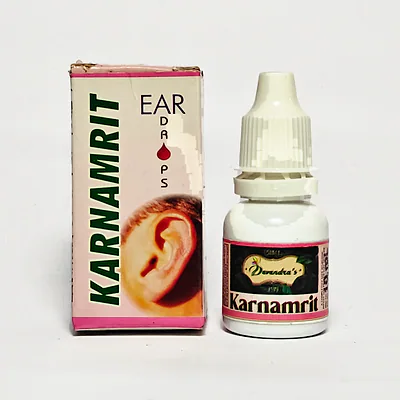
10 mL: ₹50
Karnamrit ('nectar for the ear') is an Ayurvedic ear drop: an ark of Bilva leaf, garlic, Triphala, drumstick and mango barks, Punarnava, Madar leaf, Apamarga, Dhatura leaf and poppy husk, with a little camphor.
The booklet uses it for earache and ear swelling. Garlic is antimicrobial against common ear pathogens in the laboratory, and herbal oil drops eased ear pain in children with otitis media in a clinical trial.
Used for
- Earache (Karnashoola)
- Ear itching & irritation
- Mild ear inflammation — after a doctor's check
Why ears ache
Most earache comes from infection — of the middle ear behind the eardrum (otitis media, common after a cold) or of the ear canal (otitis externa, 'swimmer's ear') — or from pain referred from the teeth or throat. Pressure and inflammation stretch sensitive tissues.
Ayurveda calls earache Karnashoola, a Vata disorder, often with Kapha congestion, and treats it with warm, aromatic drops (Karnapurana) that calm Vata and clear Kapha.
Karnamrit soothes in 3 ways
- Analgesic (Vedanasthapana) — Dhatura's tropane alkaloids and poppy husk's opium alkaloids act on pain nerves; in a trial in children with acute otitis media, herbal ear drops containing garlic eased ear pain.
- Antimicrobial — Garlic derivatives inhibited common external-ear and chronic-otitis pathogens in laboratory studies, and camphor is antiseptic.
- Anti-inflammatory (Shothahara) — Drumstick bark, mango bark and Punarnava are anti-inflammatory in experimental studies, easing swelling in the canal.
Key ingredients
- Lahsun (Garlic) (Allium sativum, bulb) — 1 part. Garlic's sulphur compounds (alliin, allicin, ajoene) are antimicrobial, antioxidant and anti-atherosclerotic in experimental studies; in clinical meta-analyses garlic modestly lowered blood pressure and cholesterol.
- Sahjan (Drumstick) (Moringa oleifera, stem bark) — 1 part. Drumstick-tree bark, used in Ayurveda for abscesses, swelling and pain (Shothahara). Moringa's isothiocyanates and flavonoids are anti-inflammatory and antimicrobial in experimental studies.
- Aamra (Mango bark) (Mangifera indica, stem bark) — 1 part. Mango bark is astringent and used in Ayurveda for discharges and wounds. It is rich in mangiferin, a polyphenol that is anti-inflammatory, antioxidant and antimicrobial in experimental studies.
- Punarnava (Boerhavia diffusa, whole plant) — 1 part. Its name means 'renews the body'. Ayurveda uses it for swelling (Shotha), the kidneys and the liver; its rotenoids and flavonoids are diuretic, anti-inflammatory and hepatoprotective in experimental studies.
- Dhatura (Thorn apple) (Datura metel, leaf) — 0.5 part. Datura leaf carries the tropane alkaloids hyoscyamine and scopolamine, which block pain-signalling and smooth-muscle spasm. Ayurveda uses it in tiny amounts, mostly externally; it is poisonous if swallowed.
- Post (Poppy husk) (Papaver somniferum, capsule husk) — 1 part. The dried capsule of the opium poppy, used in traditional medicine to dull pain. It carries small, variable amounts of opium alkaloids such as morphine and codeine, which is why it must be kept from children and never swallowed.
- Kapoor (Camphor) — 0.25 %. Applied to skin, camphor activates the warmth and cold receptors TRPV1 and TRPM8 and then desensitises them — a counter-irritant effect that eases muscle and joint pain and itching. Toxic if swallowed.
Full ingredient list
- Bilva Patra (Aegle marmelos) — 1 part
- Rason (Allium sativum) — 1 part
- Trifla (Amla, Harad and Bahera) — 1 part
- Sahanjna Chhal (Moringa oleifera) — 1 part
- Aamra Chhal (Mangifera indica) — 1 part
- Punarnava (Boerhavia diffusa) — 1 part
- Dhatura Patra (Datura metel) — 0.5 part
- Ark Patra (Calotropis procera) — 1 part
- Apamarg (Achyranthes aspera) — 1 part
- Post Twak (Papaver somniferum) — 1 part
- Karpoor (camphor) — 0.25 %
How to use
Dose: 1–2 drops in the ear two to three times a day, or as directed by the physician.
- Warm the bottle — Hold the bottle in your hand for a few minutes — cold drops can make you dizzy.
- 1–2 drops — Tilt your head, put 1–2 drops in the ear without touching the dropper to the ear, and stay tilted for a minute.
- Repeat — Two to three times a day; stop and see a doctor if it isn't better in 2–3 days.
Safety & suitability
- Who it's for: Adults and older children — after a doctor has checked the ear
- Pregnancy & nursing: Ask your physician before use
- Other medicines: Tell your physician what else you take
- Sensitive skin: Patch test first
- Storage: Cool, dry place, away from direct sunlight
- Ingredients: See the full list below
Cautions
- Do not use if there is discharge from the ear, if your eardrum may be perforated, if you have grommets, or after ear surgery — see a doctor first.
- See a doctor for earache with fever, severe pain, hearing loss, dizziness, or in a baby or young child.
- Contains anticholinergic (tropane) alkaloids, from Dhatura. Avoid in glaucoma, urinary retention or an enlarged prostate, and never exceed the dose.
- Contains camphor — never swallow, and keep away from children's nose and mouth.
- Contains Post (poppy husk), which carries small amounts of opium alkaloids. For external use only — never swallow, and keep out of children's reach.
More information
- Net content: 10 mL
- Storage: Store below 30 °C, away from direct sunlight. Keep the cap tightly closed.
- Country of origin: India
- Manufacturer: Devendra Ayurved Ashram Pvt. Ltd., A-12, Industrial Estate, Sujroo, Muzaffarnagar (U.P.) – 251003. Mfg. Lic. No. A-50/77/94 · GMP-certified company.
References
- Devendra Ayurved Ashram Pvt. Ltd. Vivran Pustika (product guide).
- Sarrell EM, Mandelberg A, Cohen HA. Efficacy of naturopathic extracts in the management of ear pain associated with acute otitis media. Arch Pediatr Adolesc Med. 2001;155(7):796-9.
- Uzun L, Dal T, Kalcıoğlu MT, et al. Antimicrobial Activity of Garlic Derivatives on Common Causative Microorganisms of the External Ear Canal and Chronic Middle Ear Infections. Turk Arch Otorhinolaryngol. 2019;57(4):161-165.
- El-Saber Batiha G, Magdy Beshbishy A, G Wasef L, et al. Chemical Constituents and Pharmacological Activities of Garlic (Allium sativum L.): A Review. Nutrients. 2020;12(3).
- Ried K. Garlic Lowers Blood Pressure in Hypertensive Individuals, Regulates Serum Cholesterol, and Stimulates Immunity: An Updated Meta-analysis and Review. J Nutr. 2016;146(2):389S-396S.
- Liu R, Liu J, Huang Q, et al. Moringa oleifera: a systematic review of its botany, traditional uses, phytochemistry, pharmacology and toxicity. J Pharm Pharmacol. 2022;74(3):296-320.
- Ediriweera MK, Tennekoon KH, Samarakoon SR. A Review on Ethnopharmacological Applications, Pharmacological Activities, and Bioactive Compounds of Mangifera indica (Mango). Evid Based Complement Alternat Med. 2017;2017:6949835.
- Mishra S, Aeri V, Gaur PK, et al. Phytochemical, therapeutic, and ethnopharmacological overview for a traditionally important herb: Boerhavia diffusa Linn. Biomed Res Int. 2014;2014:808302.
- Sharma M, Dhaliwal I, Rana K, et al. Phytochemistry, Pharmacology, and Toxicology of Datura Species-A Review. Antioxidants (Basel). 2021;10(8).
- Tikka SK, Singh LK, Mamidipalli SS, et al. Buprenorphine/naloxone maintenance for "poppy husk" dependence: A retrospective study. Asia Pac Psychiatry. 2019;11(4):e12358.
- Stinson RJ, Morice AH, Sadofsky LR. Modulation of transient receptor potential (TRP) channels by plant derived substances used in over-the-counter cough and cold remedies. Respir Res. 2023;24(1):45.
- Love JN, Sammon M, Smereck J. Are one or two dangerous? Camphor exposure in toddlers. J Emerg Med. 2004;27(1):49-54.