Kankoline
Ayurvedic mouth paint for mouth ulcers and sore gums
Mouth ulcers make every bite hurt. Kankoline soothes them where they are.
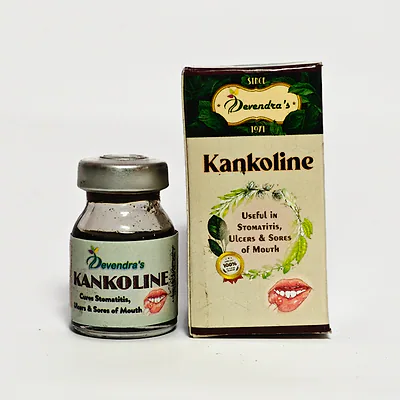
5 mL: ₹25
Kankoline is an Ayurvedic mouth paint: an ark of three astringent barks — Khair (catechu), Kanchnar and Babool — with cardamom, cubeb (Kankol) and Shubhra bhasma (calcined alum).
The pack lists it for stomatitis (Mukha paka), spots and burning in the mouth, mouth ulcers and drooling.
Used for
- Mouth ulcers (Mukha paka)
- Burning or sore mouth
- Sore, inflamed gums
- Bad breath
Why mouth ulcers keep coming
Common mouth ulcers (aphthae) are small breaks in the lining of the mouth, often triggered by a bite or a rough tooth, stress, spicy or acidic food, or low iron, B12 or folate. They usually heal in one to two weeks.
Ayurveda calls this Mukha paka — 'cooking of the mouth' — from aggravated Pitta, often with poor digestion. Astringent, cooling applications (Kashaya) are the classical local treatment, with a bland diet.
Kankoline soothes in 3 ways
- Astringent (Stambhana) — Catechu, Babool and Kanchnar barks are rich in tannins that tighten and protect the raw ulcer surface; alum adds a strong astringent effect.
- Antimicrobial — Catechu's catechins and cubeb's lignans are antimicrobial and anti-inflammatory in experimental studies.
- Fresh & Soothing — Cardamom and cubeb freshen the breath and soothe the mouth.
Key ingredients
- Katha (Catechu) (Acacia catechu, bark) — 500 mg. The concentrated heartwood extract of the khair tree, rich in catechins and epicatechin. Strongly astringent, it is antioxidant, anti-inflammatory and antimicrobial in experimental studies; Ayurveda uses it for diarrhoea, the mouth and skin disease.
- Babool (Indian gum arabic tree) (Acacia nilotica, bark) — 500 mg. Its bark and pods are rich in tannins, gallic acid and flavonoids. Astringent, antimicrobial and anti-inflammatory in experimental studies, it is used in Ayurveda for loose stools, bleeding, leucorrhoea and oral health.
- Kabab chini (Cubeb) (Piper cubeba, fruit) — 150 mg. Tailed pepper, used in Unani and Ayurvedic medicine for the urinary tract, digestion and the mouth. Its lignans (cubebin) are anti-inflammatory, antimicrobial and analgesic in experimental studies.
- Elaichi (Cardamom) (Elettaria cardamomum, fruit) — 150 mg. An aromatic for nausea, indigestion and bad breath. Cardamom's 1,8-cineole and α-terpinyl acetate are carminative, antispasmodic and antimicrobial in experimental studies.
- Shubhra bhasma (calcined alum) — 30 mg. Another name for calcined alum (Sphatika). A strong astringent that tightens tissue and checks bleeding and discharges; Ayurveda uses it for bleeding piles, heavy periods and leucorrhoea.
Full ingredient list
Distillate (ark) of
- Khair (Acacia catechu, bark) — 500 mg
- Kanchnar (Bauhinia variegata, bark) — 500 mg
- Babool (Acacia nilotica, bark) — 500 mg
- Laghuaila (Elettaria cardamomum, fruit) — 150 mg
- Kankol (Piper cubeba, fruit) — 150 mg
- Shubhra Bhasma (calcined alum) — 30 mg
- Chini (sugar) — 5 g
- Sodium Benzoate (preservative, as per Drug Act) — q.s.
How to use
Dose: Apply to the ulcers or sore area with a clean cotton bud two to four times a day.
- Shake well — Shake the bottle before use.
- Paint the sore — Dab it onto the ulcer with a clean cotton bud; let the saliva run out rather than rinsing straight away.
- Go easy on spice — Avoid chilli, sour and very hot food until it heals, as the booklet advises.
Safety & suitability
- Who it's for: Adults; children only as a physician advises
- Pregnancy & nursing: Ask your physician before use
- Other medicines: Tell your physician what else you take
- Sensitive skin: Patch test first
- Storage: Cool, dry place, away from direct sunlight
- Ingredients: See the full list below
Cautions
- A mouth ulcer that hasn't healed in 3 weeks, keeps coming back, or is painless and hard should be seen by a doctor or dentist.
More information
- Net content: 5 mL
- Storage: Store below 30 °C, away from direct sunlight. Keep the cap tightly closed.
- Country of origin: India
- Manufacturer: Devendra Ayurved Ashram Pvt. Ltd., A-12, Industrial Estate, Sujroo, Muzaffarnagar (U.P.) – 251003. Mfg. Lic. No. A-50/77/94 · GMP-certified company.
References
- Kumari M, Radha, Kumar M, et al. Acacia catechu (L.f.) Willd.: A Review on Bioactive Compounds and Their Health Promoting Functionalities. Plants (Basel). 2022;11(22).
- Hafez LO, Brito-Casillas Y, Abdelmageed N, et al. The Acacia (Vachellia nilotica (L.) P.J.H. Hurter & Mabb.): Traditional Uses and Recent Advances on Its Pharmacological Attributes and Potential Activities. Nutrients. 2024;16(24).
- Drissi B, Mahdi I, Yassir M, et al. Cubeb (Piper cubeba L.f.): A comprehensive review of its botany, phytochemistry, traditional uses, and pharmacological properties. Front Nutr. 2022;9:1048520.
- Ashokkumar K, Murugan M, Dhanya MK, et al. Botany, traditional uses, phytochemistry and biological activities of cardamom [Elettaria cardamomum (L.) Maton] - A critical review. J Ethnopharmacol. 2020;246:112244.
- The Ayurvedic Pharmacopoeia of India, Part I (single drugs) and Part II (formulations). Government of India, Ministry of AYUSH.