Fertila Syrup
Ayurvedic women's reproductive tonic
Ayurveda's traditional 'Putrada' herbs, for women planning a family.
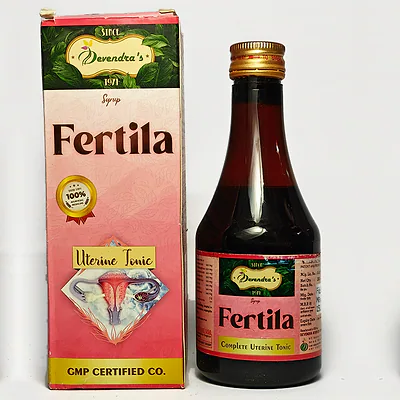
200 mL: ₹140
Fertila is an Ayurvedic tonic for women's reproductive health, built on two seeds that Ayurveda has long given to women hoping to conceive — Shivlingi and Putrajeevak — with Ashwagandha, Kayphal and Nagkeshar, and Trikatu to aid digestion and absorption.
It is a traditional tonic, not a fertility treatment: difficulty conceiving needs a gynaecologist's assessment, and Fertila is meant to sit alongside that care.
Used for
- Women's reproductive tonic (Garbhashaya-balya) — traditional use
- Planning a pregnancy — with your doctor's advice
- General strength & vitality (Balya)
What fertility depends on
Conception needs regular ovulation, open and healthy fallopian tubes, a receptive womb and healthy sperm. Hormone imbalances (such as PCOS or thyroid disease), weight, stress, infections of the tubes, endometriosis and age can each get in the way — so the first step is always finding the cause.
Ayurveda describes four essentials for conception — Ritu (the right time), Kshetra (a healthy womb), Ambu (nourishing fluids) and Beeja (healthy egg and sperm) — and links problems to disturbed Apana Vata and weak Agni. Its 'Putrada' herbs aim to nourish and steady the reproductive system (Artava).
Fertila's traditional approach in 3 parts
- Reproductive Tonic (Garbhaprada, traditional) — Shivlingi and Putrajeevak are Ayurveda's classic seeds for conception; Putrajeevak seed oil improved fertility measures in a zebrafish model, though there are no human trials.
- Adaptogen & Strength (Balya, Rasayana) — Ashwagandha lowered perceived stress and cortisol in meta-analyses of randomised trials — relevant because stress affects menstrual and ovulatory health.
- Digestive & Bioenhancer (Deepana) — Trikatu (dry ginger, black and long pepper) kindles digestion, and piperine raises the absorption of compounds taken with it.
Key ingredients
- Shivlingi (Bryonia laciniosa, seed) — 100 mg. Seeds traditionally given to women hoping to conceive (Garbhaprada). Reviews report anti-inflammatory, antioxidant and aphrodisiac activity in experimental studies; there are no clinical trials on fertility.
- Putrajeevak (Putranjiva roxburghii, seed) — 100 mg. Its name means 'life-giver to offspring': Ayurveda's classic seed for conception. In a zebrafish model of impaired fertility, its seed oil increased ovarian follicles and mature eggs and improved sperm counts; human studies are lacking.
- Ashwagandha (Withania somnifera, root) — 100 mg. Ayurveda's best-known Balya-Rasayana. In randomised trials ashwagandha root extract lowered perceived stress and cortisol and improved sleep and muscle strength; its withanolides are the main active constituents.
- Kayphal (Katphala) (Myrica esculenta, fruit) — 100 mg. A Himalayan remedy for asthma, cough and bronchitis. Its stem bark curbed eosinophil build-up and fluid leakage in experimental allergic inflammation, likely by limiting histamine release from mast cells.
- Nagkesar (Mesua ferrea, stamen) — 100 mg. Fragrant stamens Ayurveda uses for bleeding piles and heavy periods (Raktastambhana). They are rich in coumarins and xanthones; laboratory studies report antimicrobial and antioxidant activity, and a subacute rat study of the flower extract found no toxicity.
- Sonth (Dry ginger) (Zingiber officinale, rhizome) — 100 mg. Ayurveda's 'universal medicine' (Vishwabheshaja) for weak digestion. Its gingerols and shogaols speed gastric emptying and calm nausea; a systematic review of clinical trials found about 1.5 g a day in divided doses relieves nausea.
- Kali mirch (Black pepper) (Piper nigrum, fruit) — 100 mg. Its alkaloid piperine stimulates pancreatic digestive enzymes and shortens food transit time in experimental studies, and famously raises the absorption of other compounds by slowing their breakdown in the gut wall and liver.
- Pippali (Long pepper) (Piper longum, fruit) — 100 mg. A classical Rasayana for the respiratory tract and digestion. Like black pepper it carries piperine, plus piperlongumine; it is anti-inflammatory, bronchoprotective and bioavailability-enhancing in experimental studies.
Full ingredient list
Liquid extract of
- Shivlingi (Bryonia laciniosa, seed) — 100 mg
- Putra Jeevak (Putranjiva roxburghii, seed) — 100 mg
- Ashwagandha (Withania somnifera, root) — 100 mg
- Kayphal (Myrica esculenta, fruit) — 100 mg
- Sonth (Zingiber officinale, rhizome) — 100 mg
- Kali Mirch (Piper nigrum, fruit) — 100 mg
- Pipal (Piper longum, fruit) — 100 mg
- Nagkeshar (Mesua ferrea, stamen) — 100 mg
- Chini (sugar) — 5 g
- Preservative, Colour & Essence (as per Drug Act) — q.s.
How to use
Dose: 10 mL twice a day with water, or as directed by the physician. Shake well before use.
- Shake well — Shake the bottle before each dose.
- Measure the dose — Use the measuring cap — the dose above, or the one your physician gives.
- Keep a routine — Take it at the same times each day, for as long as advised.
Safety & suitability
- Who it's for: Adults; children only at the dose a physician sets
- Pregnancy & nursing: Stop once you are pregnant unless your doctor advises otherwise
- Other medicines: Tell your physician what else you take
- Diabetic?: Contains sugar (5 g per 10 mL) — ask your physician
- Storage: Cool, dry place, away from direct sunlight
- Ingredients: See the full list below
Cautions
- See a gynaecologist if you have not conceived after a year of trying (or 6 months if you are over 35), or if your periods are irregular or very painful.
- Contains sugar (5 g per 10 mL) — people with diabetes should ask their physician first.
- Do not use if any precipitate, fungus or foreign particle is found — replace the bottle.
More information
- Net content: 200 mL
- Storage: Keep in a cool, dry place away from direct sunlight. Close the cap tightly after use.
- Country of origin: India
- Manufacturer: Devendra Ayurved Ashram Pvt. Ltd., A-12, Industrial Estate, Sujroo, Muzaffarnagar (U.P.) – 251003. Mfg. Lic. No. A-50/77/94 · GMP-certified company.
References
- Akhgarjand C, Asoudeh F, Bagheri A, et al. Does Ashwagandha supplementation have a beneficial effect on the management of anxiety and stress? A systematic review and meta-analysis of randomized controlled trials. Phytother Res. 2022;36(11):4115-4124.
- Katiyar D, Saxena R, Kumar A, et al. Appraising the Phytochemical and Therapeutic Perspectives of Bryonia laciniosa: A Literature Metasynthesis. Comb Chem High Throughput Screen. 2023;26(7):1385-1399.
- Balkrishna A, Nain P, Joshi M, et al. Supercritical Fluid Extract of Putranjiva roxburghii Wall. Seeds Mitigates Fertility Impairment in a Zebrafish Model. Molecules. 2021;26(4).
- Bonilla DA, Moreno Y, Gho C, et al. Effects of Ashwagandha (Withania somnifera) on Physical Performance: Systematic Review and Bayesian Meta-Analysis. J Funct Morphol Kinesiol. 2021;6(1).
- Fatima K, Malik J, Muskan F, et al. Safety and efficacy of Withania somnifera for anxiety and insomnia: Systematic review and meta-analysis. Hum Psychopharmacol. 2024;39(6):e2911.
- Patel K, Rao Nj, Gajera V, et al. Anti-allergic Activity of Stem Bark of Myrica esculenta Buch.-Ham. (Myricaceae). J Young Pharm. 2010;2(1):74-8.
- Kabra A, Martins N, Sharma R, et al. Myrica esculenta Buch.-Ham. ex D. Don: A Natural Source for Health Promotion and Disease Prevention. Plants (Basel). 2019;8(6).
- Konyanee A, Chaniad P, Phuwajaroanpong A, et al. Exploring the potential antimalarial properties, safety profile, and phytochemical composition of Mesua ferrea Linn. PLoS One. 2024;19(12):e0312047.
- Shirsat P, A R Z, Kashikar R, et al. Subacute toxicity study of the ethanolic extract of Mesua ferrea (L.) flowers in rats. Drug Chem Toxicol. 2022;45(4):1570-1577.
- Nikkhah Bodagh M, Maleki I, Hekmatdoost A. Ginger in gastrointestinal disorders: A systematic review of clinical trials. Food Sci Nutr. 2019;7(1):96-108.
- Srinivasan K. Black pepper and its pungent principle-piperine: a review of diverse physiological effects. Crit Rev Food Sci Nutr. 2007;47(8):735-48.
- Biswas P, Ghorai M, Mishra T, et al. Piper longum L.: A comprehensive review on traditional uses, phytochemistry, pharmacology, and health-promoting activities. Phytother Res. 2022;36(12):4425-4476.
- Johri RK, Zutshi U. An Ayurvedic formulation 'Trikatu' and its constituents. J Ethnopharmacol. 1992;37(2):85-91.