Diareena M. Tablet
Ayurvedic tablets for diarrhoea and dysentery
Cramps, urgency, mucus — dysentery wears you out. Diareena M helps settle it.
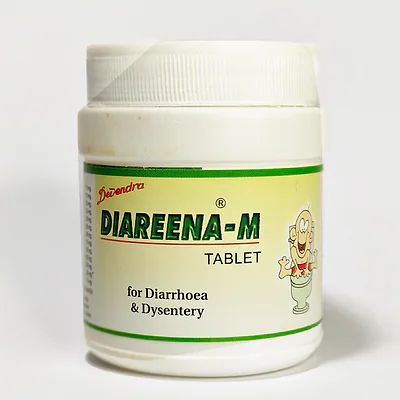
100 Tab: ₹75
Diareena M Tablets bring together Ayurveda's strongest stool-binding (Sangrahi) herbs — Kutaj, Lodhra, Dhataki, bael pulp, Mochras and catechu — with sal resin, white clay, Shankh bhasma and Swarna gairik, processed in Nagarmotha, mint and black cardamom.
The booklet says they act on the small and large intestine and lists them for diarrhoea, griping, mucus or blood in the stool, frothy stools, and acute and chronic dysentery.
Used for
- Diarrhoea (Atisara)
- Acute & chronic dysentery (Pravahika)
- Mucus in stools & griping
Why dysentery drags on
In dysentery the lining of the large bowel is inflamed — often by bacteria or amoebae — so stools come small, frequent and painful, with mucus and sometimes blood. Ongoing irritation keeps the gut over-active, and fluid and salts are lost.
Ayurveda calls this Pravahika: Vata, obstructed by Ama and Kapha in the colon, forces repeated straining. Treatment digests the Ama, binds and soothes the inflamed lining with astringents (Sangrahi) and calms Vata.
Diareena M works in 3 ways
- Antidysenteric & Antimicrobial (Atisaraghna) — Kutaj's conessine is antiamoebic and antibacterial, and catechu and bael are antimicrobial in experimental studies.
- Astringent & Stool-binding (Sangrahi) — Tannins from Lodhra, Dhataki, catechu and Mochras tighten the inflamed lining, while white clay adsorbs fluid and irritants; Mochras also protected the stomach lining in a rat study.
- Antispasmodic (Shoolaprashamana) — Kutaj relaxes gut smooth muscle in laboratory studies, and the Nagarmotha, mint and cardamom used in processing ease cramps.
Key ingredients
- Kutaj (Kurchi) (Holarrhena antidysenterica, stem bark) — 75 mg. Ayurveda's foremost herb for diarrhoea and dysentery (Atisara, Pravahika). Its steroidal alkaloids, chiefly conessine, are antiamoebic and antibacterial; in laboratory studies the bark extract relaxed gut smooth muscle by calcium-channel blockade.
- Lodhra (Symplocos racemosa, stem bark) — 75 mg. A bark Ayurveda uses for heavy periods, leucorrhoea, loose stools and the skin. Its tannins, flavonoids and loturine alkaloids are astringent, anti-inflammatory and antimicrobial in experimental studies.
- Dhataki (Dhai flowers) (Woodfordia fruticosa, flower) — 50 mg. The classical starter for Asava-Arishtas. Its flowers carry alcohol-producing yeasts (including Saccharomyces cerevisiae) and an invertase enzyme that splits sugar into fermentable glucose and fructose, raising the alcohol yield.
- Bilva (Bael) (Aegle marmelos, fruit pulp) — 100 mg. Unripe bael fruit is Ayurveda's classic food-medicine for loose stools and dysentery. Rich in tannins, mucilage and coumarins such as marmelosin, it is antidiarrhoeal, antimicrobial and anti-inflammatory in experimental studies.
- Mochras (Semal gum) (Bombax ceiba, gum) — 50 mg. The astringent gum of the silk-cotton tree, used in Ayurveda for diarrhoea, dysentery and bleeding. Its tannins and mucilage bind and soothe; the gum reduced gastric acidity and ulceration in a rat study, though clinical research is lacking.
- Katha (Catechu) (Acacia catechu, heartwood extract) — 30 mg. The concentrated heartwood extract of the khair tree, rich in catechins and epicatechin. Strongly astringent, it is antioxidant, anti-inflammatory and antimicrobial in experimental studies; Ayurveda uses it for diarrhoea, the mouth and skin disease.
- Gile safed (white clay) — 100 mg. Kaolin, a fine white clay, adsorbs fluid and irritants in the gut and was long a standard ingredient of antidiarrhoeal mixtures.
- Kajjali (black mercuric sulphide) — 10 mg. Purified mercury rubbed with purified sulphur into black mercuric sulphide — the base of many Rasa-shastra medicines. Mercuric sulphide is poorly absorbed, but mercury toxicity has been reported, so dose and duration matter.
Full ingredient list
- Kajjali (mercury rubbed with sulphur) — 10 mg
- Lodhra (Symplocos racemosa, stem bark) — 75 mg
- Dhataki pushpa (Woodfordia fruticosa, flower) — 50 mg
- Ral safed (Shorea robusta, resin) — 50 mg
- Shuddh swarna gairik (purified red ochre) — 30 mg
- Sonth (Zingiber officinale, rhizome) — 25 mg
- Shankh bhasma (calcined conch shell) — 50 mg
- Kutaj twak (Holarrhena antidysenterica, stem bark) — 75 mg
- Mochras (Bombax ceiba, gum) — 50 mg
- Bilvagiri (Aegle marmelos, fruit pulp) — 100 mg
- Gile safed (kaolin, white clay) — 100 mg
- Katha (Acacia catechu, heartwood extract) — 30 mg
- Kapoor (camphor) — 10 mg
Processed (bhavana) in
- Nagarmotha (Cyperus rotundus, rhizome)
- Podina (Mentha arvensis, leaf)
- Badi ilaychi (Amomum subulatum, fruit)
How to use
Dose: Adults: 1–2 tablets twice a day, or as directed by the physician.
- Take your dose — The dose above, or the one your physician gives.
- With water — Swallow with water (or milk, where the pack says so).
- Stay consistent — Take it at the same times each day, for the course advised.
Safety & suitability
- Who it's for: Adults; children only as a physician advises (contains Kajjali)
- Pregnancy & nursing: Not advised — see the cautions
- Other medicines: Tell your physician what else you take
- Diabetic?: Check the label and ask your physician
- Storage: Cool, dry place, away from direct sunlight
- Ingredients: See the full list below
Cautions
- Keep up fluids — take oral rehydration solution (ORS). See a doctor at once for blood in the stool, high fever, signs of dehydration, or diarrhoea lasting more than 2 days.
- Contains purified mercury (a traditional Rasa-shastra ingredient) in Kajjali. Take only at the stated dose and for the advised duration, under an Ayurvedic physician; not during pregnancy or breastfeeding, for children, or with kidney disease.
- Contains a small amount of camphor (Kapoor). Keep strictly to the dose and out of children's reach — camphor is poisonous in overdose, especially for young children.
More information
- Net content: 100 Tab
- Storage: Store below 30 °C in a cool, dry place, in the original pack.
- Country of origin: India
- Manufacturer: Devendra Ayurved Ashram Pvt. Ltd., A-12, Industrial Estate, Sujroo, Muzaffarnagar (U.P.) – 251003. Mfg. Lic. No. A-50/77/94 · GMP-certified company.
References
- Devendra Ayurved Ashram Pvt. Ltd. Vivran Pustika (product guide).
- Jamadagni PS, Pawar SD, Jamadagni SB, et al. Review of Holarrhena antidysenterica (L.) Wall. ex A. DC.: Pharmacognostic, Pharmacological, and Toxicological Perspective. Pharmacogn Rev. 2017;11(22):141-144.
- Gilani AH, Khan A, Khan AU, et al. Pharmacological basis for the medicinal use of Holarrhena antidysenterica in gut motility disorders. Pharm Biol. 2010;48(11):1240-6.
- Acharya N, Acharya S, Shah U, et al. A comprehensive analysis on Symplocos racemosa Roxb.: Traditional uses, botany, phytochemistry and pharmacological activities. J Ethnopharmacol. 2016;181:236-51.
- Manwar J, Mahadik K, Paradkar A, et al. Isolation, biochemical and genetic characterizations of alcohol-producing yeasts from the flowers of Woodfordia fruticosa. J Young Pharm. 2013;5(4):191-4.
- Kroes BH, van den Berg AJ, Abeysekera AM, et al. Fermentation in traditional medicine: the impact of Woodfordia fruticosa flowers on the immunomodulatory activity, and the alcohol and sugar contents of Nimba arishta. J Ethnopharmacol. 1993;40(2):117-25.
- Manandhar B, Paudel KR, Sharma B, et al. Phytochemical profile and pharmacological activity of Aegle marmelos Linn. J Integr Med. 2018;16(3):153-163.
- Monika S, Thirumal M, Kumar PR. Phytochemical and biological review of Aegle marmelos Linn. Future Sci OA. 2023;9(3):FSO849.
- Upadhyay SS, Parate SS, D'Souza UP, et al. An Integrative Omics and Network Pharmacology Approach to Evaluate the Antiulcer Activity of Bombax ceiba L. Gum in Rats. ACS Omega. 2025;10(48):59044-59055.
- Kumari M, Radha, Kumar M, et al. Acacia catechu (L.f.) Willd.: A Review on Bioactive Compounds and Their Health Promoting Functionalities. Plants (Basel). 2022;11(22).
- Joshi N, Dash MK, Upadhyay C, et al. Physico-chemical characterization of kajjali, black sulphide of mercury, with respect to the role of sulfur in its formation and structure. J Ayurveda Integr Med. 2021;12(4):590-600.
- Kamath SU, Pemiah B, Sekar RK, et al. Mercury-based traditional herbo-metallic preparations: a toxicological perspective. Arch Toxicol. 2012;86(6):831-8.