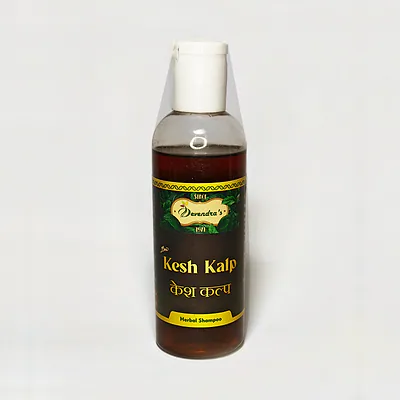
Dev Keshkalp
Ayurvedic herbal shampoo with Shikakai, Reetha, Amla and Bhringraj
The herbs your grandmother washed her hair with — in a bottle.
100 mL: ₹120 · 200 mL: ₹220
Dev Keshkalp is a herbal shampoo built on India's two traditional hair-washes, Shikakai and Reetha (soapnut), with Amla, Bhringraj, henna, neem, aloe, tulsi, fenugreek, licorice, Jatamansi and kalonji, plus lemon juice.
The pack describes it for hair fall, greying and dandruff, and for shiny, strong hair. Here we describe what its herbs are known to do.
Used for
- Gentle herbal hair wash
- Dandruff & itchy scalp
- Hair fall (Khalitya) — traditional use
- Dull, dry hair
Why hair falls and flakes
Dandruff is mostly the work of Malassezia, a yeast that thrives on an oily scalp and irritates it into flaking and itching. Hair shedding has many causes, from stress, illness and diet to hormones and genes, and harsh detergents can leave hair dry and brittle.
Ayurveda calls hair fall Khalitya and early greying Palitya, both traced to aggravated Pitta reaching the scalp along with Vata; dandruff (Darunaka) is a Kapha–Vata disorder. Its answer is cleansing with natural saponin herbs and applying Keshya herbs that cool Pitta and nourish the hair.
Dev Keshkalp works in 3 ways
- Gentle Cleansing (Prakshalana) — Shikakai and Reetha are rich in saponins, natural foaming agents that lift oil and dirt more gently than many synthetic detergents.
- Anti-dandruff (Darunaka-hara) — Neem and henna are antifungal: in laboratory tests a rosemary–neem extract outperformed ketoconazole against Malassezia, the dandruff yeast. Aloe soothes an itchy scalp.
- Hair Tonic (Keshya) — Bhringraj, 'king of hair', and Amla are Ayurveda's classic hair tonics; in laboratory studies Amla blocked 5α-reductase, the enzyme behind pattern hair loss, and Jatamansi promoted hair growth.
Key ingredients
- Shikakai (Acacia concinna, fruit) — 5 g. Shikakai pods are rich in saponins, natural foaming agents that wash the hair and scalp gently. It has been India's traditional hair-wash for centuries and is a staple of herbal shampoos.
- Reetha (Soapnut) (Sapindus trifoliatus, fruit) — 5 g. Soapnut's pericarp is rich in triterpenoid saponins — natural surfactants that lather and lift dirt and oil — which is why Reetha has washed hair in India for centuries.
- Bhringraj (Eclipta alba, whole plant) — 5 g. Bhringraj — literally 'king of hair' — is Ayurveda's foremost herb for hair fall and early greying. Its coumestans (wedelolactone) are under study; the evidence is mostly traditional and experimental.
- Amalaki (Amla) (Emblica officinalis, fruit) — 5 g. Amla is a traditional hair tonic. In a laboratory screen of 17 plants used for hair care, its extract was the second most potent inhibitor of 5α-reductase, the enzyme behind pattern hair loss.
- Neem (Azadirachta indica, leaf) — 5 g. Neem leaf is antifungal and anti-inflammatory. In laboratory tests a combined rosemary–neem extract was more active than ketoconazole against Malassezia furfur, the yeast behind dandruff.
- Mehendi (Henna) (Lawsonia inermis, leaf) — 5 g. Henna leaf coats the hair shaft and is antifungal in experimental studies. Natural henna rarely causes allergy; 'black henna', which contains the dye PPD, is the usual culprit.
- Ghritkumari (Aloe vera) (Aloe barbadensis, leaf) — 5 g. Aloe gel's polysaccharides soothe and moisturise skin; dermatology reviews describe anti-inflammatory and antifungal effects, mostly from experimental studies.
- Jatamansi (Nardostachys jatamansi, rhizome) — 5 g. Ayurveda uses Jatamansi in hair oils. Its rhizome extract and isolated terpenoids promoted hair growth in laboratory studies.
Full ingredient list
Extract of
- Nimb patra (Azadirachta indica, leaf) — 5 g
- Ghrit kumari (Aloe barbadensis, leaf) — 5 g
- Tulsi patra (Ocimum sanctum, leaf) — 5 g
- Methi (Trigonella foenum-graecum, seed) — 5 g
- Shikakai (Acacia concinna, fruit) — 5 g
- Amla (Emblica officinalis, fruit) — 5 g
- Reetha (Sapindus trifoliatus, fruit) — 5 g
- Bhringraj (Eclipta alba, whole plant) — 5 g
- Mehendi patra (Lawsonia inermis, leaf) — 5 g
- Mulethi (Glycyrrhiza glabra, root) — 5 g
- Balchad (Nardostachys jatamansi, rhizome) — 5 g
- Kalonji (Nigella sativa, seed) — 5 g
- Nimbu Ras (Citrus limon, fruit) — 10 g
Base
- Shampoo base, fragrance and preservative (as approved) — q.s.
How to use
Dose: Apply a little to wet hair and scalp, work into a lather, leave for a short while, then rinse thoroughly — or as directed by the physician.
- Wet — Wet the hair and scalp with lukewarm water.
- Massage — Work a little Dev Keshkalp into the scalp and through the hair.
- Wait and rinse — Leave it on for a minute or two, then rinse thoroughly.
Safety & suitability
- Who it's for: Adults; children only as a physician advises
- Pregnancy & nursing: Ask your physician before use
- Other medicines: Tell your physician what else you take
- Sensitive skin: Patch test first
- Storage: Cool, dry place, away from direct sunlight
- Ingredients: See the full list below
Cautions
- For external use only. Keep out of the eyes — if it gets in, rinse well with water.
- Try it on a small patch of skin first if you have sensitive skin or a henna allergy; stop if the scalp becomes red, itchy or sore.
- Do not use if the liquid shows sediment, fungus or foreign particles (as the pack says).
- Sudden, patchy or heavy hair loss needs a doctor's check.
More information
- Net content: 100 mL · 200 mL
- Storage: Store below 30 °C, away from direct sunlight. Keep the cap tightly closed.
- Country of origin: India
- Manufacturer: Devendra Ayurved Ashram Pvt. Ltd., A-12, Industrial Estate, Sujroo, Muzaffarnagar (U.P.) – 251003. Mfg. Lic. No. A-50/77/94 · GMP-certified company.
References
- Sang SH, Akowuah GA, Liew KB, et al. Natural alternatives from your garden for hair care: Revisiting the benefits of tropical herbs. Heliyon. 2023;9(11):e21876.
- Dubey S, Nema N, Nayak S. Preparation and evaluation of herbal shampoo powder. Anc Sci Life. 2004;24(1):38-44.
- Sochacki M, Vogt O. Triterpenoid Saponins from Washnut (Sapindus mukorossi Gaertn.)-A Source of Natural Surfactants and Other Active Components. Plants (Basel). 2022;11(18).
- Jahan R, Al-Nahain A, Majumder S, et al. Ethnopharmacological Significance of Eclipta alba (L.) Hassk. (Asteraceae). Int Sch Res Notices. 2014;2014:385969.
- Kumar N, Rungseevijitprapa W, Narkkhong NA, et al. 5α-reductase inhibition and hair growth promotion of some Thai plants traditionally used for hair treatment. J Ethnopharmacol. 2012;139(3):765-71.
- Hashem MM, Attia D, Hashem YA, et al. Rosemary and neem: an insight into their combined anti-dandruff and anti-hair loss efficacy. Sci Rep. 2024;14(1):7780.
- Badoni Semwal R, Semwal DK, Combrinck S, et al. Lawsonia inermis L. (henna): ethnobotanical, phytochemical and pharmacological aspects. J Ethnopharmacol. 2014;155(1):80-103.
- de Groot AC. Side-effects of henna and semi-permanent 'black henna' tattoos: a full review. Contact Dermatitis. 2013;69(1):1-25.
- Feily A, Namazi MR. Aloe vera in dermatology: a brief review. G Ital Dermatol Venereol. 2009;144(1):85-91.
- Gottumukkala VR, Annamalai T, Mukhopadhyay T. Phytochemical investigation and hair growth studies on the rhizomes of Nardostachys jatamansi DC. Pharmacogn Mag. 2011;7(26):146-50.