Dee Kuf Syrup
Ayurvedic cough syrup for breathlessness and cough
Thick phlegm keeps a cough going. Dee Kuf loosens it and lets your chest settle.
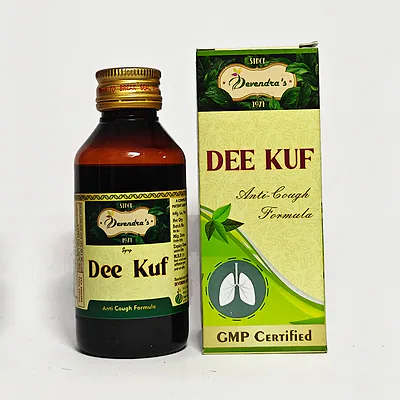
60 mL: ₹50 · 100 mL: ₹75
Dee Kuf is an Ayurvedic cough syrup that the pack describes as an excellent medicine for Shwasa and Kasa — breathlessness and cough. Eight herbs and two classical salts work together to thin phlegm, open the airways and calm an irritated throat.
It is built around Vasaka, Kantakari and Bibhitaki, three of Ayurveda's most-used herbs for cough, with Somlata (ephedra) to ease a tight chest.
Used for
- Cough (Kasa)
- Breathlessness (Shwasa)
- Hoarse or sore throat
Why a cough lingers
A cough is a protective reflex: the airways throwing out whatever irritates them. It drags on when mucus turns thick and sticky — every cough is hard work, and the irritated lining triggers the next one.
Ayurveda describes Kasa as aggravated Kapha clogging Pranavaha Srotas, the channels of breath, so that Prana and Udana Vayu are forced upward and out as a cough; when the narrowed airways also leave you breathless, it is Shwasa. In modern terms: mucus hypersecretion, sluggish mucociliary clearance, airway inflammation and, at times, bronchospasm.
Dee Kuf works in 3 ways
- Mucolytic & Expectorant (Kaphanissaraka) — Vasaka's alkaloid vasicine — the template for the mucolytic drugs bromhexine and ambroxol — works with Bibhitaki and the saline salt Narsar to thin sticky phlegm and help clear it.
- Bronchodilator (Shwasahara) — Somlata supplies ephedrine, which relaxes airway smooth muscle through β₂-adrenergic receptors; Kantakari and Apamarga have eased bronchospasm in clinical and laboratory studies.
- Antitussive & Soothing (Kasahara & Kanthya) — Banafsha shortened cough in a trial in asthmatic children, and menthol from peppermint raises the cough-reflex threshold.
Key ingredients
- Vasaka (Arusa) (Adhatoda vasica, leaf) — 200 mg. Ayurveda's foremost herb for cough. Its alkaloids vasicine and vasicinone thinned secretions, quietened coughing and relaxed constricted airways in animal studies, and vasicine is the natural template from which the mucolytic drugs bromhexine and ambroxol were developed.
- Somlata (Ephedra) (Ephedra vulgaris, stem) — 100 mg. Ephedra's main alkaloid, ephedrine, stimulates adrenergic receptors — directly and by releasing noradrenaline. Through β₂-receptors it relaxes bronchial smooth muscle, which is why it was long used for wheeze. The same stimulation can raise heart rate and blood pressure: see the cautions.
- Kantakari (Solanum virginianum (S. surattense), whole plant) — 200 mg. A classic Ayurvedic herb for cough and wheeze. In a small clinical study in mild-to-moderate asthma it improved peak expiratory flow and eased cough and breathlessness over three days, comparable to deriphylline; a polysaccharide from its leaves suppressed cough in guinea pigs.
- Bahera (Bibhitaki) (Terminalia bellirica, fruit) — 200 mg. The Triphala fruit Ayurveda reserves for Kapha in the throat and chest (Kasahara, Kanthya). Rich in gallic and ellagic acids and other tannins, it is antioxidant, anti-inflammatory and antimicrobial in laboratory studies.
- Banafsha (Viola odorata, whole plant) — 100 mg. Sweet violet, a Unani and Ayurvedic staple for cough. In a double-blind trial in 182 children with intermittent asthma, violet syrup added to standard care cleared cough faster than placebo.
- Apamarga (Achyranthes aspera, whole plant) — 100 mg. Valued in Ayurveda for respiratory complaints. In animal studies its extract relaxed constricted airways much as aminophylline does, stabilised mast cells and lowered allergic markers (IgE and Th2 cytokines).
- Narsar (ammonium chloride) — 50 mg. A classical 'saline expectorant', thought to act by a reflex from the stomach that increases airway secretions and thins phlegm. It is the standard reference expectorant in animal studies; clinical evidence in people is limited.
- Peppermint (Mentha × piperita) — 5 mg. Menthol activates the cold-sensing TRPM8 receptor in the airways and gut, giving a cooling feel, damping the cough reflex and relaxing intestinal smooth muscle; in a human study, menthol vapour raised the cough threshold.
Full ingredient list
Liquid extract of
- Somlata (Ephedra vulgaris, stem) — 100 mg
- Kantkari (Solanum virginianum (S. surattense), whole plant) — 200 mg
- Anartwak (Punica granatum, seed) — 100 mg
- Bahera (Terminalia bellirica, fruit) — 200 mg
- Kulanjan (Alpinia galanga, rhizome) — 25 mg
- Arusa (Adhatoda vasica, leaf) — 200 mg
- Banafsa (Viola odorata, whole plant) — 100 mg
- Apamarg (Achyranthes aspera, whole plant) — 100 mg
- Narsar (ammonium chloride) — 50 mg
- Suryakshar (potassium nitrate) — 50 mg
- Piperment (Mentha × piperita) — 5 mg
- Chini (sugar) — 5 g
- Satloban (sodium benzoate) — q.s.
- Colour (approved red) — q.s.
- Essence (sweet orange) — q.s.
How to use
Dose: 5–15 mL three to four times a day, with hot water, or as directed by the physician.
- Shake well — Shake the bottle before each dose.
- Measure the dose — Use the measuring cap — the dose above, or the one your physician gives.
- Keep a routine — Take it at the same times each day, for as long as advised.
Safety & suitability
- Who it's for: Adults; children only at the dose a physician sets
- Pregnancy & nursing: Ask your physician before use
- Other medicines: Tell your physician what else you take
- Diabetic?: Contains sugar (5 g per 10 mL) — ask your physician
- Storage: Cool, dry place, away from direct sunlight
- Ingredients: See the full list below
Cautions
- Contains Somlata (ephedra), a source of ephedrine, which can raise heart rate and blood pressure. Ask a doctor before use if you have heart disease, high blood pressure, diabetes, thyroid disease, seizures, narrow-angle glaucoma, a psychiatric condition, or trouble urinating due to an enlarged prostate. Do not take with a prescription MAO-inhibitor antidepressant, or within 2 weeks of stopping one.
- Contains sugar (5 g per 10 mL) — people with diabetes should ask their physician first.
- Do not use if any precipitate, fungus or foreign particle is found — replace the bottle.
More information
- Net content: 60 mL · 100 mL
- Storage: Keep in a cool, dry place away from direct sunlight. Close the cap tightly after use.
- Country of origin: India
- Manufacturer: Devendra Ayurved Ashram Pvt. Ltd., A-12, Industrial Estate, Sujroo, Muzaffarnagar (U.P.) – 251003. Mfg. Lic. No. A-50/77/94 · GMP-certified company.
References
- Liu W, Wang Y, He DD, et al. Antitussive, expectorant, and bronchodilating effects of quinazoline alkaloids (±)-vasicine, deoxyvasicine, and (±)-vasicinone from aerial parts of Peganum harmala L. Phytomedicine. 2015;22(12):1088-95.
- Grange JM, Snell NJ. Activity of bromhexine and ambroxol, semi-synthetic derivatives of vasicine from the Indian shrub Adhatoda vasica, against Mycobacterium tuberculosis in vitro. J Ethnopharmacol. 1996;50(1):49-53.
- Claeson UP, Malmfors T, Wikman G, et al. Adhatoda vasica: a critical review of ethnopharmacological and toxicological data. J Ethnopharmacol. 2000;72(1-2):1-20.
- Statler AK, Maani CV, Kohli A. Ephedrine. StatPearls. 2023.
- Shekelle PG, Hardy ML, Morton SC, et al. Efficacy and safety of ephedra and ephedrine for weight loss and athletic performance: a meta-analysis. JAMA. 2003;289(12):1537-45.
- US Code of Federal Regulations, 21 CFR 341.76 — labeling of bronchodilator drug products (ephedrine warnings).
- Govindan S, Viswanathan S, Vijayasekaran V, et al. Further studies on the clinical efficacy of Solanum xanthocarpum and Solanum trilobatum in bronchial asthma. Phytother Res. 2004;18(10):805-9.
- Raja W, Nosalova G, Ghosh K, et al. In vivo antitussive activity of a pectic arabinogalactan isolated from Solanum virginianum L. in Guinea pigs. J Ethnopharmacol. 2014;156:41-6.
- Gupta A, Kumar R, Bhattacharyya P, et al. Terminalia bellirica (Gaertn.) roxb. (Bahera) in health and disease: A systematic and comprehensive review. Phytomedicine. 2020;77:153278.
- Qasemzadeh MJ, Sharifi H, Hamedanian M, et al. The Effect of Viola odorata Flower Syrup on the Cough of Children With Asthma: A Double-Blind, Randomized Controlled Trial. J Evid Based Complementary Altern Med. 2015;20(4):287-91.
- Kaushik A, Singh DP, Sahu M, et al. Protective effect of Achyranthes aspera against compound 48/80, histamine and ovalbumin-induced allergic disorders in murine model. Mol Biol Rep. 2024;51(1):202.
- Wise PM, Breslin PA, Dalton P. Sweet taste and menthol increase cough reflex thresholds. Pulm Pharmacol Ther. 2012;25(3):236-41.
- Stinson RJ, Morice AH, Sadofsky LR. Modulation of transient receptor potential (TRP) channels by plant derived substances used in over-the-counter cough and cold remedies. Respir Res. 2023;24(1):45.