Dee Compound Syrup
Ayurvedic women's tonic with Ashoka and the five astringent barks
For the tired, run-down feeling that monthly cycles can leave behind.
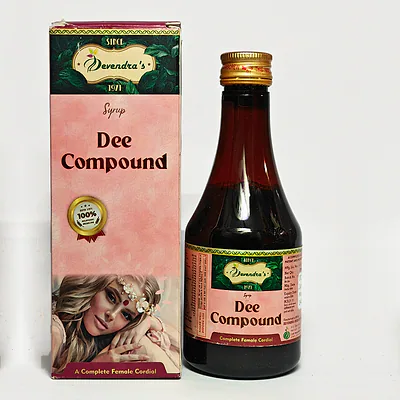
200 mL: ₹140
Dee Compound is an Ayurvedic women's tonic built on Ashoka bark and the classical Panchavalkala — the astringent barks of banyan, cluster fig, sacred fig and Plaksha — with Punarnava, Triphala, Lodhra, Giloy, Ashwagandha and more, as an ark (distillate).
The pack says it relieves physical weakness and women's complaints; the booklet lists white and red discharge, uterine weakness and irregular periods. It can be taken with Lukonil tablets or capsules, as the booklet suggests.
Used for
- Women's tonic — physical weakness
- White discharge (Shweta pradara) — traditional use
- Irregular periods — traditional use
Why monthly cycles can wear you down
Heavy or frequent periods, recurring discharge and the low iron that heavy bleeding brings can leave you weak, tired and achy in the back and lower belly. Hormonal shifts, infections and pelvic congestion are common causes.
Ayurveda calls white discharge Shweta pradara and heavy bleeding Rakta pradara, arising when Kapha, Pitta and Vata disturb the uterus and Rakta. The classical response uses cooling, astringent barks (Kashaya rasa) to tone the uterus and check discharges, with Rasayanas to rebuild strength.
Dee Compound works in 3 ways
- Astringent Barks (Panchavalkala, Stambhana) — Ashoka and the fig barks — banyan, cluster fig and sacred fig — are rich in tannins and anti-inflammatory and antimicrobial in experimental studies; Ayurveda uses them for discharges and bleeding.
- Uterine Tonic (Garbhashaya-balya) — Ashoka, Lodhra and Nagkeshar are Ayurveda's classic herbs for uterine weakness and heavy periods; modern clinical evidence is still limited.
- Strength & Fluid Balance (Rasayana, Shothahara) — Ashwagandha and Giloy are Rasayanas — ashwagandha eased stress in meta-analyses of trials — and Punarnava, the largest herb here, is diuretic and anti-inflammatory.
Key ingredients
- Ashoka (Saraca asoca, stem bark) — 667 mg. Ayurveda's best-known herb for women — its name means 'without sorrow'. The bark is rich in catechins and other tannins and is traditionally used for heavy or painful periods and uterine weakness; modern clinical research on it is still limited.
- Punarnava (Boerhavia diffusa, whole plant) — 267 mg. Its name means 'renews the body'. Ayurveda uses it for swelling (Shotha), the kidneys and the liver; its rotenoids and flavonoids are diuretic, anti-inflammatory and hepatoprotective in experimental studies.
- Vat (Banyan) (Ficus bengalensis, stem bark) — 133 mg. Banyan bark, one of the Panchavalkala, is cooling and astringent in Ayurveda, used for discharges, bleeding and Prameha. Reviews describe antioxidant, anti-inflammatory, antidiabetic and wound-healing activity in experimental studies.
- Gular (Udumbara) (Ficus glomerata, fruit) — 133 mg. Cluster-fig bark, one of the Panchavalkala, used in Ayurveda for discharges, bleeding and Prameha. It is antidiabetic, anti-inflammatory, antidiarrhoeal and antioxidant in experimental studies, with a few small clinical studies.
- Ashvattha (Sacred fig) (Ficus religiosa, bark) — 133 mg. Sacred-fig bark, one of the Panchavalkala. Ayurveda uses it for discharges, bleeding and wounds; extracts are anti-inflammatory, antimicrobial and wound-healing in experimental studies.
- Pakhar (Plaksha) (Ficus lacor, stem bark) — 133 mg. One of the five classical astringent barks (Panchavalkala) Ayurveda uses for discharges and wounds. Its extracts were anti-inflammatory in an animal arthritis model; research is limited.
- Lodhra (Symplocos racemosa, stem bark) — 67 mg. A bark Ayurveda uses for heavy periods, leucorrhoea, loose stools and the skin. Its tannins, flavonoids and loturine alkaloids are astringent, anti-inflammatory and antimicrobial in experimental studies.
- Ashwagandha (Withania somnifera, root) — 67 mg. Ayurveda's best-known Balya-Rasayana. In randomised trials ashwagandha root extract lowered perceived stress and cortisol and improved sleep and muscle strength; its withanolides are the main active constituents.
- Giloy (Guduchi) (Tinospora cordifolia, stem) — 67 mg. A Rasayana for chronic fever and immunity. Its polysaccharides, alkaloids and diterpenoids are immunomodulatory, antipyretic and anti-inflammatory in experimental studies. Rare liver injury has been reported, possibly from mis-identified Tinospora species.
- Nagkesar (Mesua ferrea, stamen) — 33 mg. Fragrant stamens Ayurveda uses for bleeding piles and heavy periods (Raktastambhana). They are rich in coumarins and xanthones; laboratory studies report antimicrobial and antioxidant activity, and a subacute rat study of the flower extract found no toxicity.
Full ingredient list
Distillate (ark) of
- Ashok Chhaal (Saraca asoca, stem bark) — 667 mg
- Nagkeshar (Mesua ferrea, stamen) — 33 mg
- Giloya (Tinospora cordifolia, stem) — 67 mg
- Pakhar Chhaal (Ficus lacor, stem bark) — 133 mg
- Kamal Gatta (Nelumbo nucifera, seed) — 33 mg
- Lodh (Symplocos racemosa, stem bark) — 67 mg
- Gular Chaal (Ficus glomerata, fruit) — 133 mg
- Shivlingi (Bryonia laciniosa, seed) — 13 mg
- Arusa (Adhatoda vasica, leaf) — 133 mg
- Babool Chhaal (Acacia nilotica, stem bark) — 67 mg
- Padhal (Stereospermum suaveolens, fruit) — 13 mg
- Ashwagandha (Withania somnifera, root) — 67 mg
- Pipal Chhaal (Ficus religiosa, bark) — 133 mg
- Jirak (Carum carvi, fruit) — 33 mg
- Patang (Caesalpinia sappan, heartwood) — 67 mg
- Vat Chhaal (Ficus bengalensis, stem bark) — 133 mg
- Bach (Acorus calamus, rhizome) — 33 mg
- Her (Terminalia chebula, fruit) — 67 mg
- Bahera (Terminalia bellirica, fruit) — 67 mg
- Anwla (Emblica officinalis, dried fruit) — 67 mg
- Punarnava (Boerhavia diffusa, whole plant) — 267 mg
- Maju Phal (Quercus infectoria, gall) — 33 mg
- Laxmana (Ipomoea sepiaria, whole plant) — 13 mg
- Chini (sugar) — 8 g
- Colour, Essence, Preservative (added as approved) — q.s.
How to use
Dose: 4–8 mL twice a day with water, or as directed by the physician.
- Shake well — Shake the bottle before each dose.
- Measure the dose — Use the measuring cap — the dose above, or the one your physician gives.
- Keep a routine — Take it at the same times each day, for as long as advised.
Safety & suitability
- Who it's for: Adults; children only at the dose a physician sets
- Pregnancy & nursing: Not during pregnancy unless your doctor advises it
- Other medicines: Tell your physician what else you take
- Diabetic?: Contains sugar (8 g per 16 mL) — ask your physician
- Storage: Cool, dry place, away from direct sunlight
- Ingredients: See the full list below
Cautions
- Very heavy bleeding, bleeding between periods or after menopause, foul-smelling or blood-stained discharge, or pelvic pain with fever needs a gynaecologist.
- Contains Bach (Acorus calamus): keep to the stated dose and do not use for long periods without a physician.
- Contains sugar (8 g per 16 mL) — people with diabetes should ask their physician first.
- Do not use if any precipitate, fungus or foreign particle is found — replace the bottle.
More information
- Net content: 200 mL
- Storage: Keep in a cool, dry place away from direct sunlight. Close the cap tightly after use.
- Country of origin: India
- Manufacturer: Devendra Ayurved Ashram Pvt. Ltd., A-12, Industrial Estate, Sujroo, Muzaffarnagar (U.P.) – 251003. Mfg. Lic. No. A-50/77/94 · GMP-certified company.
References
- Akhgarjand C, Asoudeh F, Bagheri A, et al. Does Ashwagandha supplementation have a beneficial effect on the management of anxiety and stress? A systematic review and meta-analysis of randomized controlled trials. Phytother Res. 2022;36(11):4115-4124.
- Urumarudappa SKJ, Rosario S, G R, et al. A comprehensive review on Saraca asoca (Fabaceae) - Historical perspective, traditional uses, biological activities, and conservation. J Ethnopharmacol. 2023;317:116861.
- Mishra S, Aeri V, Gaur PK, et al. Phytochemical, therapeutic, and ethnopharmacological overview for a traditionally important herb: Boerhavia diffusa Linn. Biomed Res Int. 2014;2014:808302.
- Murugesu S, Selamat J, Perumal V. Phytochemistry, Pharmacological Properties, and Recent Applications of Ficus benghalensis and Ficus religiosa. Plants (Basel). 2021;10(12).
- Yadav RK, Nandy BC, Maity S, et al. Phytochemistry, pharmacology, toxicology, and clinical trial of Ficus racemosa. Pharmacogn Rev. 2015;9(17):73-80.
- Singh D, Singh B, Goel RK. Traditional uses, phytochemistry and pharmacology of Ficus religiosa: a review. J Ethnopharmacol. 2011;134(3):565-83.
- Sindhu RK, Arora S. Therapeutic Effect of Ficus lacor Aerial Roots of Various Fractions on Adjuvant-Induced Arthritic Rats. ISRN Pharmacol. 2013;2013:634106.
- Singh P, Ranjan R, Tripathi R, et al. GC-MS and NMR spectroscopy based metabolite profiling of Panchvalkal kwath (polyherbal formulation). Nat Prod Res. 2023;37(7):1221-1226.
- Acharya N, Acharya S, Shah U, et al. A comprehensive analysis on Symplocos racemosa Roxb.: Traditional uses, botany, phytochemistry and pharmacological activities. J Ethnopharmacol. 2016;181:236-51.
- Bonilla DA, Moreno Y, Gho C, et al. Effects of Ashwagandha (Withania somnifera) on Physical Performance: Systematic Review and Bayesian Meta-Analysis. J Funct Morphol Kinesiol. 2021;6(1).
- Fatima K, Malik J, Muskan F, et al. Safety and efficacy of Withania somnifera for anxiety and insomnia: Systematic review and meta-analysis. Hum Psychopharmacol. 2024;39(6):e2911.
- Yates CR, Bruno EJ, Yates MED. Tinospora Cordifolia: A review of its immunomodulatory properties. J Diet Suppl. 2022;19(2):271-285.
- Kumar P, Kamle M, Mahato DK, et al. Tinospora cordifolia (Giloy): Phytochemistry, Ethnopharmacology, Clinical Application and Conservation Strategies. Curr Pharm Biotechnol. 2020;21(12):1165-1175.
- Philips CA, Theruvath AH. A comprehensive review on the hepatotoxicity of herbs used in the Indian (Ayush) systems of alternative medicine. Medicine (Baltimore). 2024;103(16):e37903.
- Panneer Selvam K, Payyappallimana U, Ravikumar K, et al. Can Guduchi (Tinospora cordifolia), a well-known ayurvedic hepato-protectant cause liver damage?. J Ayurveda Integr Med. 2023;14(1):100658.
- Konyanee A, Chaniad P, Phuwajaroanpong A, et al. Exploring the potential antimalarial properties, safety profile, and phytochemical composition of Mesua ferrea Linn. PLoS One. 2024;19(12):e0312047.
- Shirsat P, A R Z, Kashikar R, et al. Subacute toxicity study of the ethanolic extract of Mesua ferrea (L.) flowers in rats. Drug Chem Toxicol. 2022;45(4):1570-1577.