D.A. Pyrine Tablet
Ayurvedic pain-relief tablets for back, joint and nerve pain
When Vata flares, it hurts. D.A. Pyrine is a classical answer to Vata pain.
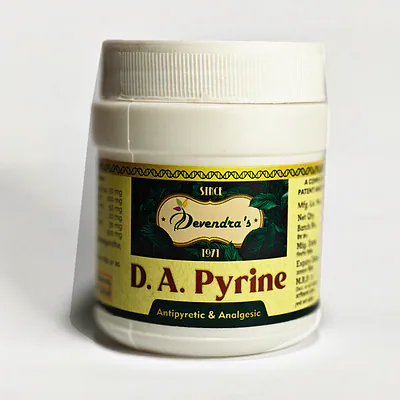
100 Tab: ₹75
D.A. Pyrine is an Ayurvedic analgesic for Vata pain — the aching, shooting and stiff pain of the back, joints and nerves. Purified Kuchla (nux vomica) and Suranjan (Colchicum) lead the formula, with dry ginger, long pepper, colocynth and aloe latex, processed in Rasna, Punarnava, Malkangni, Ashwagandha and Vidhara.
The booklet says it acts mainly on the nerves (Vatavahini nadi) and that its liver-stimulating, diuretic herbs help clear uric acid from the blood and joints. It lists low-back pain, sciatica (Gridhrasi), joint pain, neuritis, headache and the pain of injuries.
Used for
- Low-back pain & sciatica (Gridhrasi)
- Joint pain (Sandhivata) — traditional use
- Nerve pain (Vata-shoola)
- Body ache & injury pain
Why Vata pain sets in
Back, joint and nerve pain usually comes from inflamed or worn joints, strained muscles, or a nerve pinched or irritated on its way out of the spine (as in sciatica). Inflammatory signals sensitise pain nerves, so movement hurts and stiffness builds; in gout, uric-acid crystals in the joint set off an intense inflammatory reaction.
Ayurveda calls this Vatavyadhi: dry, cold, mobile Vata, aggravated by age, overexertion or cold, or blocked by Ama (as in Amavata), lodges in joints and nerves and causes pain (Shoola), stiffness and cracking. Treatment calms Vata, digests Ama and eases pain (Vedanasthapana).
D.A. Pyrine eases pain in 3 ways
- Nervine Analgesic (Vedanasthapana) — Purified Kuchla's alkaloids strychnine and brucine are analgesic and anti-inflammatory in experimental studies; Ayurveda uses it in tiny, purified doses for nerve pain.
- Anti-inflammatory & Anti-gout (Shothahara) — Suranjan supplies colchicine, which stops white cells entering inflamed joints — the basis of its use in gout — and Rasna and Malkangni are anti-inflammatory in experimental studies.
- Clearing Ama (Pachana, Virechana) — Dry ginger and long pepper digest Ama, and colocynth and aloe latex purge it — the classical approach to Amavata.
Key ingredients
- Kuchla (Nux vomica) (Strychnos nux-vomica, seed) — 50 mg. Purified nux-vomica seed, used in Ayurveda for nerve pain, paralysis and weak digestion. Its alkaloids strychnine and brucine are analgesic and anti-inflammatory in experimental studies — and toxic, which is why purification and exact dosing are essential.
- Suranjan (Colchicum) (Colchicum luteum, seed) — 30 mg. The Unani remedy for gout and joint pain. Colchicum's alkaloid colchicine stops white blood cells from migrating into the joint by binding tubulin — the same drug doctors use for gout — and is toxic in excess.
- Sonth (Dry ginger) (Zingiber officinale, rhizome) — 100 mg. Ayurveda's 'universal medicine' (Vishwabheshaja) for weak digestion. Its gingerols and shogaols speed gastric emptying and calm nausea; a systematic review of clinical trials found about 1.5 g a day in divided doses relieves nausea.
- Pippali (Long pepper) (Piper longum, fruit) — 100 mg. A classical Rasayana for the respiratory tract and digestion. Like black pepper it carries piperine, plus piperlongumine; it is anti-inflammatory, bronchoprotective and bioavailability-enhancing in experimental studies.
- Indrayan (Colocynth) (Citrullus colocynthis, fruit) — 50 mg. Bitter apple, one of the strongest purgatives in traditional medicine. Its cucurbitacins are cathartic and anti-inflammatory and it lowers blood glucose in experimental studies; overdose causes severe, bloody diarrhoea.
- Rasna (Pluchea lanceolata, leaf). Ayurveda's leading herb for Vata pain and joints (Vatahara, Amavatahara). Its flavonoids and triterpenes are anti-inflammatory, analgesic and anti-arthritic in experimental studies.
- Malkangni (Jyotishmati) (Celastrus paniculatus, seed). Jyotishmati, 'the luminous one', is a classical nerve and memory tonic, also used for Vata pain. Its sesquiterpene esters are neuroprotective, memory-enhancing and anti-inflammatory in experimental studies.
- Elva (Aloe latex) (Aloe barbadensis, leaf) — 20 mg. The dried bitter latex of aloe leaves. Its anthraquinones (aloin, aloe-emodin) are stimulant laxatives; Ayurveda also uses it to bring on delayed periods, so it is avoided in pregnancy. Overuse can cause diarrhoea and low potassium.
Full ingredient list
- Shudh Kuchla (Strychnos nux-vomica, seed) — 50 mg
- Sonth (Zingiber officinale, rhizome) — 100 mg
- Indrayanfal (Citrullus colocynthis, fruit) — 50 mg
- Elva (Aloe barbadensis, leaf) — 20 mg
- Suranjanshiri (Colchicum luteum, seed) — 30 mg
- Pippali (Piper longum, fruit) — 100 mg
Processed (bhavana) in
- Punarnava (Boerhavia diffusa)
- Rasna (Pluchea lanceolata)
- Ashwagandha (Withania somnifera)
- Bidhara (Argyreia nervosa)
- Malkangini (Celastrus paniculatus)
How to use
Dose: Adults: 1–2 tablets twice a day with cow's milk or warm water, or as directed by the physician. Do not exceed 4 tablets a day.
- Take your dose — The dose above, or the one your physician gives.
- With water — Swallow with water (or milk, where the pack says so).
- Stay consistent — Take it at the same times each day, for the course advised.
Safety & suitability
- Who it's for: Adults only
- Pregnancy & nursing: Not advised — see the cautions
- Other medicines: Tell your physician what else you take
- Diabetic?: Sugar-coated tablet — ask your physician
- Storage: Cool, dry place, away from direct sunlight
- Ingredients: See the full list below
Cautions
- The pack says: to be taken under medical supervision only.
- Back pain with weakness or numbness in the legs, loss of bladder or bowel control, fever, or after an injury needs urgent medical care.
- Contains purified Kuchla (Strychnos nux-vomica seed), a source of strychnine. Never exceed the dose; not for children, pregnancy, or people with epilepsy or high blood pressure.
- Contains purgative herbs: Indrayan (colocynth) and Elva (aloe latex). Not for pregnancy or young children, or with abdominal pain of unknown cause, intestinal obstruction or inflammatory bowel disease.
- Not to be taken during pregnancy.
- Contains Suranjan (Colchicum), a natural source of colchicine. Never exceed the dose; not during pregnancy or breastfeeding, or with kidney or liver disease. Some medicines (such as clarithromycin, certain antifungals and statins) can raise colchicine to toxic levels — ask your doctor.
More information
- Net content: 100 Tab
- Storage: Store below 30 °C in a cool, dry place, in the original pack.
- Country of origin: India
- Manufacturer: Devendra Ayurved Ashram Pvt. Ltd., A-12, Industrial Estate, Sujroo, Muzaffarnagar (U.P.) – 251003. Mfg. Lic. No. A-50/77/94 · GMP-certified company.
References
- Devendra Ayurved Ashram Pvt. Ltd. Vivran Pustika (product guide).
- Smith BA. Strychnine poisoning. J Emerg Med. 1990;8(3):321-5.
- Guo R, Wang T, Zhou G, et al. Botany, Phytochemistry, Pharmacology and Toxicity of Strychnos nux-vomica L.: A Review. Am J Chin Med. 2018;46(1):1-23.
- Dalbeth N, Lauterio TJ, Wolfe HR. Mechanism of action of colchicine in the treatment of gout. Clin Ther. 2014;36(10):1465-79.
- Abbasi H, Sharif M, John P, et al. Phytochemical, Cytoprotective Profiling, and Anti-Inflammatory Potential of Colchicum luteum in Rheumatoid Arthritis: An Experimental and Simulation Study. Nutrients. 2024;16(23).
- Nikkhah Bodagh M, Maleki I, Hekmatdoost A. Ginger in gastrointestinal disorders: A systematic review of clinical trials. Food Sci Nutr. 2019;7(1):96-108.
- Biswas P, Ghorai M, Mishra T, et al. Piper longum L.: A comprehensive review on traditional uses, phytochemistry, pharmacology, and health-promoting activities. Phytother Res. 2022;36(12):4425-4476.
- Johri RK, Zutshi U. An Ayurvedic formulation 'Trikatu' and its constituents. J Ethnopharmacol. 1992;37(2):85-91.
- Hussain AI, Rathore HA, Sattar MZ, et al. Citrullus colocynthis (L.) Schrad (bitter apple fruit): a review of its phytochemistry, pharmacology, traditional uses and nutritional potential. J Ethnopharmacol. 2014;155(1):54-66.
- Rahimi R, Amin G, Ardekani MR. A review on Citrullus colocynthis Schrad.: from traditional Iranian medicine to modern phytotherapy. J Altern Complement Med. 2012;18(6):551-4.
- Srivastava P, Shanker K. Pluchea lanceolata (Rasana): Chemical and biological potential of Rasayana herb used in traditional system of medicine. Fitoterapia. 2012;83(8):1371-85.
- Nagpal K, Garg M, Arora D, et al. An extensive review on phytochemistry and pharmacological activities of Indian medicinal plant Celastrus paniculatus Willd. Phytother Res. 2022;36(5):1930-1951.
- Dong X, Zeng Y, Liu Y, et al. Aloe-emodin: A review of its pharmacology, toxicity, and pharmacokinetics. Phytother Res. 2020;34(2):270-281.
- Guo X, Mei N. Aloe vera: A review of toxicity and adverse clinical effects. J Environ Sci Health C Environ Carcinog Ecotoxicol Rev. 2016;34(2):77-96.