Coldrina Capsule
Ayurvedic capsules for cold, cough and congestion
Coldrina's cold-season herbs, in a capsule you can carry.
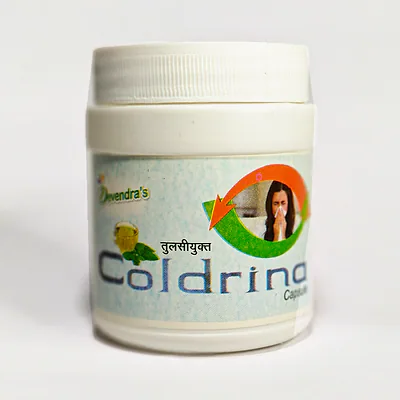
30 Cap: ₹120 · 100 Cap: ₹140
Coldrina Capsules hold the same formula as Coldrina Syrup — Tulsi, black pepper, dry ginger, turmeric and amla with Godanti bhasma and calcined alum (Sphatika bhasma) — further processed (bhavana) in juices of Tulsi, Gojihva and Kantakari.
The booklet lists them for breathlessness, cough, coryza, headache, cold and fever: a sugar-free, travel-friendly way to take the formula.
Used for
- Common cold & coryza (Pratishyaya)
- Cough (Kasa)
- Breathlessness (Shwasa)
- Heavy head with a cold
Why a cold settles in
Most colds are viral infections of the nose and throat. The lining swells and pours out mucus, the sinuses block, and the head feels heavy; a low fever and cough often follow.
Ayurveda calls this Pratishyaya: weak digestive fire (Agni) and cold exposure aggravate Kapha and Vata, which settle in the head and throat as congestion, discharge and heaviness. Treatment aims to warm, dry and clear Kapha while keeping the fever down.
Coldrina eases a cold in 3 ways
- Warming & Decongestant (Kaphahara) — Dry ginger, black pepper and Tulsi are pungent, warming herbs that clear Kapha from the head and chest; Kantakari and Gojihva, used in the bhavana, are classical herbs for cough and a sore throat.
- Anti-inflammatory & Antioxidant — Turmeric's curcumin damps inflammatory signalling (NF-κB, COX-2), and amla adds antioxidant tannins.
- Cooling & Soothing (Jwaraghna, Shirashoolahara) — Godanti bhasma is Ayurveda's classical remedy for fever and headache, and purified alum is used for phlegmy cough; modern research on both is limited.
Key ingredients
- Tulsi (Holy basil) (Ocimum sanctum, leaf) — 25 mg. Holy basil is used for cough, cold and fever (Kasa, Pratishyaya, Jwara). A systematic review of 24 human studies found favourable effects on immunity, metabolic markers and stress, with no significant adverse events reported.
- Sonth (Dry ginger) (Zingiber officinale, rhizome) — 25 mg. Ayurveda's 'universal medicine' (Vishwabheshaja) for weak digestion. Its gingerols and shogaols speed gastric emptying and calm nausea; a systematic review of clinical trials found about 1.5 g a day in divided doses relieves nausea.
- Kali mirch (Black pepper) (Piper nigrum, fruit) — 25 mg. Its alkaloid piperine stimulates pancreatic digestive enzymes and shortens food transit time in experimental studies, and famously raises the absorption of other compounds by slowing their breakdown in the gut wall and liver.
- Haridra (Turmeric) (Curcuma longa, rhizome) — 50 mg. Its curcuminoids, chiefly curcumin, damp inflammatory signalling (NF-κB, COX-2) and scavenge free radicals in experimental studies. Ayurveda uses it for cough and cold, skin, wounds and the liver.
- Amalaki (Amla) (Emblica officinalis, fruit) — 75 mg. Ayurveda's foremost Rasayana and one of the three Triphala fruits. Rich in vitamin C, emblicanins and other tannins, it is strongly antioxidant, anti-inflammatory, gastroprotective and hepatoprotective in experimental studies.
- Godanti bhasma (calcined gypsum) — 200 mg. Gypsum heat-processed into anhydrous calcium sulphate. Ayurveda uses Godanti for fever, headache and chronic cough (Jwaraghna, Shirashoolahara) and as a calcium source; laboratory work has characterised the particles, but clinical research is limited.
- Kantakari (Solanum virginianum, whole plant). A classic Ayurvedic herb for cough and wheeze. In a small clinical study in mild-to-moderate asthma it improved peak expiratory flow and eased cough and breathlessness over three days, comparable to deriphylline; a polysaccharide from its leaves suppressed cough in guinea pigs.
Full ingredient list
- Tulsi patra (Ocimum sanctum, leaf) — 25 mg
- Kali mirch (Piper nigrum, fruit) — 25 mg
- Sonth (Zingiber officinale, rhizome) — 25 mg
- Haridra (Curcuma longa, rhizome) — 50 mg
- Amalaki (Emblica officinalis, fruit) — 75 mg
- Godanti bhasma (calcined gypsum) — 200 mg
- Sphatika bhasma (calcined alum) — 100 mg
Processed (bhavana) in
- Tulsi patra (Ocimum sanctum, leaf)
- Gojihva (Onosma bracteatum, leaf)
- Kantakari (Solanum virginianum, whole plant)
How to use
Dose: 1–2 capsules twice a day with warm water, or as directed by the physician.
- Take your dose — The dose above, or the one your physician gives.
- With water — Swallow with water (or milk, where the pack says so).
- Stay consistent — Take it at the same times each day, for the course advised.
Safety & suitability
- Who it's for: Adults; children only at the dose a physician sets
- Pregnancy & nursing: Ask your physician before use
- Other medicines: Tell your physician what else you take
- Diabetic?: No added sugar — ask your physician
- Storage: Cool, dry place, away from direct sunlight
- Ingredients: See the full list below
Cautions
- A cold that lasts more than 10 days, a high fever, breathlessness, chest pain or a cough with blood needs a doctor.
More information
- Net content: 30 Cap · 100 Cap
- Storage: Store below 30 °C in a cool, dry place, in the original pack.
- Country of origin: India
- Manufacturer: Devendra Ayurved Ashram Pvt. Ltd., A-12, Industrial Estate, Sujroo, Muzaffarnagar (U.P.) – 251003. Mfg. Lic. No. A-50/77/94 · GMP-certified company.
References
- Devendra Ayurved Ashram Pvt. Ltd. Vivran Pustika (product guide).
- Jamshidi N, Cohen MM. The Clinical Efficacy and Safety of Tulsi in Humans: A Systematic Review of the Literature. Evid Based Complement Alternat Med. 2017;2017:9217567.
- Cohen MM. Tulsi - Ocimum sanctum: A herb for all reasons. J Ayurveda Integr Med. 2014;5(4):251-9.
- Nikkhah Bodagh M, Maleki I, Hekmatdoost A. Ginger in gastrointestinal disorders: A systematic review of clinical trials. Food Sci Nutr. 2019;7(1):96-108.
- Srinivasan K. Black pepper and its pungent principle-piperine: a review of diverse physiological effects. Crit Rev Food Sci Nutr. 2007;47(8):735-48.
- Hewlings SJ, Kalman DS. Curcumin: A Review of Its Effects on Human Health. Foods. 2017;6(10).
- Saini R, Sharma N, Oladeji OS, et al. Traditional uses, bioactive composition, pharmacology, and toxicology of Phyllanthus emblica fruits: A comprehensive review. J Ethnopharmacol. 2022;282:114570.
- Das SK, Joshi A, Bisht L, et al. Godanti bhasma (anhydrous CaSO(4)) induces massive cytoplasmic vacuolation in mammalian cells: A model for phagocytosis assay. Methods. 2024;230:158-168.
- Govindan S, Viswanathan S, Vijayasekaran V, et al. Further studies on the clinical efficacy of Solanum xanthocarpum and Solanum trilobatum in bronchial asthma. Phytother Res. 2004;18(10):805-9.
- Raja W, Nosalova G, Ghosh K, et al. In vivo antitussive activity of a pectic arabinogalactan isolated from Solanum virginianum L. in Guinea pigs. J Ethnopharmacol. 2014;156:41-6.