Bal Ghutti Syrup
Ayurvedic gripe syrup for babies' tummy troubles
Little tummies, big discomfort. A few drops of Bal Ghutti, the way grandmothers gave it.
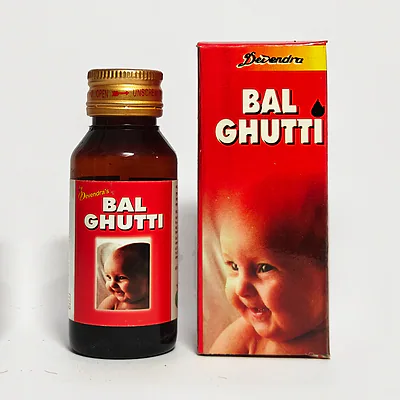
60 mL: ₹50
Bal Ghutti is a traditional Ayurvedic 'ghutti' for infants and young children: an ark (distillate) of seventeen herbs — ajwain, fennel, Banafsha, Gaozaban, small Harad, Punarnava and more — with a little purified borax, in a sweet syrup.
The booklet describes it as digestive, appetising and Kapha-clearing, and lists it for weak digestion, gas, colic and griping, constipation, the green-yellow stools and loose motions of teething, and minor coughs and colds.
Used for
- Gas, colic & griping
- Indigestion & poor appetite
- Constipation
- Loose stools while teething
- Minor cough & cold
Why babies get tummy troubles
A baby's digestion is still maturing. Swallowed air, a new food or teething can easily bring wind, colic, loose or green stools, or constipation — and with crying, more air is swallowed.
Ayurveda sees childhood as the Kapha stage of life, when digestive fire (Agni) is gentle and easily upset. Ghuttis combine mild digestive and wind-relieving herbs with Kapha-clearing herbs for the chest, given in tiny doses.
Bal Ghutti helps in 3 ways
- Carminative & Antispasmodic (Vatanulomana) — Ajwain's thymol and fennel's anethole relax intestinal smooth muscle and ease gas in experimental studies; in small trials, fennel extract showed encouraging results for infant colic.
- Gentle Digestive & Laxative (Deepana, Anulomana) — Small Harad and Amaltas keep the bowels gently regular, and Kasni and Punarnava are Ayurveda's liver-supporting herbs.
- Soothing for Chest & Throat (Kasahara) — Banafsha, Vasaka, Kantakari, licorice and Karkatshringi are classical herbs for a child's cough and cold.
Key ingredients
- Ajwain (Carom) (Trachyspermum ammi, fruit) — 250 mg. Thymol-rich seeds that Ayurveda uses for wind, colic and indigestion. In experimental studies ajwain relaxes intestinal smooth muscle, increases digestive enzyme and bile secretion and is antibacterial and antifungal.
- Saunf (Fennel) (Foeniculum vulgare, fruit) — 125 mg. Sweet, cooling seeds for wind, colic and indigestion, long given to infants. Anethole relaxes intestinal smooth muscle in experimental studies, and a systematic review found encouraging, though limited, trial results for fennel in infant colic.
- Banafsha (Viola odorata, whole plant) — 250 mg. Sweet violet, a Unani and Ayurvedic staple for cough. In a double-blind trial in 182 children with intermittent asthma, violet syrup added to standard care cleared cough faster than placebo.
- Gojihva (Gaozaban) (Onosma bracteatum, leaf) — 250 mg. A Unani and Ayurvedic leaf for cough, sore throat and a restless mind. Its mucilage soothes; its extract damped inflammatory cytokines in a rat arthritis model and showed antimicrobial activity in the laboratory.
- Haritaki (Harad) (Terminalia chebula, fruit) — 250 mg. The first of the Triphala fruits and Ayurveda's classic Anulomana: it keeps the bowels regular. Its tannins (chebulagic and chebulinic acids) are antioxidant, anti-inflammatory and hepatoprotective in laboratory studies.
- Amaltas (Indian laburnum) (Cassia fistula, fruit pulp) — 62.5 mg. The sweet pulp of the Indian laburnum pod is Ayurveda's mildest purgative. It contains anthraquinones (rhein, sennosides); a small systematic review found it partly effective for stool pain and consistency in constipated children.
- Kasni (Chicory) (Cichorium intybus, seed) — 62.5 mg. Chicory, a Unani and Ayurvedic liver herb rich in inulin, sesquiterpene lactones and phenolic acids. In a meta-analysis of five small trials in fatty liver disease, chicory lowered the liver enzymes ALT and AST.
- Vasaka (Arusa) (Adhatoda vasica, leaf) — 125 mg. Ayurveda's foremost herb for cough. Its alkaloids vasicine and vasicinone thinned secretions, quietened coughing and relaxed constricted airways in animal studies, and vasicine is the natural template from which the mucolytic drugs bromhexine and ambroxol were developed.
- Tankan bhasma (purified borax) — 62.5 mg. Borax, heat-dried until it puffs. Ayurveda uses it to liquefy and expel Kapha in cough and asthma and as an emmenagogue. Boron compounds are toxic in excess, so the dose must not be exceeded.
- Vacha (Bach) (Acorus calamus, rhizome) — 25 mg. A pungent rhizome Ayurveda uses for speech, memory and Kapha in the chest. It is anticonvulsant, neuroprotective and antispasmodic in experimental studies; its β-asarone limits long-term use.
Full ingredient list
Distillate (ark) of
- Banafsha (Viola odorata, whole plant) — 250 mg
- Gajba (Gaozaban) (Onosma bracteatum, leaf) — 250 mg
- Ajwain (Trachyspermum ammi, fruit) — 250 mg
- Punarnava (Boerhavia diffusa, whole plant) — 250 mg
- Harad chhoti (Terminalia chebula, fruit) — 250 mg
- Arusa (Adhatoda vasica, leaf) — 125 mg
- Kantkari (Solanum virginianum, whole plant) — 125 mg
- Madhuyashti (Glycyrrhiza glabra, root) — 125 mg
- Lisoda (Cordia dichotoma, fruit) — 125 mg
- Saunf (Foeniculum vulgare, fruit) — 125 mg
- Karkatshringi (Pistacia integerrima, gall) — 62.5 mg
- Kakmachi (Solanum nigrum, whole plant) — 62.5 mg
- Vayvidang (Embelia ribes, fruit) — 62.5 mg
- Kasni (Cichorium intybus, seed) — 62.5 mg
- Amaltas (Cassia fistula, fruit pulp) — 62.5 mg
- Bach (Acorus calamus, rhizome) — 25 mg
- Shuddh tankan (purified borax) — 62.5 mg
- Chini (sugar) — 8.75 g
How to use
Dose: Infants 5–20 drops, children ¼–1 teaspoon, two to three times a day as needed — in mother's milk, a little warm water or fruit juice — or as directed by the physician.
- Shake well — Shake the bottle before each dose.
- Measure the dose — Use the measuring cap — the dose above, or the one your physician gives.
- Keep a routine — Take it at the same times each day, for as long as advised.
Safety & suitability
- Who it's for: Infants and children — at the dose for their age
- Pregnancy & nursing: Ask your physician before use
- Other medicines: Tell your physician what else you take
- Diabetic?: Contains sugar (8.75 g per 10 mL) — ask your physician
- Storage: Cool, dry place, away from direct sunlight
- Ingredients: See the full list below
Cautions
- For infants, check the dose with your paediatrician first, and never give more than the stated drops: it contains purified borax, which is harmful to babies in excess.
- A baby who is feeding poorly, vomiting, has a fever, blood in the stool, fewer wet nappies or inconsolable crying needs a doctor — do not rely on a ghutti.
- Contains sugar (8.75 g per 10 mL) — people with diabetes should ask their physician first.
- Do not use if any precipitate, fungus or foreign particle is found — replace the bottle.
More information
- Net content: 60 mL
- Storage: Keep in a cool, dry place away from direct sunlight. Close the cap tightly after use.
- Country of origin: India
- Manufacturer: Devendra Ayurved Ashram Pvt. Ltd., A-12, Industrial Estate, Sujroo, Muzaffarnagar (U.P.) – 251003. Mfg. Lic. No. A-50/77/94 · GMP-certified company.
References
- Devendra Ayurved Ashram Pvt. Ltd. Vivran Pustika (product guide).
- Perry R, Hunt K, Ernst E. Nutritional supplements and other complementary medicines for infantile colic: a systematic review. Pediatrics. 2011;127(4):720-33.
- Boskabady MH, Alitaneh S, Alavinezhad A. Carum copticum L.: a herbal medicine with various pharmacological effects. Biomed Res Int. 2014;2014:569087.
- Badgujar SB, Patel VV, Bandivdekar AH. Foeniculum vulgare Mill: a review of its botany, phytochemistry, pharmacology, contemporary application, and toxicology. Biomed Res Int. 2014;2014:842674.
- Qasemzadeh MJ, Sharifi H, Hamedanian M, et al. The Effect of Viola odorata Flower Syrup on the Cough of Children With Asthma: A Double-Blind, Randomized Controlled Trial. J Evid Based Complementary Altern Med. 2015;20(4):287-91.
- Zafar F, Shaheen G, Asif HM, et al. Onosma bracteatum Wall Aqueous-Ethanolic Extract Suppresses Complete Freund's Adjuvant-Induced Arthritis in Rats via Regulation of TNF-α, IL-6, and C-Reactive Protein. Molecules. 2024;29(8).
- Kazmi SY, Baig HA. Extraction and Analysis of Antimicrobial Compounds from Onosma Bracteatum Using Response Surface Methodology. J Pharm Bioallied Sci. 2025;17(Suppl 1):S865-S868.
- Wang C, Zhang H, Wang X, et al. Comprehensive Review on Fruit of Terminalia chebula: Traditional Uses, Phytochemistry, Pharmacology, Toxicity, and Pharmacokinetics. Molecules. 2024;29(23).
- Mwangi RW, Macharia JM, Wagara IN, et al. The medicinal properties of Cassia fistula L: A review. Biomed Pharmacother. 2021;144:112240.
- Aslam MS. Application of genus Cassia in the treatment of Constipation: A systematic review. F1000Res. 2019;8:256.
- Street RA, Sidana J, Prinsloo G. Cichorium intybus: Traditional Uses, Phytochemistry, Pharmacology, and Toxicology. Evid Based Complement Alternat Med. 2013;2013:579319.
- Maleki E, Sadeghpour A, Taherifard E, et al. The effects of chicory supplementation on liver enzymes and lipid profiles in patients with non-alcoholic fatty liver disease: A systematic review and meta-analysis of clinical evidence. Clin Nutr ESPEN. 2023;55:447-454.
- Liu W, Wang Y, He DD, et al. Antitussive, expectorant, and bronchodilating effects of quinazoline alkaloids (±)-vasicine, deoxyvasicine, and (±)-vasicinone from aerial parts of Peganum harmala L. Phytomedicine. 2015;22(12):1088-95.
- Grange JM, Snell NJ. Activity of bromhexine and ambroxol, semi-synthetic derivatives of vasicine from the Indian shrub Adhatoda vasica, against Mycobacterium tuberculosis in vitro. J Ethnopharmacol. 1996;50(1):49-53.
- Claeson UP, Malmfors T, Wikman G, et al. Adhatoda vasica: a critical review of ethnopharmacological and toxicological data. J Ethnopharmacol. 2000;72(1-2):1-20.
- Hadrup N, Frederiksen M, Sharma AK. Toxicity of boric acid, borax and other boron containing compounds: A review. Regul Toxicol Pharmacol. 2021;121:104873.
- Siegel E, Wason S. Boric acid toxicity. Pediatr Clin North Am. 1986;33(2):363-7.
- Sharma V, Sharma R, Gautam DS, et al. Role of Vacha (Acorus calamus Linn.) in Neurological and Metabolic Disorders: Evidence from Ethnopharmacology, Phytochemistry, Pharmacology and Clinical Study. J Clin Med. 2020;9(4).
- Rajput SB, Tonge MB, Karuppayil SM. An overview on traditional uses and pharmacological profile of Acorus calamus Linn. (Sweet flag) and other Acorus species. Phytomedicine. 2014;21(3):268-76.