Asthama Tablet
Ayurvedic tablets for a wheezy, breathless chest
When every breath feels tight, the airways need opening — and calming.
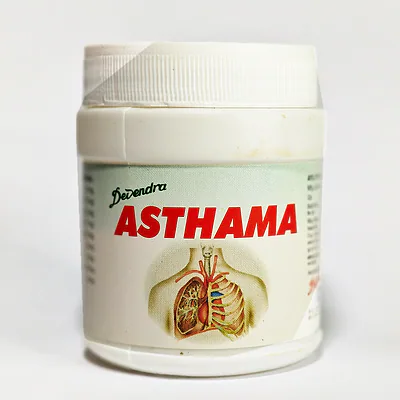
100 Tab: ₹75
Asthama Tablets are an Ayurvedic formula for Shwasa — wheezing and breathlessness — and bronchitis. The booklet describes them as acting on the respiratory system: dilating the bronchi, opening obstructed airways and soothing inflammation of the bronchial lining.
Concentrated extracts (ghan satva) of Somlata (ephedra), licorice, Kantakari, Apamarga and Anantmool are combined with Bibhitaki, long pepper, purified borax and benzoin essence, then processed in Vasaka and Kantakari juice.
Used for
- Wheeze & breathlessness (Shwasa)
- Bronchitis
- Laryngitis
Why the chest tightens
In asthma and bronchitis the airways are inflamed and over-reactive. Their smooth muscle tightens (bronchospasm), the lining swells and thick mucus collects, so air has to squeeze through narrowed tubes — the source of wheeze, a tight chest and breathlessness.
Ayurveda calls this Tamaka Shwasa: Vata, obstructed by Kapha in Pranavaha Srotas, turns back on itself (Pratiloma) and the breath becomes laboured. Management therefore pairs Vata-Kapha-pacifying bronchodilators with herbs that loosen and expel Kapha.
Asthama opens the airways in 3 ways
- Bronchodilator (Shwasahara) — Somlata supplies ephedrine, which relaxes airway smooth muscle through β₂-adrenergic receptors; Kantakari improved peak expiratory flow in a small clinical study in asthma.
- Expectorant (Kaphanissaraka) — Vasaka (in the bhavana) and Bibhitaki thin and loosen phlegm, helped by purified borax and benzoin essence, Ayurveda's traditional Kapha-liquefying agents.
- Anti-allergic & Soothing (Shothahara) — Apamarga stabilised mast cells and lowered allergic markers in animal studies, while licorice and Anantmool soothe an inflamed airway lining.
Key ingredients
- Somlata (Ephedra) (Ephedra vulgaris, stem) — 40 mg. Ephedra's main alkaloid, ephedrine, stimulates adrenergic receptors — directly and by releasing noradrenaline. Through β₂-receptors it relaxes bronchial smooth muscle, which is why it was long used for wheeze. The same stimulation can raise heart rate and blood pressure: see the cautions.
- Kantakari (Solanum virginianum, whole plant) — 30 mg. A classic Ayurvedic herb for cough and wheeze. In a small clinical study in mild-to-moderate asthma it improved peak expiratory flow and eased cough and breathlessness over three days, comparable to deriphylline; a polysaccharide from its leaves suppressed cough in guinea pigs.
- Vasaka (Arusa) (Adhatoda vasica, leaf). Ayurveda's foremost herb for cough. Its alkaloids vasicine and vasicinone thinned secretions, quietened coughing and relaxed constricted airways in animal studies, and vasicine is the natural template from which the mucolytic drugs bromhexine and ambroxol were developed.
- Mulethi (Yashtimadhu) (Glycyrrhiza glabra, root) — 30 mg. Licorice root coats and soothes irritated mucous membranes of the throat and stomach. Glycyrrhizin and licorice flavonoids are anti-inflammatory and gastroprotective in laboratory models. In Ayurveda it is the classic Kanthya — good for the throat and voice.
- Apamarga (Achyranthes aspera, whole plant) — 15 mg. Valued in Ayurveda for respiratory complaints. In animal studies its extract relaxed constricted airways much as aminophylline does, stabilised mast cells and lowered allergic markers (IgE and Th2 cytokines).
- Anantmool (Indian sarsaparilla) (Hemidesmus indicus, root) — 50 mg. Ayurveda's classic Raktashodhaka for skin, urine and fever. Its root carries 2-hydroxy-4-methoxybenzaldehyde and saponins, with anti-inflammatory, antioxidant, antimicrobial and hepatoprotective activity in experimental studies.
- Bahera (Bibhitaki) (Terminalia bellirica, fruit) — 100 mg. The Triphala fruit Ayurveda reserves for Kapha in the throat and chest (Kasahara, Kanthya). Rich in gallic and ellagic acids and other tannins, it is antioxidant, anti-inflammatory and antimicrobial in laboratory studies.
- Pippali (Long pepper) (Piper longum, fruit) — 10 mg. A classical Rasayana for the respiratory tract and digestion. Like black pepper it carries piperine, plus piperlongumine; it is anti-inflammatory, bronchoprotective and bioavailability-enhancing in experimental studies.
- Tankan bhasma (purified borax) — 20 mg. Borax, heat-dried until it puffs. Ayurveda uses it to liquefy and expel Kapha in cough and asthma and as an emmenagogue. Boron compounds are toxic in excess, so the dose must not be exceeded.
Full ingredient list
Concentrated extract (ghan satva) of
- Somkalpalata (Somlata) (Ephedra vulgaris, stem) — 40 mg
- Madhuyashti (Glycyrrhiza glabra, root) — 30 mg
- Kantkari (Solanum virginianum, whole plant) — 30 mg
- Apamarg (Achyranthes aspera, whole plant) — 15 mg
- Anantmool (Hemidesmus indicus, root) — 50 mg
- Tankan bhasma (purified borax) — 20 mg
- Satva loban (benzoic acid, from benzoin resin) — 30 mg
- Pippali (Piper longum, fruit) — 10 mg
- Bahera (Terminalia bellirica, fruit) — 100 mg
Processed (bhavana) in juice of
- Adusa patra (Adhatoda vasica, leaf)
- Kantkari (Solanum virginianum, whole plant)
How to use
Dose: 1–2 tablets twice a day with cow's milk or lukewarm water, or as directed by the physician.
- Take your dose — The dose above, or the one your physician gives.
- With water — Swallow with water (or milk, where the pack says so).
- Stay consistent — Take it at the same times each day, for the course advised.
Safety & suitability
- Who it's for: Adults; children only at the dose a physician sets
- Pregnancy & nursing: Ask your physician before use
- Other medicines: Tell your physician what else you take
- Diabetic?: Sugar-coated tablet — ask your physician
- Storage: Cool, dry place, away from direct sunlight
- Ingredients: See the full list below
Cautions
- Asthma can be serious. This does not replace an inhaler or other medicine your doctor has prescribed — keep using them, and get urgent help for a severe attack.
- Contains Somlata (ephedra), a source of ephedrine, which can raise heart rate and blood pressure. Ask a doctor before use if you have heart disease, high blood pressure, diabetes, thyroid disease, seizures, narrow-angle glaucoma, a psychiatric condition, or trouble urinating due to an enlarged prostate. Do not take with a prescription MAO-inhibitor antidepressant, or within 2 weeks of stopping one.
- Contains purified borax (Tankan). Do not exceed the dose, especially in infants and young children.
More information
- Net content: 100 Tab
- Storage: Store below 30 °C in a cool, dry place, in the original pack.
- Country of origin: India
- Manufacturer: Devendra Ayurved Ashram Pvt. Ltd., A-12, Industrial Estate, Sujroo, Muzaffarnagar (U.P.) – 251003. Mfg. Lic. No. A-50/77/94 · GMP-certified company.
References
- Devendra Ayurved Ashram Pvt. Ltd. Vivran Pustika (product guide).
- Statler AK, Maani CV, Kohli A. Ephedrine. StatPearls. 2023.
- Shekelle PG, Hardy ML, Morton SC, et al. Efficacy and safety of ephedra and ephedrine for weight loss and athletic performance: a meta-analysis. JAMA. 2003;289(12):1537-45.
- US Code of Federal Regulations, 21 CFR 341.76 — labeling of bronchodilator drug products (ephedrine warnings).
- Govindan S, Viswanathan S, Vijayasekaran V, et al. Further studies on the clinical efficacy of Solanum xanthocarpum and Solanum trilobatum in bronchial asthma. Phytother Res. 2004;18(10):805-9.
- Raja W, Nosalova G, Ghosh K, et al. In vivo antitussive activity of a pectic arabinogalactan isolated from Solanum virginianum L. in Guinea pigs. J Ethnopharmacol. 2014;156:41-6.
- Liu W, Wang Y, He DD, et al. Antitussive, expectorant, and bronchodilating effects of quinazoline alkaloids (±)-vasicine, deoxyvasicine, and (±)-vasicinone from aerial parts of Peganum harmala L. Phytomedicine. 2015;22(12):1088-95.
- Grange JM, Snell NJ. Activity of bromhexine and ambroxol, semi-synthetic derivatives of vasicine from the Indian shrub Adhatoda vasica, against Mycobacterium tuberculosis in vitro. J Ethnopharmacol. 1996;50(1):49-53.
- Claeson UP, Malmfors T, Wikman G, et al. Adhatoda vasica: a critical review of ethnopharmacological and toxicological data. J Ethnopharmacol. 2000;72(1-2):1-20.
- Wahab S, Annadurai S, Abullais SS, et al. Glycyrrhiza glabra (Licorice): A Comprehensive Review on Its Phytochemistry, Biological Activities, Clinical Evidence and Toxicology. Plants (Basel). 2021;10(12).
- Kaushik A, Singh DP, Sahu M, et al. Protective effect of Achyranthes aspera against compound 48/80, histamine and ovalbumin-induced allergic disorders in murine model. Mol Biol Rep. 2024;51(1):202.
- Nandy S, Mukherjee A, Pandey DK, et al. Indian Sarsaparilla (Hemidesmus indicus): Recent progress in research on ethnobotany, phytochemistry and pharmacology. J Ethnopharmacol. 2020;254:112609.
- Gupta A, Kumar R, Bhattacharyya P, et al. Terminalia bellirica (Gaertn.) roxb. (Bahera) in health and disease: A systematic and comprehensive review. Phytomedicine. 2020;77:153278.
- Biswas P, Ghorai M, Mishra T, et al. Piper longum L.: A comprehensive review on traditional uses, phytochemistry, pharmacology, and health-promoting activities. Phytother Res. 2022;36(12):4425-4476.
- Johri RK, Zutshi U. An Ayurvedic formulation 'Trikatu' and its constituents. J Ethnopharmacol. 1992;37(2):85-91.
- Hadrup N, Frederiksen M, Sharma AK. Toxicity of boric acid, borax and other boron containing compounds: A review. Regul Toxicol Pharmacol. 2021;121:104873.
- Siegel E, Wason S. Boric acid toxicity. Pediatr Clin North Am. 1986;33(2):363-7.