Arshochin Tablet
Ayurvedic tablets for bleeding and non-bleeding piles
Piles are uncomfortable. Talking about them shouldn't have to be.
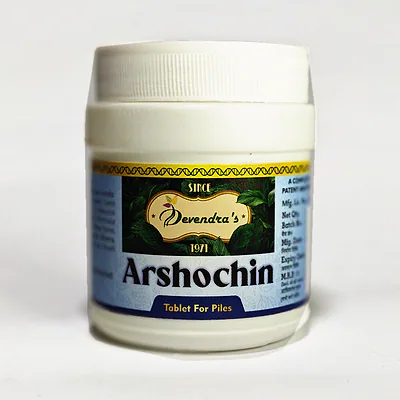
100 Tab: ₹75
Arshochin is an Ayurvedic formulation traditionally used for piles — because some problems deserve care, even if we don't like talking about them. Aritha twak, Rasot, Jimikand, Nimbgiri, Heerabol, Harad and Nagkeshar are traditionally selected for their roles in supporting bowel regulation, anorectal comfort and the Ayurvedic management of Arsha, alongside four classical mineral preparations.
The goal isn't just to 'stop piles'. A good approach also needs to address the bowel habits and local discomfort that can keep the problem going.
Used for
- Bleeding piles (Raktarsha)
- Non-bleeding piles (Shushkarsha)
- Constipation with piles
- Anal discomfort & burning
Why piles flare up
Too much sitting. Too little fibre. Too much chai. Too little water. Somewhere along the way, your gut started keeping score. Straining over hard stools engorges the cushions of veins in the anal canal; they swell, bleed bright red and can slip out (prolapse).
In Ayurvedic pathophysiology (Samprapti), piles result from Agnimandya (impairment of digestive fire) leading to Anaha (constipation and stagnation) and a local Vata-Pitta imbalance, causing enlarged, inflamed and bleeding haemorrhoids.
Arshochin helps in 4 butt-iful (pun intended) ways
- Laxative & Bowel Regulation (Anulomana) — Harad, Ayurveda's classic Anulomana, softens and regularises stools to cut the friction of passing them; radish juice, used in processing, is a traditional digestive.
- Anti-haemorrhoidal (Arshoghna) — Jimikand (elephant-foot yam) is Ayurveda's classical Arshoghna, and Reetha and Neem seed are traditional additions; Jimikand eased inflammation of the bowel lining in a rat study.
- Haemostatic & Astringent (Raktastambhana) — Nagkeshar and Rasot are Ayurveda's herbs for bleeding piles, helping check bleeding; Rasot's berberine is also antimicrobial and anti-inflammatory.
- Anti-inflammatory & Soothing (Shothahara & Vedanasthapana) — Berberine-rich Rasot, Neem and Heerabol are anti-inflammatory in experimental studies, easing local swelling, burning and discomfort.
Key ingredients
- Haritaki (Harad) (Terminalia chebula, fruit) — 50 mg. The first of the Triphala fruits and Ayurveda's classic Anulomana: it keeps the bowels regular. Its tannins (chebulagic and chebulinic acids) are antioxidant, anti-inflammatory and hepatoprotective in laboratory studies.
- Jimikand (Suran) (Amorphophallus paeoniifolius (A. campanulatus), corm) — 50 mg. Elephant-foot yam, the classical Ayurvedic food-medicine for piles (Arshoghna). Its glucomannan fibre eases stool passage, and its tuber extract damped inflammation and oxidative damage in a rat colitis model; clinical research is lacking.
- Reetha (Soapnut) (Sapindus trifoliatus, fruit rind) — 50 mg. The saponin-rich pericarp of the soapnut, used in Ayurveda for piles and worms and externally as a natural cleanser. Its triterpenoid saponins are antimicrobial and anti-inflammatory in experimental studies.
- Neem (Azadirachta indica, dried fruit) — 50 mg. Ayurveda's great bitter for skin disease and Rakta-dushti. Neem's limonoids (nimbin, nimbidin, azadirachtin) are antibacterial, antifungal and anti-inflammatory in experimental studies.
- Daruharidra (Indian barberry) (Berberis aristata, stem) — 50 mg. A bitter, yellow wood rich in the alkaloid berberine, which is antimicrobial, anti-inflammatory and hepatoprotective and improves glucose and lipid handling in studies. Ayurveda uses it for the liver, skin, eyes and wounds.
- Nagkesar (Mesua ferrea, stamen) — 25 mg. Fragrant stamens Ayurveda uses for bleeding piles and heavy periods (Raktastambhana). They are rich in coumarins and xanthones; laboratory studies report antimicrobial and antioxidant activity, and a subacute rat study of the flower extract found no toxicity.
- Mooli (Radish) (Raphanus sativus, juice). Radish juice, in which the tablets are processed (bhavana). Ayurveda counts radish digestive and good for piles; it is rich in glucosinolates and fibre, with antioxidant and hepatoprotective activity in experimental studies.
Full ingredient list
- Ritha (Sapindus trifoliatus, fruit rind) — 50 mg
- Rasot (Berberis aristata, stem) — 50 mg
- Jimikand (Amorphophallus paeoniifolius (A. campanulatus), corm) — 50 mg
- Nimbgiri (Azadirachta indica, dried fruit) — 50 mg
- Heerabol (Commiphora myrrha, resin) — 50 mg
- Haritaki (Terminalia chebula, fruit) — 50 mg
- Nagkeshar (Mesua ferrea) — 25 mg
- Muktashukti Pishti (pearl oyster shell) — 10 mg
- Swaranmakshik Bhasma (processed copper–iron pyrite) — 10 mg
- Dughdhapashan Bhasma (processed talc-like mineral) — 10 mg
- Shudh Swarngarik (purified red ochre) — 20 mg
Processed (bhavana) in
- Mooli (Raphanus sativus, juice)
How to use
Dose: 1–2 tablets twice a day with warm water, or as directed by the physician.
- Take your dose — The dose above, or the one your physician gives.
- With water — Swallow with water (or milk, where the pack says so).
- Stay consistent — Take it at the same times each day, for the course advised.
Safety & suitability
- Who it's for: Adults; children only at the dose a physician sets
- Pregnancy & nursing: Not advised — see the cautions
- Other medicines: Tell your physician what else you take
- Diabetic?: Sugar-coated tablet — ask your physician
- Storage: Cool, dry place, away from direct sunlight
- Ingredients: See the full list below
Cautions
- Rectal bleeding should always be checked by a doctor once, especially after 40 or with a change in bowel habit, to rule out other causes.
- Contains processed metal or mineral preparations: Swarna makshik bhasma. Take only at the stated dose and for the advised duration, under an Ayurvedic physician.
- Not to be taken during pregnancy.
More information
- Net content: 100 Tab
- Storage: Store below 30 °C in a cool, dry place, in the original pack.
- Country of origin: India
- Manufacturer: Devendra Ayurved Ashram Pvt. Ltd., A-12, Industrial Estate, Sujroo, Muzaffarnagar (U.P.) – 251003. Mfg. Lic. No. A-50/77/94 · GMP-certified company.
References
- Devendra Ayurved Ashram Pvt. Ltd. Vivran Pustika (product guide).
- Alonso-Coello P, Mills E, Heels-Ansdell D, et al. Fiber for the treatment of hemorrhoids complications: a systematic review and meta-analysis. Am J Gastroenterol. 2006;101(1):181-8.
- Wang C, Zhang H, Wang X, et al. Comprehensive Review on Fruit of Terminalia chebula: Traditional Uses, Phytochemistry, Pharmacology, Toxicity, and Pharmacokinetics. Molecules. 2024;29(23).
- Dey YN, Sharma G, Wanjari MM, et al. Beneficial effect of Amorphophallus paeoniifolius tuber on experimental ulcerative colitis in rats. Pharm Biol. 2017;55(1):53-62.
- Islam F, Labib RK, Zehravi M, et al. Genus Amorphophallus: A Comprehensive Overview on Phytochemistry, Ethnomedicinal Uses, and Pharmacological Activities. Plants (Basel). 2023;12(23).
- Upadhyay A, Singh DK. Pharmacological effects of Sapindus mukorossi. Rev Inst Med Trop Sao Paulo. 2012;54(5):273-80.
- Mehnaz S, Shamsi Y, Akhtar MW, et al. Therapeutic Applications of Neem (Azadirachta indica): A Narrative Review. Adv Mind Body Med. 2024;38(4):14-18.
- Marchelak A, Gieleta M, Krasocka W, et al. Berberis aristata DC. (Indian barberry): Current insight into botanical, phytochemical, and pharmacological aspects, pharmacokinetics, safety of use and modern therapeutic applications. Fitoterapia. 2025;183:106539.
- Konyanee A, Chaniad P, Phuwajaroanpong A, et al. Exploring the potential antimalarial properties, safety profile, and phytochemical composition of Mesua ferrea Linn. PLoS One. 2024;19(12):e0312047.
- Shirsat P, A R Z, Kashikar R, et al. Subacute toxicity study of the ethanolic extract of Mesua ferrea (L.) flowers in rats. Drug Chem Toxicol. 2022;45(4):1570-1577.
- Manivannan A, Kim JH, Kim DS, et al. Deciphering the Nutraceutical Potential of Raphanus sativus-A Comprehensive Overview. Nutrients. 2019;11(2).