Arjuna Tablet
Ayurvedic heart-tonic tablets with Arjuna bark
Arjuna bark: Ayurveda's heart herb, steadied with Ashwagandha and amla.
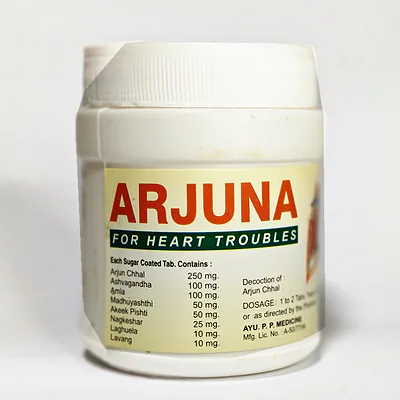
100 Tab: ₹75
Arjuna Tablets are built on 250 mg of Arjuna bark — the herb Ayurveda has given for the heart for centuries — further processed in an Arjuna decoction. Ashwagandha, amla, licorice, Akik pishti (agate), Nagkeshar, cardamom and clove complete the formula.
The booklet calls it Hridya — nourishing and steadying the heart — for weakness and 'heat' of the heart, and recommends light food: less fried, sour and spicy food, more milk, fruit, moong dal and greens.
Used for
- Heart tonic (Hridya) — traditional use
- Palpitations & 'heat' of the heart (Hrid-daurbalya)
- Fatigue & low stamina
What strains the heart
The heart pumps around 100,000 times a day. High blood pressure, raised cholesterol, diabetes, smoking, stress and inactivity damage the arteries that feed it and make it work harder; over time it can tire and struggle to keep up.
Ayurveda calls the heart the seat of Ojas and of Sadhaka Pitta and Prana. When Vata and Pitta are disturbed and Ojas is depleted, the heart weakens (Hrid-daurbalya), causing palpitations, breathlessness and fatigue. Hridya herbs aim to nourish and steady it.
Arjuna supports the heart in 3 ways
- Cardioprotective (Hridya) — Arjuna bark's triterpenoids and flavonoids are anti-ischaemic, antioxidant and lipid-lowering in studies, and a meta-analysis of small trials in stable angina was promising.
- Calming Adaptogen (Medhya, Balya) — Ashwagandha lowered perceived stress and cortisol and improved sleep in meta-analyses of randomised trials — stress is a recognised strain on the heart.
- Antioxidant & Cooling (Pittashamaka) — Amla is rich in vitamin C and tannins, strongly antioxidant in experimental studies, and licorice and agate are Ayurveda's cooling additions for the heart and mind.
Key ingredients
- Arjuna (Terminalia arjuna, stem bark) — 250 mg. The bark Ayurveda has used for the heart for centuries. Its triterpenoids and flavonoids are anti-ischaemic, antioxidant and lipid-lowering in studies; a meta-analysis of small trials in stable angina was promising, but larger, standardised studies are needed.
- Ashwagandha (Withania somnifera, root) — 100 mg. Ayurveda's best-known Balya-Rasayana. In randomised trials ashwagandha root extract lowered perceived stress and cortisol and improved sleep and muscle strength; its withanolides are the main active constituents.
- Amalaki (Amla) (Emblica officinalis, fruit) — 100 mg. Ayurveda's foremost Rasayana and one of the three Triphala fruits. Rich in vitamin C, emblicanins and other tannins, it is strongly antioxidant, anti-inflammatory, gastroprotective and hepatoprotective in experimental studies.
- Mulethi (Yashtimadhu) (Glycyrrhiza glabra, root) — 50 mg. Licorice root coats and soothes irritated mucous membranes of the throat and stomach. Glycyrrhizin and licorice flavonoids are anti-inflammatory and gastroprotective in laboratory models. In Ayurveda it is the classic Kanthya — good for the throat and voice.
- Akik pishti (agate) — 50 mg. Agate (silica) ground very fine with rose water. Unani and Ayurvedic medicine count it a cooling heart and nerve tonic for palpitations and burning; modern research on its effects is lacking.
- Nagkesar (Mesua ferrea, stamen) — 25 mg. Fragrant stamens Ayurveda uses for bleeding piles and heavy periods (Raktastambhana). They are rich in coumarins and xanthones; laboratory studies report antimicrobial and antioxidant activity, and a subacute rat study of the flower extract found no toxicity.
- Elaichi (Cardamom) (Elettaria cardamomum, fruit) — 10 mg. An aromatic for nausea, indigestion and bad breath. Cardamom's 1,8-cineole and α-terpinyl acetate are carminative, antispasmodic and antimicrobial in experimental studies.
- Lavang (Clove) (Syzygium aromaticum, flower bud) — 10 mg. Clove's eugenol is antiseptic, antispasmodic, antioxidant and locally anaesthetic — the reason clove oil is a traditional toothache remedy — and Ayurveda uses it for indigestion and cough.
Full ingredient list
- Arjun chhal (Terminalia arjuna, stem bark) — 250 mg
- Ashwagandha (Withania somnifera, root) — 100 mg
- Amla (Emblica officinalis, fruit) — 100 mg
- Madhuyashti (Glycyrrhiza glabra, root) — 50 mg
- Akik pishti (agate, levigated) — 50 mg
- Nagkeshar (Mesua ferrea, stamen) — 25 mg
- Laghu ela (Elettaria cardamomum, fruit) — 10 mg
- Lavang (Syzygium aromaticum, flower bud) — 10 mg
Processed (bhavana) in a decoction of
- Arjun chhal (Terminalia arjuna, stem bark)
How to use
Dose: 1–2 tablets twice a day with water or cow's milk, or as directed by the physician.
- Take your dose — The dose above, or the one your physician gives.
- With water — Swallow with water (or milk, where the pack says so).
- Stay consistent — Take it at the same times each day, for the course advised.
Safety & suitability
- Who it's for: Adults; children only at the dose a physician sets
- Pregnancy & nursing: Ask your physician before use
- Other medicines: Tell your physician what else you take
- Diabetic?: Sugar-coated tablet — ask your physician
- Storage: Cool, dry place, away from direct sunlight
- Ingredients: See the full list below
Cautions
- Chest pain, breathlessness, fainting or a racing heart need urgent medical care — do not self-treat.
- If you take medicines for the heart, blood pressure, diabetes or blood thinning, check with your doctor first. Licorice can raise blood pressure in large amounts.
More information
- Net content: 100 Tab
- Storage: Store below 30 °C in a cool, dry place, in the original pack.
- Country of origin: India
- Manufacturer: Devendra Ayurved Ashram Pvt. Ltd., A-12, Industrial Estate, Sujroo, Muzaffarnagar (U.P.) – 251003. Mfg. Lic. No. A-50/77/94 · GMP-certified company.
References
- Devendra Ayurved Ashram Pvt. Ltd. Vivran Pustika (product guide).
- Dwivedi S, Chopra D. Revisiting Terminalia arjuna - An Ancient Cardiovascular Drug. J Tradit Complement Med. 2014;4(4):224-31.
- Maulik SK, Talwar KK. Therapeutic potential of Terminalia arjuna in cardiovascular disorders. Am J Cardiovasc Drugs. 2012;12(3):157-63.
- Kaur N, Shafiq N, Negi H, et al. Terminalia arjuna in Chronic Stable Angina: Systematic Review and Meta-Analysis. Cardiol Res Pract. 2014;2014:281483.
- Akhgarjand C, Asoudeh F, Bagheri A, et al. Does Ashwagandha supplementation have a beneficial effect on the management of anxiety and stress? A systematic review and meta-analysis of randomized controlled trials. Phytother Res. 2022;36(11):4115-4124.
- Bonilla DA, Moreno Y, Gho C, et al. Effects of Ashwagandha (Withania somnifera) on Physical Performance: Systematic Review and Bayesian Meta-Analysis. J Funct Morphol Kinesiol. 2021;6(1).
- Fatima K, Malik J, Muskan F, et al. Safety and efficacy of Withania somnifera for anxiety and insomnia: Systematic review and meta-analysis. Hum Psychopharmacol. 2024;39(6):e2911.
- Saini R, Sharma N, Oladeji OS, et al. Traditional uses, bioactive composition, pharmacology, and toxicology of Phyllanthus emblica fruits: A comprehensive review. J Ethnopharmacol. 2022;282:114570.
- Wahab S, Annadurai S, Abullais SS, et al. Glycyrrhiza glabra (Licorice): A Comprehensive Review on Its Phytochemistry, Biological Activities, Clinical Evidence and Toxicology. Plants (Basel). 2021;10(12).
- Konyanee A, Chaniad P, Phuwajaroanpong A, et al. Exploring the potential antimalarial properties, safety profile, and phytochemical composition of Mesua ferrea Linn. PLoS One. 2024;19(12):e0312047.
- Shirsat P, A R Z, Kashikar R, et al. Subacute toxicity study of the ethanolic extract of Mesua ferrea (L.) flowers in rats. Drug Chem Toxicol. 2022;45(4):1570-1577.
- Ashokkumar K, Murugan M, Dhanya MK, et al. Botany, traditional uses, phytochemistry and biological activities of cardamom [Elettaria cardamomum (L.) Maton] - A critical review. J Ethnopharmacol. 2020;246:112244.
- Batiha GE, Alkazmi LM, Wasef LG, et al. Syzygium aromaticum L. (Myrtaceae): Traditional Uses, Bioactive Chemical Constituents, Pharmacological and Toxicological Activities. Biomolecules. 2020;10(2).