Anurjana Tablet
Ayurvedic anti-allergy tablets for hives, itching and rashes
Itchy welts that come and go? Your skin is reacting to something inside.
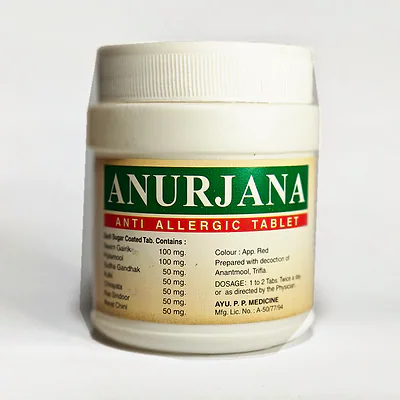
100 Tab: ₹100
Anurjana is an Ayurvedic formula the booklet calls 'Anti Allergic': for Sheetapitta (hives), Kandu (itching), Pama (itchy eruptions), Kushtha (skin disease) and blood and toxin-related (Rakta-Visha) disorders.
Its bitter, cooling herbs — Kutki, Chirayata and Revat chini — work alongside purified sulphur, Swarna gairik and Ras sindoor, processed in Anantmool and Triphala decoctions, which the booklet credits with purifying the blood and balancing all three doshas.
Used for
- Hives (Sheetapitta)
- Itching (Kandu)
- Itchy eruptions (Pama)
- Allergic skin rashes
Why hives flare
Hives are raised, itchy welts that appear and fade within hours. Mast cells in the skin release histamine and other mediators — after a food, a drug, an infection, heat or stress, and often for no clear reason — and the small vessels leak fluid into the skin.
Ayurveda calls this Sheetapitta: exposure to cold winds and incompatible foods aggravates Kapha and Vata, which mix with Pitta and spread through the blood (Rakta) to the skin, raising itchy, burning wheals. Treatment purifies the blood (Raktashodhana), cools Pitta and clears the trapped toxins (Visha).
Anurjana calms the skin in 3 ways
- Anti-inflammatory (Shothahara) — Kutki's picroside II and apocynin damp inflammatory signalling in experimental studies, and Triphala is antioxidant and anti-inflammatory.
- Cooling Blood Purifier (Raktashodhaka) — Chirayata and Anantmool are Ayurveda's classic bitter, cooling blood purifiers; Swarna gairik is the traditional mineral for burning and Sheetapitta.
- Gut & Liver Support (Anulomana) — Revat chini and Triphala keep the bowels moving, and Kutki and Chirayata are hepatoprotective in experimental studies — clearing the Ama that Ayurveda links to recurrent hives.
Key ingredients
- Kutki (Katuki) (Picrorhiza kurroa, rhizome) — 50 mg. A Himalayan bitter for the liver and skin. Its picroside II and apocynin (first isolated from this plant) damp inflammatory signalling in experimental studies; Ayurveda uses it for Sheetapitta, fever and Kamala.
- Chirayata (Swertia chirayita, whole plant) — 50 mg. One of Ayurveda's strongest bitters, for fever, poor appetite and the liver. Its xanthones and secoiridoids (amarogentin, swertiamarin) are hepatoprotective, antipyretic and hypoglycaemic in experimental studies.
- Revat chini (Himalayan rhubarb) (Rheum emodi, root) — 50 mg. Himalayan rhubarb root: in small doses its tannins are astringent, in larger doses its anthraquinones (emodin, rhein, sennosides) are laxative. Reviews also describe anti-inflammatory and hepatoprotective activity in experimental studies.
- Anantmool (Indian sarsaparilla) (Hemidesmus indicus, root). Ayurveda's classic Raktashodhaka for skin, urine and fever. Its root carries 2-hydroxy-4-methoxybenzaldehyde and saponins, with anti-inflammatory, antioxidant, antimicrobial and hepatoprotective activity in experimental studies.
- Triphala. Amla, Harad and Bahera in equal parts — Ayurveda's best-known bowel regulator and Rasayana. Reviews describe laxative, antioxidant, anti-inflammatory and gut-microbiome-modulating effects, mostly from experimental and small clinical studies.
- Gandhak (purified sulphur) — 50 mg. Sulphur purified by melting in ghee and milk. Ayurveda uses it inside and out for itching, eczema and other skin disease and as a mild laxative; topical sulphur is a long-established keratolytic and antimicrobial for skin.
- Swarna gairik (red ochre) — 100 mg. A purified natural iron-oxide earth (haematite-rich ochre). Ayurveda counts it cooling and uses it for acidity, burning sensations, vomiting and bleeding; modern research on its effects is limited.
- Pippalimool (Long pepper root) (Piper longum, root) — 100 mg. Long-pepper root, a classical Deepana-Pachana herb that Ayurveda uses to kindle digestion, settle Vata and ease pain. Like the fruit it carries piperine, which stimulates digestive enzymes and is anti-inflammatory in experimental studies.
- Ras sindoor (purified mercuric sulphide) — 50 mg. Mercury and sulphur sublimed together into red mercuric sulphide, a classical Rasa-shastra catalyst said to potentiate the herbs it is given with. Mercuric sulphide is poorly absorbed, but mercury toxicity has been reported, so dose and duration matter.
Full ingredient list
- Shuddh gandhak (purified sulphur) — 50 mg
- Pippalimool (Piper longum, root) — 100 mg
- Kutki (Picrorhiza kurroa, rhizome) — 50 mg
- Chirayata (Swertia chirayita, whole plant) — 50 mg
- Ras sindoor (processed red mercuric sulphide) — 50 mg
- Revat chini (Rheum emodi, root) — 50 mg
- Swarna gairik (purified red ochre) — 100 mg
Processed (bhavana) in decoctions of
- Anantmool (Hemidesmus indicus, root)
- Triphala (Amla, Harad and Bahera)
How to use
Dose: 1–2 tablets twice a day with water, or as directed by the physician.
- Take your dose — The dose above, or the one your physician gives.
- With water — Swallow with water (or milk, where the pack says so).
- Stay consistent — Take it at the same times each day, for the course advised.
Safety & suitability
- Who it's for: Adults only
- Pregnancy & nursing: Not advised — see the cautions
- Other medicines: Tell your physician what else you take
- Diabetic?: Sugar-coated tablet — ask your physician
- Storage: Cool, dry place, away from direct sunlight
- Ingredients: See the full list below
Cautions
- Swelling of the lips, tongue or throat, wheezing or faintness with hives is an emergency — get medical help at once.
- Contains purified mercury (a traditional Rasa-shastra ingredient) in Ras sindoor. Take only at the stated dose and for the advised duration, under an Ayurvedic physician; not during pregnancy or breastfeeding, for children, or with kidney disease.
More information
- Net content: 100 Tab
- Storage: Store below 30 °C in a cool, dry place, in the original pack.
- Country of origin: India
- Manufacturer: Devendra Ayurved Ashram Pvt. Ltd., A-12, Industrial Estate, Sujroo, Muzaffarnagar (U.P.) – 251003. Mfg. Lic. No. A-50/77/94 · GMP-certified company.
References
- Devendra Ayurved Ashram Pvt. Ltd. Vivran Pustika (product guide).
- Ren Y, Liu Z, Wei L, et al. Picroside II as a Potential Anti-Inflammatory Agent. Pharmaceutics. 2026;18(4).
- Savla SR, Laddha AP, Kulkarni YA. Pharmacology of apocynin: a natural acetophenone. Drug Metab Rev. 2021;53(4):542-562.
- Almeleebia TM, Alsayari A, Wahab S. Pharmacological and Clinical Efficacy of Picrorhiza kurroa and Its Secondary Metabolites: A Comprehensive Review. Molecules. 2022;27(23).
- Swati K, Bhatt V, Sendri N, et al. Swertia chirayita: A comprehensive review on traditional uses, phytochemistry, quality assessment and pharmacology. J Ethnopharmacol. 2023;300:115714.
- Rokaya MB, Münzbergová Z, Timsina B, et al. Rheum australe D. Don: a review of its botany, ethnobotany, phytochemistry and pharmacology. J Ethnopharmacol. 2012;141(3):761-74.
- Semwal RB, Semwal DK, Combrinck S, et al. Emodin - A natural anthraquinone derivative with diverse pharmacological activities. Phytochemistry. 2021;190:112854.
- Nandy S, Mukherjee A, Pandey DK, et al. Indian Sarsaparilla (Hemidesmus indicus): Recent progress in research on ethnobotany, phytochemistry and pharmacology. J Ethnopharmacol. 2020;254:112609.
- Peterson CT, Denniston K, Chopra D. Therapeutic Uses of Triphala in Ayurvedic Medicine. J Altern Complement Med. 2017;23(8):607-614.
- Joshi N, Dash MK, Upadhyay C, et al. Physico-chemical characterization of kajjali, black sulphide of mercury, with respect to the role of sulfur in its formation and structure. J Ayurveda Integr Med. 2021;12(4):590-600.
- The Ayurvedic Pharmacopoeia of India, Part I (single drugs) and Part II (formulations). Government of India, Ministry of AYUSH.
- Biswas P, Ghorai M, Mishra T, et al. Piper longum L.: A comprehensive review on traditional uses, phytochemistry, pharmacology, and health-promoting activities. Phytother Res. 2022;36(12):4425-4476.
- Kamath SU, Pemiah B, Sekar RK, et al. Mercury-based traditional herbo-metallic preparations: a toxicological perspective. Arch Toxicol. 2012;86(6):831-8.
- Liu J, Shi JZ, Yu LM, et al. Mercury in traditional medicines: is cinnabar toxicologically similar to common mercurials?. Exp Biol Med (Maywood). 2008;233(7):810-7.