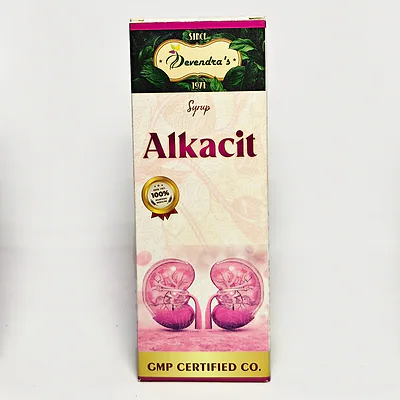
Alkacit Syrup
Ayurvedic diuretic syrup for burning or scanty urination
When passing urine burns or slows to a trickle, the urinary tract needs a flush.
100 mL: ₹75 · 200 mL: ₹140
Alkacit is an Ayurvedic urinary syrup: an ark of Punarnava, Gokshura and Kush root with the classical salts Narsar and Kalmishora and a little tartaric acid. Its Hindi गुणधर्म calls it Deepana, Pachana, Mutrala and Shothahara — digestive, appetising, diuretic and swelling-reducing.
The pack lists it for painful urination (Mutrakrichha), scanty urine (Mutralpata), loss of appetite, weak digestion and swelling.
Used for
- Painful, burning urination (Mutrakrichha)
- Scanty urine (Mutralpata)
- Swelling & water retention (Shotha)
- Poor appetite & weak digestion
Why urination burns
Burning or difficult urination usually means an irritated bladder or urethra — from an infection, concentrated urine when you drink too little, crystals, or heat. Drinking more and increasing urine flow helps flush the tract.
Ayurveda calls this Mutrakrichha: aggravated Pitta and Vata in the urinary channels (Mutravaha Srotas) make urine hot, scanty and painful. Cooling diuretic herbs (Mutrala) are the classical first step.
Alkacit works in 3 ways
- Diuretic (Mutrala) — Punarnava and Gokshura are Ayurveda's leading diuretics; both increased urine output in experimental studies, and Kalmishora (potassium nitrate) is a classical saline diuretic.
- Anti-inflammatory & Anti-oedematous (Shothahara) — Punarnava's rotenoids and flavonoids are anti-inflammatory in experimental studies, easing swelling and water retention.
- Digestive & Appetiser (Deepana-Pachana) — Narsar and tartaric acid whet the appetite and aid digestion, as the pack notes.
Key ingredients
- Punarnava (Boerhavia diffusa, whole plant) — 1 g. Its name means 'renews the body'. Ayurveda uses it for swelling (Shotha), the kidneys and the liver; its rotenoids and flavonoids are diuretic, anti-inflammatory and hepatoprotective in experimental studies.
- Gokhru (Gokshura) (Tribulus terrestris, whole plant) — 1 g. Ayurveda's chief herb for the urinary tract (Mutrala) and a reproductive tonic. Its saponins (protodioscin) and flavonoids are diuretic and anti-urolithic in animal studies; human evidence is limited.
- Kalmishora (potassium nitrate) — 0.1 g. A classical alkaline salt used in Ayurveda to liquefy Kapha and as a diuretic (Mutrala); here it partners Narsar. There is little modern research on this use.
- Narsar (ammonium chloride) — 0.1 g. A classical 'saline expectorant', thought to act by a reflex from the stomach that increases airway secretions and thins phlegm. It is the standard reference expectorant in animal studies; clinical evidence in people is limited.
- Tatri (tartaric acid) — 0.1 g. Tartaric acid adds a sourness that whets the appetite (Ruchya); with an alkali it forms a tartrate.
Full ingredient list
Distillate (ark) of
- Punarnava (Boerhavia diffusa, whole plant) — 1 g
- Gokshroo (Tribulus terrestris, whole plant) — 1 g
- Kushmool (Desmostachya bipinnata, root) — 0.25 g
- Shudh Narsar (ammonium chloride) — 0.1 g
- Kalmishora (potassium nitrate) — 0.1 g
- Tatri (tartaric acid) — 0.1 g
- Chini (sugar) — 3 g
- Colour (tartrazine) — q.s.
- Essence (sweet orange) — q.s.
How to use
Dose: 5–10 mL two to three times a day with water, or as directed by the physician.
- Shake well — Shake the bottle before each dose.
- Measure the dose — Use the measuring cap — the dose above, or the one your physician gives.
- Keep a routine — Take it at the same times each day, for as long as advised.
Safety & suitability
- Who it's for: Adults; children only at the dose a physician sets
- Pregnancy & nursing: Ask your physician before use
- Other medicines: Tell your physician what else you take
- Diabetic?: Contains sugar (3 g per 10 mL) — ask your physician
- Storage: Cool, dry place, away from direct sunlight
- Ingredients: See the full list below
Cautions
- Fever, back or side pain, blood in the urine, or burning that lasts more than a day or two may mean a kidney or bladder infection — see a doctor.
- Contains sugar (3 g per 10 mL) — people with diabetes should ask their physician first.
- Do not use if any precipitate, fungus or foreign particle is found — replace the bottle.
More information
- Net content: 100 mL · 200 mL
- Storage: Keep in a cool, dry place away from direct sunlight. Close the cap tightly after use.
- Country of origin: India
- Manufacturer: Devendra Ayurved Ashram Pvt. Ltd., A-12, Industrial Estate, Sujroo, Muzaffarnagar (U.P.) – 251003. Mfg. Lic. No. A-50/77/94 · GMP-certified company.
References
- Mishra S, Aeri V, Gaur PK, et al. Phytochemical, therapeutic, and ethnopharmacological overview for a traditionally important herb: Boerhavia diffusa Linn. Biomed Res Int. 2014;2014:808302.
- Ștefănescu R, Tero-Vescan A, Negroiu A, et al. A Comprehensive Review of the Phytochemical, Pharmacological, and Toxicological Properties of Tribulus terrestris L. Biomolecules. 2020;10(5).
- Liu W, Wang Y, He DD, et al. Antitussive, expectorant, and bronchodilating effects of quinazoline alkaloids (±)-vasicine, deoxyvasicine, and (±)-vasicinone from aerial parts of Peganum harmala L. Phytomedicine. 2015;22(12):1088-95.